Analysis on the Standardized Training Subject System and Practical Training Value of Driving Simulators
With the rapid popularization of intelligent driving training, traditional real-vehicle training is restricted by many factors such as site conditions, weather, safety risks and operating costs, making it difficult to fully cover the teaching of complex road conditions and emergency scenarios. In accordance with the industrial standard Automobile Driving Training Simulator (JT/T 378-2022) issued by the Ministry of Transport and the national motor vehicle driving training and teaching syllabus, driving simulators have become standard teaching equipment for formal driving training. Relying on virtual reality, dynamic simulation and data traceability technologies, they have constructed a standardized, systematic and full-scenario simulated training subject system. Different from traditional real-vehicle teaching, driving simulator training features zero risk, high reusability, full-scenario coverage and high accuracy, making up for the shortcomings of real-vehicle training. It covers core training contents including basic operation, site examination, road practical operation, harsh environment adaptation and emergency disposal, serving as a core practical training carrier for cultivating drivers’ skills and shaping their safety awareness. This paper systematically sorts out the core training subjects of driving simulators, elaborates on the training content, key teaching points and practical training significance of each subject, and deeply analyzes the unique value of simulated driving training, so as to provide a reference for standardized and intelligent driving training teaching.
I. Basic Operation Simulation Training Subject: Consolidating Standardized Driving Fundamentals
As an introductory compulsory subject for driving simulator training and a pre-simulation teaching content specified in the driving training syllabus, basic operation simulation training is mainly designed for zero-basis learners. Its core goal is to help learners get familiar with the operating structure of motor vehicles, standardize basic operating movements, develop standardized driving habits, and completely solve the problems of novice drivers such as fear of driving, unfamiliar operations and non-standard movements, so as to lay a solid foundation for subsequent site and road training. Without the need for real vehicles, this subject adopts simulator hardware including simulated steering wheel, clutch, brake, accelerator, gear shifter and dashboard to realize 1:1 restoration of real-vehicle operations, serving as the core foundation of all simulated training subjects.
The core training content of this subject consists of four modules, covering standardized operations throughout the introductory driving process. First is vehicle basic cognition and pre-driving preparation training. Learners get familiar with the functions and usage of core vehicle components such as seats, rearview mirrors, safety belts, hand brakes, operating pedals, light control levers and wipers through the simulator. They repeatedly practice standardized pre-driving operations including adjusting seat height and position, calibrating rearview mirror angles, fastening safety belts and conducting vehicle perimeter inspection, forming the standard habit of checking and adjusting before driving. Second is engine start-stop and instrument recognition training, which simulates engine start and stop under different vehicle conditions. Learners are trained to accurately identify various dashboard signals such as vehicle speed, engine speed, fuel level and fault indicator lights, and master basic vehicle condition judgment methods.
Third is the precise operation training of control devices, which is the top priority of basic training. Learners repeatedly practice the coordination logic of clutch, brake and accelerator on the simulator, perceive the stroke and force change of pedals, and overcome common problems such as engine stalling, vehicle sliding and sudden acceleration or braking. Meanwhile, they master standard gear shifting rules for both manual and automatic transmission vehicles, avoiding dangerous behaviors such as gear shifting without observation and wrong gear operation. Equipped with high-sensitivity force feedback function, the simulator can accurately restore the damping feeling of real-vehicle operation, enabling learners to form muscle memory quickly. Fourth is static basic light operation training, covering the operation and applicable scenarios of common lights such as high and low beam lights, turn signals, position lights, hazard warning lights and fog lights, laying a foundation for subsequent night driving and light simulation assessment.
Compared with traditional real-vehicle introductory teaching, simulator-based basic training achieves zero loss and zero risk. Learners can practice standardized movements repeatedly without limitation. The system records operation data in real time and corrects non-standard gestures and operating habits, eliminating bad driving habits from the very beginning and greatly improving the efficiency of subsequent practical training, which is an essential basic subject for standardized intelligent driving training.
II. Site Skill Simulation Training Subject: Restoring Standardized Examination Skills
Corresponding to the core content of Subject 2 in traditional driving training, site skill simulation training is a mandatory core subject of simulator practical training and a key simulated teaching content stipulated by the Ministry of Transport. Adopting virtual reality technology, this subject realizes 1:1 restoration of standardized examination sites, marking lines, slopes and curbs, and completely reproduces all examination items of Subject 2. It supports the training of various permitted vehicle types including C1, C2 and large and medium-sized passenger and freight vehicles. Its core objective is to improve learners’ capabilities in precise vehicle control, distance judgment and trajectory control, and help them fully master the examination and practical skills for site driving.
For small motor vehicles, the simulator site training fully covers five core items with training standards completely consistent with official examination standards. The first is reverse parking. The simulator accurately restores the marking sizes and reference points of official examination sites, captures learners’ steering wheel angle, vehicle trajectory and parking position in real time, and accurately judges problems such as line crossing, temporary stop and parking deviation with an error accuracy within 2 centimeters. Learners can repeatedly polish their skills in observing reference points, controlling steering timing and fine-tuning vehicle posture to overcome the biggest difficulty in Subject 2. The second is parallel parking, which simulates narrow roadside parking scenarios in urban areas and trains learners’ capabilities in controlling edge distance, predicting reverse trajectory and grasping steering timing, fitting high-frequency daily parking scenarios.
The third is fixed-point parking and starting on ramps. The simulator accurately restores ramp slopes and truly reproduces real-vehicle states such as vehicle sliding, engine stalling and insufficient power, targeting to improve learners’ capabilities in clutch-accelerator-brake coordination, brake control and fixed-point judgment, and make up for novices’ deficiencies in ramp operation. The fourth is right-angle turning and curve driving, which simulates narrow roads and curve scenarios to train learners’ abilities of low-speed stable driving, slight steering adjustment and vehicle spatial position judgment, refining their delicate vehicle control skills and cultivating accurate predictive driving thinking.
For large and medium-sized passenger, freight and special operation vehicles, the simulator adds special site items such as single-side bridge crossing, width-limited gate passing, continuous obstacle avoidance and undulating road driving, fully meeting the site training needs of various vehicle types. In addition, the simulator is equipped with intelligent scoring, playback and data statistics functions, which can evaluate operation compliance in real time in accordance with examination standards, accurately identify learners’ weak items and achieve targeted intensive training. This subject effectively avoids the problems of time consumption, labor cost, vehicle scratch risks and weather interference in real-vehicle site training, enabling learners to master full set of site driving skills in a short time and greatly improving examination pass rate and practical operation ability.
III. Road Driving Simulation Training Subject: Restoring Real Road Scenarios for Practical Training
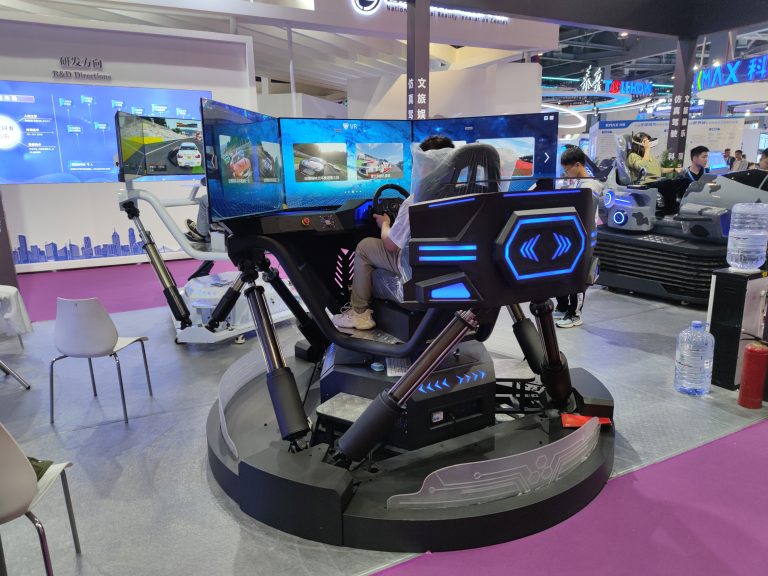
Corresponding to the road driving skills of Subject 3 in traditional driving training, road driving simulation training is a key transition subject connecting site training and real-road driving. According to the driving training and teaching syllabus, complex road conditions and special road sections in road driving can be taught through simulators. Relying on three-screen panoramic vision and dynamic traffic simulation technology, it highly restores real traffic environments of urban, suburban and rural roads, including dynamic elements such as traffic flow, pedestrians, road intersections and traffic signals. It focuses on cultivating learners’ practical abilities in road observation, road condition prediction, civilized yielding and dynamic vehicle control.
This subject fully covers 16 standardized road operation items of Subject 3, simulating the whole process of real-road driving. The core training items include standardized pre-driving preparation, dynamic light simulation, smooth starting, straight-line driving, gear matching and shifting, lane changing, road turning, passing crosswalks, school zones and bus stops, meeting vehicles, overtaking, U-turns and night driving. The simulator can randomly generate real-road emergency scenarios such as pedestrian crossing, non-motor vehicle retrograde, temporary lane change of social vehicles and road intersection grabbing, training learners’ safety driving thinking of advance observation, deceleration and avoidance, and emergency prediction.
On the basis of conventional road training, the simulator intensifies special contents that are difficult to practice frequently in real-vehicle training. Among them, night driving training can simulate various light scenarios including unlit roads, lit roads, oncoming high beam glare and night backlight, enabling learners to master the skills of night light use, speed control and line of sight prediction to avoid night driving risks. Meanwhile, the system simulates morning and evening peak congestion scenarios to train learners’ habits of controlling following distance, driving stably at low speed and yielding politely, and correct novices’ bad habits of speeding, close following and random lane changing.
Different from real-vehicle road training restricted by traffic order and safety risks, simulator road training can reproduce various complex road scenarios infinitely. It allows learners to accumulate road driving experience in a zero-risk environment, adapt to dynamic traffic conditions, get rid of the single thinking of site training, and truly realize the capability transformation from “controlling the vehicle” to “driving on the road”, laying a solid foundation for real-vehicle road training and daily independent driving.
IV. Special Scenario Simulation Training Subject: Making Up for the Deficiencies of Real-Vehicle Teaching
As a characteristic subject with the core advantages of driving simulators, special scenario simulation training is an important supplement to modern intelligent driving training. Restricted by safety conditions and site limitations, traditional real-vehicle teaching can hardly carry out training under harsh weather, special road sections and high-risk road conditions. In contrast, simulators can accurately reproduce various extreme scenarios, which is a special teaching content recommended by the national driving training syllabus. It aims to improve learners’ adaptability and risk control ability under complex road conditions and make up for the lack of emergency experience of novice drivers.
This subject mainly includes three core training modules. The first is harsh weather driving training, which accurately simulates extreme weather such as rainy, foggy, snowy, windy, icy, high-temperature and low-temperature conditions. It restores real road states including slippery pavement, blocked vision, extended braking distance and vehicle sideslip risk, training learners’ special skills of speed reduction, stable braking, cautious steering and light adaptation, and enabling them to master core risk avoidance points in harsh weather. The second is special road section driving training, covering high-speed roads, mountain steep slopes, cliff-side roads, tunnels, waterlogged roads and muddy roads which are high-risk for real-vehicle training. It targets to train professional skills such as high-speed following, tunnel light switching, meeting vehicles on mountain curves and steep slope risk avoidance, filling the gaps in traditional driving training.
The third is high-risk road condition special drill, simulating sudden road subsidence, unexpected obstacles, road construction and sudden congestion to train learners’ abilities of advance deceleration, obstacle avoidance and stable passing. All special scenario trainings are zero-risk practical exercises, allowing learners to practice repeatedly and summarize experience to establish driving cognition of extreme road conditions. It effectively solves the problems of panic, operation errors and improper disposal of novice drivers facing complex scenarios, and greatly improves comprehensive driving literacy.
V. Emergency Disposal Simulation Training Subject: Building the Final Line of Defense for Safe Driving
As an advanced core subject of simulators, emergency disposal simulation training is aligned with the core content of safety and civilized driving knowledge (Subject 4), focusing on the emergency disposal of sudden vehicle faults and traffic accidents, serving as the ultimate practical training course for safe driving. Most traffic accidents are not caused by insufficient driving skills, but by panic and improper disposal in sudden emergencies. Relying on dynamic simulation technology, this subject restores various sudden vehicle fault scenarios, training learners to respond calmly and avoid risks scientifically so as to minimize accident losses.
The core training content covers various high-frequency sudden faults and accident disposal scenarios, including high-speed tire blowout, brake failure, steering failure, vehicle sideslip, engine stall, rear-end collision warning and vehicle deviation. The simulator can highly restore the vehicle dynamics, body posture and operation feedback when faults occur, allowing learners to immerse themselves in faulty driving states and master standard disposal procedures: stably controlling the direction and avoiding sudden braking during tire blowout; decelerating by gear shifting and avoiding obstacles when brakes fail; fine-tuning the direction to correct body posture during sideslip, and other core emergency skills.
Meanwhile, this subject carries out practical training on on-site accident disposal and self-rescue, simulating on-site protection, warning triangle placement, personnel evacuation and simple first aid after traffic accidents. It analyzes wrong disposal methods combined with real accident cases to deepen learners’ safety cognition. Compared with theoretical memorization, immersive simulated training enables learners to firmly master emergency disposal specifications and form reflexive correct operations, truly realizing “calm response and scientific disposal”, and fundamentally improving drivers’ traffic safety guarantee capability.
VI. Overall Value and Industrial Significance of Driving Simulator Training Subjects
Combining the five major simulated training subjects, the driving simulator has built a full-chain closed-loop practical training system of “standardized foundation – examination-oriented site training – real-road combat – special scenario adaptation – emergency risk avoidance”, which complements and cooperates with traditional real-vehicle teaching to form a new standardized intelligent driving training model. Basic subjects standardize operating habits and eliminate bad driving behaviors from the source; site subjects accurately align with examination standards to improve training efficiency and pass rate; road subjects restore real road conditions to accumulate practical driving experience; special scenario subjects make up for the blind spots of real-vehicle teaching to cover full-scenario driving needs; emergency subjects strengthen risk avoidance capabilities and consolidate the bottom line of driving safety. The entire simulated training system fully complies with the national driving training syllabus with outstanding compliance, professionalism and practicality.
From the perspective of teaching, simulator training breaks the time, space and weather limitations of traditional driving training, realizing 24-hour uninterrupted practical training with zero vehicle loss and zero safety accidents, and greatly reducing driving training costs. Meanwhile, the intelligent data scoring system accurately locates learners’ weaknesses and realizes personalized teaching, completely changing the drawbacks of traditional teaching such as empirical judgment, lack of unified standards and untraceable training results. For learners, zero-basis trainees can quickly build vehicle sense, eliminate driving fear and standardize operations through simulated training, accumulating rich experience in complex road conditions and emergency disposal. It effectively solves the industry pain point of “obtaining a driver’s license without practical driving ability” and cultivates qualified drivers with solid skills, sound safety awareness and professional disposal capabilities.
Conclusion
The standardized training subjects of driving simulators are not merely auxiliary examination training tools, but a scientific, systematic and comprehensive driver competency cultivation system, serving as the core support for the transformation and upgrading of intelligent driving training in the new era. The five core subjects progress step by step and fully cover the rigid needs of driving teaching, meeting both the standardized requirements of driving examinations and the practical needs of daily safe driving, effectively making up for various shortcomings of traditional real-vehicle teaching. Under the background of increasingly strict traffic safety management and accelerated intelligent upgrading of the driving training industry, standardized simulator practical training has become an essential link in driving teaching. Driving schools and learners should attach full importance to the value of simulated training, abandon exam-oriented and formalized training concepts, and deepen the practical training key points of each subject. Only in this way can we promote learning through training and improve driving capabilities in an all-round way, enhance drivers’ operational skills, scenario adaptability and emergency risk avoidance literacy, and help build a safe, standardized and civilized road traffic environment.
RELATED POSTS
Diversified Popular Science Applications and Social Value of VR Automobile Collision Simulators
Comprehensive Operation Plan for Immersive Large-Space VR Experience Hall
Diverse Application Scenarios and Industry Value Analysis of Six-Axis Full-Dynamic G-Force Racing Simulation Cockpit
Diversified Application Scenarios and Practical Value Analysis of Simple Car Driving Simulators
Application Scenarios and Value Analysis of VR Unattended All-in-One Machine