Research on Technical Advantages and Practical Training Applications of 6-DOF Full-Scenario Automobile Driving Simulator
With the in-depth transformation of modern driving training systems toward practicalization, intelligence, low cost and zero risk, the limitations of traditional on-site driving training have become increasingly prominent. Conventional outdoor training is restricted by weather, venues, road conditions, safety risks and training costs, making it difficult to carry out regular training under extreme road conditions, harsh environments, sudden dangers and complex battlefield scenarios. This results in drivers lacking practical experience and emergency response capabilities when facing special working conditions, sudden failures and complex road environments. Against this backdrop, the automobile driving simulator equipped with a six-degree-of-freedom (6-DOF) motion feedback system and integrated with multi-scenario three-dimensional training modules has become core intelligent equipment for modern driving training, special driving teaching and traffic safety popularization. Breaking the shackles of traditional training modes, the equipment integrates five core training systems including battlefield special driving, harsh weather driving, emergency risk avoidance, complex terrain driving and practical combat scenario deduction. Relying on high-precision dynamic simulation technology, it realizes immersive driving training with full-scenario, full-working-condition and full-process coverage, comprehensively makes up for the shortcomings of traditional driving training, and provides solid support for the professional, standardized and practical cultivation of driving capabilities.
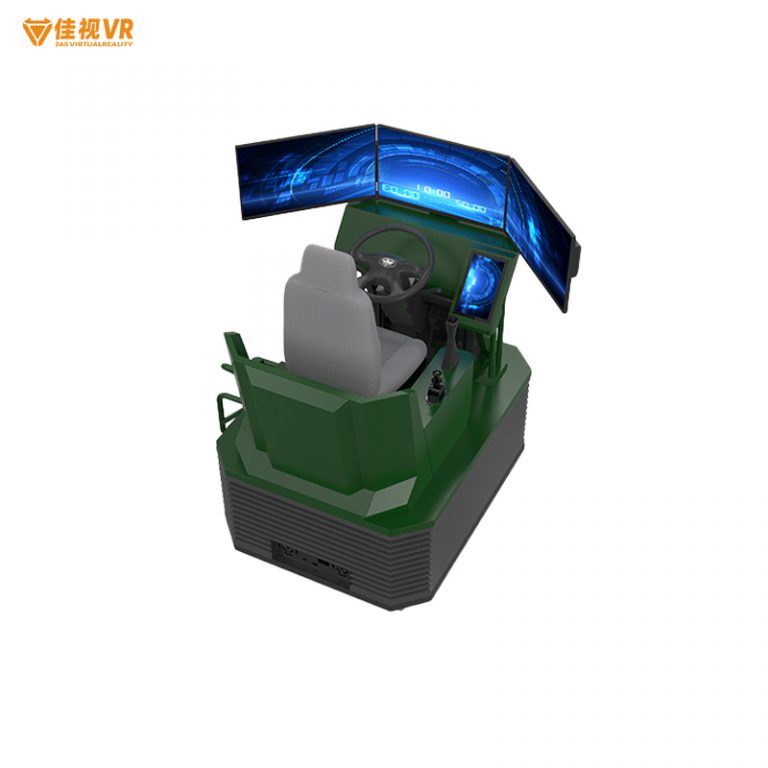
Compared with traditional fixed and static screen-based simulation equipment, the 6-DOF full-scenario automobile driving simulator studied in this paper boasts outstanding technical advancement and scenario adaptability. Equipped with the industry-standard 6-DOF motion feedback platform as its core hardware and simulation carrier, it can comprehensively capture all driving operation instructions including steering wheel adjustment, accelerator control, braking and gear shifting. Combined with changes in virtual road conditions, vehicle operating states and environmental interference factors, it dynamically feeds back real vehicle posture in real time. The system accurately reproduces physical vehicle movements such as bumping, tilting, sideslip, shaking, sinking and bouncing, completely solving the industry pain points of disjointed visual and somatosensory feedback, low simulation fidelity and poor training effects of traditional simulators. It enables virtual training to be highly consistent with real driving scenarios, greatly enhances the immersion, authenticity and professionalism of training, and achieves the training goal of “practicing virtually and improving practically”.
In terms of scenario construction, the simulator establishes five standardized core training systems, covering full-dimensional training requirements including civilian complex driving, special battlefield driving, emergency risk disposal and practical combat scenario drills. With far richer, more professional and more practical scenarios than ordinary civilian simulation equipment, it adapts to multiple application scenarios such as advanced training for ordinary drivers, special training for professional drivers and traffic safety education. The battlefield special driving module serves as the core competitive advantage of the equipment, tailored for special driving training. It accurately reproduces typical complex battlefield road conditions including floating bridges, crater roads and anti-tank obstacle roads. In floating bridge training, the system simulates real physical characteristics such as floating bridge shaking, elastic settlement, deck slipping and lateral deviation, restoring the unstable driving state of heavy vehicles passing temporary floating bridges and training drivers’ precise speed control, fine steering adjustment and stable passing capabilities. The crater road scenario highly reproduces damaged battlefield roads with scattered craters of varying depths, simulating severe vehicle bumping, wheel suspension and body tilting during high-speed and low-speed passage to cultivate drivers’ stable control ability on damaged complex roads. The anti-tank obstacle road scenario replicates artificial battlefield barriers and simulates working conditions such as uneven road barriers, sudden road changes and obstacle detouring, fostering drivers’ practical combat literacy in rapid obstacle avoidance, precise passage and emergency disposal on battlefields.
The special meteorological driving module focuses on driving training under harsh weather conditions such as rain, snow and fog, compensating for the inability of conventional training to carry out harsh weather drills on a regular basis. In traditional on-site training, extreme weather is uncontrollable, random and risky, making it impossible to organize targeted training as needed. Most drivers therefore lack driving experience in harsh environments and are prone to operational errors and improper risk disposal when encountering sudden bad weather. The simulator supports unrestricted all-weather simulation of rainy, snowy and foggy scenarios and fully restores driving conditions under diverse meteorological environments. The rainy scenario accurately simulates road ponding, slippery surfaces, extended braking distances, blurred vision and rain-shielded windows, adjusting training difficulty according to rainfall intensity to standardize drivers’ behaviors of deceleration, stable braking, ponding avoidance and sideslip prevention. The snowy scenario reproduces road snow accumulation, ice slipping, wheel idling and reduced steering sensitivity, simulating vehicle power attenuation and delayed braking in low-temperature environments to develop drivers’ good habits of speed stabilization, directional maintenance and gentle operation on icy and snowy roads. The foggy scenario simulates fog of different concentrations to reduce visibility and restore driving environments with blocked sight, ambiguous road conditions and missing reference objects, training drivers to properly use lights, drive at low speed, make careful predictions and maintain safe vehicle distances, effectively improving their safety driving capabilities under extreme meteorological conditions.
The emergency risk avoidance module is a core functional unit for improving drivers’ safety disposal capabilities, focusing on high-frequency sudden vehicle faults and dangers including tire blowouts, vehicle sideslips and brake failures to build a systematic and normalized emergency disposal training system. Sudden vehicle faults are major causes of road traffic accidents. Lacking targeted professional training, most drivers tend to panic and make operational errors in emergencies, aggravating accident hazards. The simulator highly reproduces sudden dangers such as high-speed tire blowouts, curve sideslips and straight-line braking failures during driving, and restores dangerous vehicle states including loss of control, lateral deviation, severe shaking and braking failure through the 6-DOF motion system. In tire blowout training, it simulates different body postures caused by front and rear tire blowouts at high speed, standardizing drivers’ disposal procedures of stabilizing direction, decelerating gently and avoiding dangers while prohibiting incorrect operations such as sharp steering and sudden braking. The sideslip scenario targets sideslip risks caused by slippery roads, high-speed cornering and emergency lane changes, restoring vehicle loss-of-control states and guiding drivers to correct directions, adjust speed and stabilize vehicles. The brake failure scenario simulates complete and partial braking system failures, training drivers’ professional skills of decelerating via gears, auxiliary handbrake braking, emergency danger avoidance and obstacle evasion. Repeated immersive training enables drivers to master standardized disposal processes for various emergencies, form muscle memory and conditioned reflexes, and greatly improve road driving emergency response capabilities.
The complex road driving module simulates various unconventional and high-difficulty road conditions including wading roads, loose sand roads and narrow bridges, comprehensively improving drivers’ vehicle control and road condition prediction capabilities on complex terrains. Conventional roads are flat with favorable traffic conditions and cannot provide high-intensity driving training, while complex roads such as wading sections, sandy roads and bridges impose high requirements on speed control, operation rhythm, condition prediction and vehicle protection. In the wading scenario, the simulator accurately reproduces road conditions with different water depths, restoring water resistance, wheel slipping, limited vehicle power and flameout risks, training drivers’ standardized wading operations of uniform low-speed passage, no temporary stopping and stable vehicle control. The loose sand road scenario replicates soft sand surfaces, road subsidence and wheel sinking and slipping, simulating power loss and vehicle deviation to cultivate drivers’ skills of steady throttle control, uniform straight driving and no sharp steering on sandy roads. The bridge passing scenario focuses on narrow bridges, long bridges and elevated bridges, restoring environmental factors such as deck crosswind, narrow road surfaces and overhead dangers, relieving drivers’ psychological tension during elevated passage, and training their precise distance control, straight-line driving and stable passing capabilities, so as to comprehensively enhance their comprehensive control level on complex terrains.
Different from single-subject training equipment, this simulator innovatively integrates a scenario-based comprehensive training module, transforming fragmented single-subject training into systematic practical combat drills. Its core scenarios include battlefield combined obstacle passage and behind-enemy support missions. Traditional driving training mostly consists of independent drills for single road conditions and single dangers, failing to simulate complex overlapping scenarios with multiple obstacles, working conditions and risks, so that drivers cannot form systematic practical driving thinking. The scenario-based training module organically combines various battlefield obstacles, complex road conditions, sudden dangers and environmental interference to build a complete practical combat driving task chain. The battlefield combined obstacle scenario integrates craters, floating bridges, obstacle sections and narrow curves to simulate continuous and complex battlefield traffic environments, testing drivers’ comprehensive capabilities of continuous control, rapid road condition prediction and dynamic disposal. The behind-enemy support scenario combines battlefield task requirements to simulate complex field road conditions, concealed passage, sudden obstacles and time-limited driving conditions. It integrates driving operations with practical combat tasks, cultivating drivers’ task awareness, pressure resistance and practical combat thinking while polishing driving skills, realizing the dual integration of skill training and combat literacy cultivation.
As the core technical support of the equipment, the 6-DOF motion feedback platform is the key to ensuring high authenticity and professionalism of full-scenario training, completely subverting the static, single and non-sensory training mode of traditional simulation equipment. Relying on high-precision servo drive systems and dynamic simulation algorithms, it realizes full-dimensional dynamic responses in six degrees of freedom: vertical, horizontal, longitudinal, pitching, rolling and yawing, with millisecond-level synchronous response to driver operations and scenario changes without delay, stutter or distortion. It accurately outputs corresponding vehicle posture changes under various working conditions such as acceleration, deceleration, steering, braking, bumping, slipping, loss of control and obstacle impact, perfectly reproducing the physical operation laws of real vehicles. Compared with simple 2-DOF and 3-DOF motion equipment, the 6-DOF platform supports full-dimensional dynamic simulation, which can restore subtle vehicle vibration caused by slight road changes and highly reproduce vehicle loss-of-control states in high-risk scenarios. Drivers obtain somatosensory feedback completely consistent with real vehicles in the virtual environment. This immersive dynamic simulation realizes integrated training of vision, somatosense and operation, greatly enhances training immersion, shortens skill formation cycles and ensures training effects consistent with practical combat standards.
From the perspective of practical training value, the 6-DOF full-scenario automobile driving simulator has the core advantages of zero risk, low cost, high efficiency, all-weather availability and full coverage, thoroughly solving various pain points of traditional on-site driving training. Traditional real-vehicle training involves multiple costs and risks including vehicle wear, fuel consumption, venue operation and safety accidents. Harsh weather, high-risk working conditions and battlefield scenarios cannot be practiced with real vehicles, leading to insufficient training coverage and practicality. In contrast, unrestricted by weather, venues, time and road conditions, the simulator supports normalized all-weather training for various complex, high-risk and special scenarios with zero casualties, zero equipment loss and zero training accidents, greatly reducing training costs and safety risks. Meanwhile, it supports multiple training modes including individual special training, cyclic group training and centralized mass training, adapting to diverse scenarios such as college teaching, military training, science popularization venues and enterprise training with far higher efficiency than traditional real-vehicle training.
In the construction of teaching and training systems, the equipment effectively improves the driving training curriculum system and realizes full-level teaching coverage of basic operation, complex road driving, harsh environment adaptation, emergency risk avoidance and practical combat tasks. For novice drivers, it consolidates basic control capabilities and standardizes driving habits through complex conventional roads and harsh weather scenarios. For advanced and special drivers, it comprehensively improves their control and emergency disposal capabilities under complex working conditions and high-pressure scenarios through battlefield special scenarios, scenario-based practical drills and high-risk emergency training. For traffic safety popularization, immersive dangerous scenario simulation enables experiencers to intuitively perceive the hazards of irregular driving, complex road conditions and sudden vehicle failures, strengthen safety awareness, and realize dual empowerment of skill training and safety education.
In conclusion, the 6-DOF full-scenario automobile driving simulator integrates five core training systems: battlefield driving, special meteorological adaptation, emergency risk avoidance, complex road driving and scenario-based practical combat. With the core advantages of high-precision dynamic simulation, full working condition coverage and low-cost zero-risk efficient training, it breaks the scenario, risk and cost limitations of traditional driving training. Through immersive, systematic and practical simulation training, it comprehensively improves drivers’ comprehensive capabilities in vehicle control, road condition prediction, emergency disposal and combat pressure resistance. It is not only applicable to advanced civilian driving training and traffic safety popularization, but also adapted to professional special combat driving training. With the continuous iteration of intelligent simulation technology, such full-scenario dynamic simulation equipment will become core supporting equipment for the upgrading of driving training systems, continuously promote the transformation of driving training modes toward intelligence, practicalization, standardization and high efficiency, and provide strong technical and equipment support for the professional cultivation of various driving talents.
RELATED POSTS
How Visual Immersion Is Achieved in Three-Screen 6-Axis Racing Simulators

Technological Empowerment and Scenario Innovation: An Analysis of the Future Development Trends of VR Full-Sense Theaters

Breaking Through the Fog to Explore the Deep-sea Mystery — Experience Review of VR Large-Space Bermuda Adventure
Construction of a Practical Military Vehicle Driving Training System and Capability Forging
Technology Empowers Training, Precisely Forges Capabilities – A Detailed Explanation of the Military and Special Vehicle Driving Simulator Training System