Technology Empowers Driving Training Innovation – Application and Development of Driving Simulators in Driving Schools
With the continuous increase in China’s car ownership, driving skills have transformed from an “optional skill” to an “essential ability”. While the driving training industry has experienced large-scale development, it also faces many bottlenecks in the traditional teaching model. Problems such as long waiting times for driving practice, high risks of real-vehicle training, unbalanced teaching efficiency, and high venue and energy consumption costs not only affect students’ learning experience but also restrict the high-quality development of driving schools. Against the backdrop of in-depth integration of intelligent transportation and artificial intelligence technologies, driving simulators, as a new type of teaching equipment, have gradually entered major driving schools. With their advantages of safety, efficiency, economy, and flexibility, they have restructured the driving training teaching process, promoting the driving training industry from the 1.0 era of “oral instruction and hands-on demonstration”, the 2.0 era of “two-network connection”, to the 3.0 era of “technology-led, green and intelligent”, becoming an important supporting force for the transformation and upgrading of the driving training industry. This article will combine the technical characteristics and application scenarios of driving simulators, in-depth analyze their value, existing problems in the use of driving schools, and explore their future development trends, providing reference for the intelligent development of the driving training industry.
I. Technical Characteristics and Classification of Driving Simulators
Driving simulators are intelligent equipment based on virtual reality (VR), multi-axis dynamic simulation, high-precision physical engine and other technologies, which take 1:1 restoration of real driving scenarios as the core and provide students with immersive driving training. Its core principle is to simulate the physical characteristics, road conditions and operation feedback during vehicle driving through the coordination of hardware equipment and software systems, allowing students to complete the learning and consolidation of driving skills in a virtual environment, and realize an efficient teaching closed loop of “virtual training + real-vehicle reinforcement”.
(I) Core Technical Characteristics
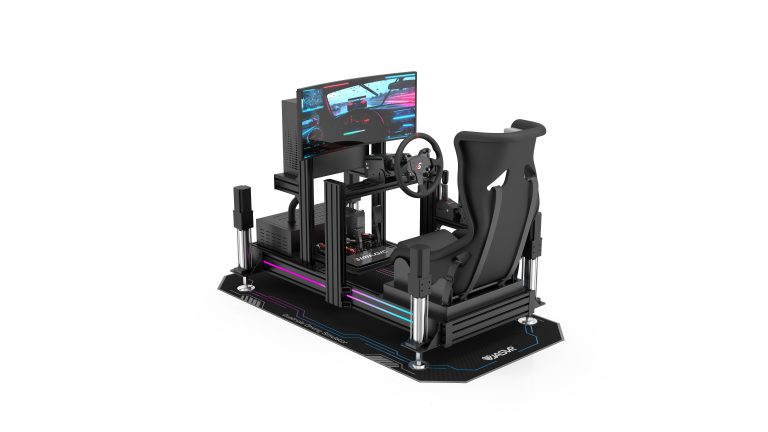
The core competitiveness of driving simulators comes from their advanced technical support, which is mainly reflected in three aspects. First, immersive scene restoration technology. Through three-screen surround display systems, VR high-definition headsets and other equipment, combined with high-precision 3D modeling, it can 1:1 restore real scenes such as urban roads, mountain bends and examination venues. Some high-end equipment can achieve 2-centimeter-level precision replication of examination venues, allowing students to experience the driving environment immersively; at the same time, it can simulate complex weather such as heavy rain, snow and fog, as well as dangerous scenes such as tire blowouts and sudden obstacles, filling the gap of high-risk scenes that are difficult to cover in real-vehicle training. Second, precise operation feedback technology. The core components of the simulator, such as steering wheel, accelerator, brake and clutch, all adopt real-vehicle accessories, combined with a six-axis motion platform and force feedback system, which can real-time simulate the physical feedback during vehicle acceleration, steering and braking, such as steering resistance, brake jitter and road bumps, ensuring that the operation feel is highly consistent with real driving and helping students quickly establish a sense of vehicle control. Third, intelligent data analysis technology. The built-in AI teaching system can real-time record students’ operation data, including steering wheel angle, accelerator and brake pedal force, gear shifting timing, number of wrong operations, etc. Through big data analysis, it generates personalized learning reports, accurately locates students’ weak links, provides a basis for targeted guidance by coaches, and realizes standardized teaching of “teaching students in accordance with their aptitude”.
(II) Main Equipment Classification
Combined with the teaching needs and budget differences of driving schools, the current driving simulators on the market are mainly divided into three categories, adapting to the development needs of driving schools of different scales. First, the basic fixed type, which adopts mechanical transmission + three-screen display + fixed chassis, with a unit price of about 10,000 to 50,000 yuan. Its core function is to meet students’ entry-level needs such as gear operation, starting and stopping, and basic subject practice. It is simple to operate and cost-effective, suitable for mass purchase by small and medium-sized driving schools for initial basic training of students. Second, the mid-range dynamic type, equipped with a six-degree-of-freedom motion platform, AI error correction system and 1:1 modeling of the examination venue, with a unit price of about 50,000 to 150,000 yuan. It can simulate complex road conditions and examination scenarios, support the full-process training of Subject 2 and Subject 3, and can automatically identify students’ wrong operations and give voice prompts, making it the preferred equipment for mainstream driving schools. Third, the high-end immersive type, integrating VR panoramic view, digital twin, gesture recognition and other technologies, with a unit price of about 200,000 to 500,000 yuan. Through 4.5K binocular resolution VR headsets and ultra-simulation dynamic platforms, it achieves 360° panoramic driving experience, supports multi-person collaborative training and personalized scene customization, and is mainly used in demonstration driving schools and large chain driving schools to enhance brand competitiveness.
II. Application Status and Core Scenarios of Driving Simulators in Driving Schools
In recent years, with the advancement of intelligent driving training policies and the maturity of technology, the penetration rate of driving simulators in driving schools has gradually increased. Data shows that the current penetration rate of driving simulators in domestic driving schools is about 35%, among which leading provinces such as Guangdong, Jiangsu and Zhejiang have reached 50%-70%, while the central and western regions are still in the initial stage of popularization with significant room for sinking. As of April 2025, 4 out of 5 driving schools in Chongyang County, Hubei Province have invested a total of 9 intelligent driving training simulators; Fangyuan Driving School in Yuhang District, Zhejiang Province, Yuchang Driving School in Longyang District, Yunnan Province, etc. have all built immersive simulated driving classrooms, forming a teaching model of “simulation first, real-vehicle reinforcement”. The application of driving simulators has covered the entire process of driving school teaching, and the core scenarios are mainly concentrated in the following four aspects.
(I) Novice Entry Basic Training to Lay a Solid Foundation for Driving
For novice students who have just come into contact with driving, the core pain point is their unfamiliarity with vehicle operation, psychological tension, easy operation errors, and the risk of scratches and stalling in real-vehicle training. Driving simulators provide a zero-risk entry training environment for novice students, becoming the core position for novice teaching in driving schools. At Juncheng Driving School in Chongyang County, student Li practiced uphill starting in heavy rain through the simulator. He said: “I used to wait in line for an hour and practice real-vehicle driving for 5 minutes, but now I can practice with the simulator at any time and correct mistakes repeatedly.” This training mode allows novice students to repeatedly practice basic operations such as steering wheel holding, clutch half-linkage, gear shifting, starting and stopping in a stress-free and risk-free environment, and gradually become familiar with the vehicle operation logic.
The entry-level teaching of the simulator adopts a progressive checkpoint mode, gradually increasing the difficulty from basic operations to simple road conditions, combined with voice guidance and animation demonstration, transforming abstract driving skills into perceptible mechanical memory. For example, the simulator of Banqiao Driving School in Xinghua can vividly disassemble basic essentials such as steering wheel holding and clutch half-linkage through 10-minute 3D animations. Students can independently adjust the training rhythm and repeatedly practice weak links until they master them proficiently. This mode not only reduces the psychological pressure of novice students but also shortens the entry adaptation cycle, enabling students to have solid basic operation capabilities before real-vehicle training, greatly improving the efficiency of real-vehicle training.
(II) Subject-Specific Intensive Training to Improve Examination Pass Rate
Subject 2 and Subject 3 are the core links of the driving test, as well as the key and difficult points of students’ training. In traditional real-vehicle training, limited by venue and coach energy, it is difficult for students to conduct intensive training on weak items. With the advantages of high scene restoration and repeatable training, driving simulators have become an important tool for subject-specific intensive training. The simulator has built-in full-process training modules for Subject 2 and Subject 3, which restore the examination venue markings, examination routes and evaluation standards at 1:1. Students can independently choose training items and repeatedly polish difficult items such as reverse parking, side parking, uphill fixed-point parking and starting.
At Xinyu Driving School in Wuxi, since the introduction of intelligent simulators, the pass rate of students in Subject 2 and Subject 3 has increased by about 15%. The simulator of the driving school can accurately record the error between the wheels and the side lines when students are reversing into the parking space, and the angle of each steering wheel turn is recorded and scored by the system. After the training, a short video of the operation replay is generated, making the error points such as line pressing and stalling clear at a glance. Students at Fangyuan Driving School in Yuhang simulate scenes such as night driving and high-speed overtaking through the simulator, accumulate experience in complex road conditions, and the pass rate of Subject 2 has increased to 90%. In addition, the simulator also supports randomly triggering scenes such as morning and evening peak traffic flow and school zone speed limits, helping students adapt to sudden situations in the Subject 3 examination and improve their examination-taking ability.
(III) Complex Scene Emergency Training to Strengthen Safety Awareness
In traditional real-vehicle training, due to safety risks and venue limitations, it is difficult to carry out targeted training on severe weather such as heavy rain, snow and fog, as well as dangerous scenes such as tire blowouts, sudden obstacles and vehicle rear-end collisions. As a result, after obtaining their driver’s licenses, students have insufficient emergency response capabilities when facing sudden situations. Driving simulators can perfectly solve this pain point. By simulating various complex scenes and dangerous situations, students can accumulate emergency response experience in a zero-risk environment and strengthen their safe driving awareness.
The intelligent simulated driving classroom of Yuchang Driving School in Longyang District can realize “one-click switching” of scenes such as rainy day skidding, night driving and mountain bends. Students can experience the change of braking distance on low-adhesion roads indoors and practice emergency operations such as emergency braking and direction correction. The simulators in Chongyang County can simulate complex scenes such as icy and snowy roads and heavy rain, helping students master driving skills under different road conditions. Data shows that drivers who have undergone simulated emergency training have significantly reduced reaction speed and error rate on real roads, and their safe driving awareness has also been significantly improved. This training mode not only fills the gap in real-vehicle training but also helps students establish the concept of “defensive driving”, reducing the occurrence of traffic accidents from the source.
(IV) Personalized Teaching and Management to Optimize Teaching Efficiency
The intelligent data analysis function of driving simulators has broken the traditional “one-size-fits-all” teaching mode in driving training, realizing the organic combination of personalized teaching and refined management. On the one hand, the simulator can generate personalized learning reports according to students’ operation data, accurately locating students’ weak links. For example, some students are prone to stalling when starting uphill, and some students have unsmooth gear shifting in Subject 3. Coaches can carry out targeted guidance according to the reports, avoiding ineffective training and improving teaching efficiency. On the other hand, the data of the simulator can be connected to the provincial supervision platform to realize real-time verification of class hours, eliminating problems such as forced charges and reduced training quality. At the same time, driving schools can real-time check students’ training progress and operation status through the intelligent management platform, realizing transparent and traceable training process.
The “AI Coach” system of Fangyuan Driving School in Yuhang can accurately record various operation data of students and generate learning situation analysis reports. By consulting the reports, coaches can accurately point out students’ operation problems and provide improvement suggestions. Students at Xinyu Driving School in Wuxi can check their own learning trajectory and number of mistakes on their mobile phones, practice online and review offline, and timely strengthen weak items. This “human-machine collaboration” teaching mode not only gives play to the advantages of the AI system such as standardized teaching, high patience and repeatable training but also retains the core value of real coaches with rich experience and flexible error correction, realizing the organic unity of standardization and personalization.
III. Core Value of Driving Simulators in Driving Schools
The wide application of driving simulators in driving schools has not only restructured the driving training teaching process but also brought multiple values to students, driving schools and the industry, becoming an important driving force for the high-quality development of the driving training industry. Its core value is mainly reflected in four aspects: safety, efficiency, economy and environmental protection, realizing a win-win situation for students, driving schools and the industry.
(I) For Students: Lower Learning Threshold, Improve Learning Experience and Skills
For students, the most intuitive value of driving simulators is to lower the learning threshold and improve the learning experience and driving skills. First, eliminate psychological pressure. The simulator provides a zero-risk training environment. Students do not need to worry about scratches, fines and other problems caused by operation errors. They can practice in a relaxed state, effectively relieving the tension of real-vehicle training. Xiao Wang, a post-00s student at Banqiao Driving School in Xinghua, was once at a loss due to nervousness in real-vehicle operation. After repeated practice on the simulator, he gradually found a sense of accomplishment and finally passed the driving test smoothly. Second, save time costs. Traditional real-vehicle training is limited by venue, coach and weather. Students often need to wait in line for a long time, while the simulator can realize all-weather and on-demand driving practice. Students can arrange training flexibly according to their own time, greatly shortening the learning cycle. Third, improve the practicality of skills. The complex scenes and emergency training covered by the simulator can help students master more comprehensive driving skills, avoid the problem of “being able to drive after passing the test but not being able to drive”, and cultivate drivers who truly have safe driving capabilities. In addition, the indoor training environment of the simulator allows students to avoid wind and sun, which is especially suitable for groups with tight time and emphasis on experience such as students and office workers.
(II) For Driving Schools: Reduce Costs and Increase Efficiency, Enhance Core Competitiveness
For driving schools, driving simulators are an important starting point to reduce costs and increase efficiency and realize transformation and upgrading. First, reduce operating costs. The simulator can replace part of the real-vehicle class hours, greatly reducing the fuel consumption, vehicle wear and maintenance costs of real-vehicle training. According to statistics from the transportation department of Chongyang County, the simulator can help driving schools reduce energy consumption costs by more than 50%; at the same time, the simulator does not need to occupy a lot of venues, can be centrally arranged indoors, saving venue rent, and one simulator can meet the alternating training of multiple students at the same time, reducing the input of coach manpower. The comprehensive training cost of a single driving school can be reduced by 30%-50%. Second, improve teaching quality and efficiency. The standardized teaching mode of the simulator avoids the problems of uneven coach level and inconsistent teaching methods in traditional teaching. Through AI error correction and personalized guidance, it greatly improves the pass rate of students, thereby enhancing the reputation and enrollment competitiveness of the driving school. Third, solve the problem of student backlog. Many driving schools have the problem of more students, fewer coaches and insufficient vehicles, leading to long waiting time for students to practice driving and low satisfaction. The simulator can quickly digest the backlogged students, and can increase the training capacity without increasing coaches and vehicles, improving the student experience. For example, after putting 5 simulators into use, Banqiao Driving School in Xinghua had 60 college student students on the first day of experience, with an average of 4 projects practiced continuously per person, and the longest duration was 2.5 hours, effectively relieving the pressure of students waiting in line.
(III) For the Industry: Promote Intelligent Transformation and Realize Green and Low-Carbon Development
The popularization of driving simulators has promoted the transformation of the driving training industry from traditional extensive teaching to intelligent and refined teaching, helping the industry achieve high-quality, green and low-carbon development. On the one hand, the application of simulators has promoted the digital upgrading of the driving training industry. Through big data, artificial intelligence and other technologies, it has realized the standardization, transparency and personalization of the teaching process, solving the problems of irregular teaching and difficult supervision in the traditional driving training industry. At present, the national “theory + simulation + real-vehicle” phased teaching has been implemented, and simulation class hours have been included in the statutory training requirements. Vehicle management offices in many places have connected simulation equipment data with the examination system, further promoting the standardized development of the driving training industry. On the other hand, the simulator has significant green and low-carbon advantages. It does not require fuel consumption, does not produce exhaust emissions, effectively reduces environmental pollution in the driving training industry, and conforms to the national “double carbon” strategic requirements. In addition, the popularization of simulators can also promote the transformation of the driving training industry from homogeneous competition to differentiated competition. Driving schools can build intelligent driving training brands by introducing advanced simulation equipment, improving the overall service quality and level of the industry.
IV. Existing Problems and Shortcomings in the Use of Driving Simulators in Driving Schools
Although the application of driving simulators in driving schools has achieved remarkable results, in the process of popularization, affected by factors such as technical level, teaching mode and cognitive level, there are still some problems and shortcomings, which restrict the full play of their role, mainly concentrated in the following four aspects.
(I) Uneven Equipment Quality and Large Differences in Experience
At present, there are many brands of driving simulators on the driving training market, with prices ranging from tens of thousands of yuan to hundreds of thousands of yuan, and the equipment quality and technical level are uneven. In order to reduce costs, some small and medium-sized driving schools purchase low-cost and low-quality simulators. Such equipment has problems such as low scene restoration, inaccurate operation feedback, stuck software systems and frequent failures, which cannot achieve real driving experience, and may even mislead students to form wrong operation habits. For example, some basic simulators lack a force feedback system, and the steering wheel operation is too light, which is quite different from real vehicles. After students practice proficiently on the simulator, they will have difficulty adapting to the operation when switching to real vehicles; in addition, the software system of some simulators is not updated in time, and the examination venue scenes and examination rules are inconsistent with the latest driving test standards, affecting the training effect. In addition, the after-sales service of some manufacturers is not perfect, and the equipment cannot be repaired in time when it breaks down, affecting the normal teaching progress of the driving school.
(II) Insufficient Integration of Teaching Modes, Disconnection between “Simulation and Real-Vehicle”
After introducing driving simulators, some driving schools have not established a scientific “simulation + real-vehicle” integrated teaching mode, leading to the disconnection between simulators and real-vehicle training, which cannot give full play to their auxiliary role. On the one hand, some coaches do not attach enough importance to simulators, still adhere to the traditional teaching ideas, regard simulators as “auxiliary tools”, or even leave them idle, only letting students practice temporarily when they are waiting for real vehicles in line, failing to integrate simulators into the entire teaching process. On the other hand, there is a lack of professional simulator teaching guidance. Some coaches are not familiar with the operation functions and teaching methods of simulators, and cannot carry out targeted guidance according to students’ simulation training data, resulting in the skills practiced by students on simulators cannot be effectively transferred to real-vehicle training. In addition, some driving schools do not set up a transition link between simulation training and real-vehicle training. When students switch directly from simulators to real vehicles, they will have difficulty adapting due to differences in operation feel and environment, affecting training efficiency.
(III) Students’ Cognitive Bias, Acceptance Needs to Be Improved
Some students have cognitive biases about driving simulators, believing that “simulators are not as real as real vehicles”, practicing simulators is meaningless, and they prefer to carry out real-vehicle training directly, or even resist simulator training. Especially for some older students, they are not familiar with the operation of intelligent equipment, and it is difficult to adapt to the teaching mode of simulators, thinking that simulators are complex and impractical to operate. In addition, some students have a mentality of “perfunctory class hours”, do not take training seriously on the simulator, only to complete the statutory class hour requirements, leading to the simulation training being a mere formality and failing to achieve the expected training effect. This cognitive bias not only affects the promotion and application of simulators but also wastes the equipment investment of driving schools.
(IV) Ununified Policies and Standards, Popularization Blocked
At present, the relevant policies and industry standards for driving simulators in China are still imperfect, with regional differences, affecting the popularization of simulators in driving schools. On the one hand, the certification standards for simulation class hours in some regions are not unified. Some regions do not recognize simulation class hours, or have different regulations on the equipment requirements and training duration of simulators, leading to the failure of normal certification of students’ simulation class hours after driving schools introduce simulators, affecting the enthusiasm of driving schools. On the other hand, the equipment certification and technical standards of simulators have not been unified. The equipment on the market lacks unified specifications in terms of scene restoration, operation feedback accuracy, data interface, etc., leading to the inability of simulators of different brands to intercommunicate and connect, and also not conducive to the unified supervision of regulatory authorities. In addition, some small and medium-sized driving schools are limited by budget and cannot afford the purchase cost of mid-to-high-end simulators, while the training effect of low-cost simulators is limited, further restricting the popularization of simulators.
V. Countermeasures and Suggestions for Optimizing the Application of Driving Simulators in Driving Schools
In view of the problems existing in the use of driving simulators in driving schools, combined with the development needs of the driving training industry, targeted measures need to be taken from four aspects: equipment quality, teaching mode, cognitive guidance and policy standardization to optimize the application effect of simulators, promote their wide popularization in driving schools, and help the driving training industry achieve intelligent and high-quality development.
(I) Standardize the Equipment Market and Improve Equipment Quality and Service Level
First, strengthen industry supervision, formulate unified technical standards and certification specifications for driving simulators, clarify the requirements for equipment scene restoration, operation feedback accuracy, software update frequency, etc., eliminate low-cost and low-quality equipment, and standardize the market order. Regulatory authorities can work with industry associations to carry out simulator equipment certification, file equipment that meets the standards, and guide driving schools to purchase qualified equipment. Second, guide manufacturers to increase investment in technological research and development, improve the technical level of simulators, optimize scene restoration effect and operation feedback accuracy, develop software systems adapted to the latest driving test standards, and improve the after-sales service system, establish a national after-sales service network, timely solve equipment failures, and provide driving schools with integrated services of installation, implementation, landing and operation. Third, driving schools should reasonably choose the type of simulator according to their own scale and teaching needs, avoid blindly pursuing low prices or high-end, and give priority to equipment with high cost performance, mature technology and perfect after-sales service to ensure the effect of simulation training.
(II) Build an Integrated “Simulation + Real-Vehicle” Teaching Mode to Improve Teaching Efficiency
Driving schools should break the limitations of the traditional teaching mode, establish a scientific integrated “simulation + real-vehicle” teaching system, and integrate simulators into the entire teaching process. First, formulate a standardized teaching plan, reasonably allocate the duration of simulation training and real-vehicle training according to the driving test subjects and students’ learning progress. For example, novice students first conduct 1-2 weeks of simulation basic training, then enter real-vehicle training; for the difficult items of Subject 2 and Subject 3, first conduct special intensive training through simulators, then consolidate and improve through real-vehicle training. Second, strengthen coach training, organize coaches to learn the operation functions, teaching methods and data analysis skills of simulators, improve coaches’ intelligent teaching ability, so that coaches can accurately locate weak links according to students’ simulation training data and carry out targeted guidance. Third, set up a transition link between simulation and real-vehicle. After students complete the simulation training, arrange coaches to conduct 2-3 hours of real-vehicle adaptation training to help students quickly adapt to the real-vehicle operation feel and real driving environment, and realize the effective transfer of simulation skills to real-vehicle skills.
(III) Strengthen Cognitive Guidance and Improve Students’ Acceptance
First, driving schools should strengthen the promotion of simulators, introduce the advantages, training effects and application value of simulators to students through offline display, student experience, case explanation and other ways, let students understand the role of simulators in reducing training risks, saving time, improving skills, etc., and eliminate cognitive biases. For example, driving schools can organize new students to carry out simulator experience activities, let students personally feel the training effect of simulators, and change the wrong cognition that “simulators are not as real as real vehicles”. Second, optimize the teaching experience of simulators. For students of different age groups, adjust the operation interface and teaching mode of simulators. For example, provide simple and easy-to-understand operation guidelines for older students, simplify the operation process, and improve their willingness to use. Third, establish an incentive mechanism. Give appropriate rewards to students who earnestly complete simulation training and have good training effects, such as prioritizing real-vehicle training and reducing part of the tuition fees, to guide students to actively participate in simulation training and avoid the situation of “perfunctory class hours”.
(IV) Improve Policies and Standards to Promote the Popularization of Simulators
First, relevant national departments should accelerate the formulation of unified policies and industry standards for driving simulators, clarify the certification standards, equipment requirements, teaching specifications of simulation class hours, etc., realize the unification of standards nationwide, and let driving schools and students use simulators with confidence. At the same time, include the application of simulators into the intelligent driving training assessment system, encourage driving schools to introduce simulators, and promote the intelligent transformation of the driving training industry. Second, increase policy support, give certain financial subsidies or tax incentives to driving schools that introduce qualified simulators, especially small and medium-sized driving schools, reduce their equipment purchase costs, and improve the enthusiasm of driving schools to introduce simulators. Third, strengthen regional coordination, promote the popularization of simulators in driving schools in the central and western regions, counties and towns, and narrow the gap in driving training quality between regions through policy guidance and technical support, so that more students can benefit from intelligent driving training technology.
VI. Development Trends of Driving Simulators in Driving Schools
With the continuous development of artificial intelligence, virtual reality, digital twin and other technologies, as well as the continuous transformation and upgrading of the driving training industry, the application of driving simulators in driving schools will show a more intelligent, diversified and integrated development trend. In the future, they will gradually become the core equipment of driving training teaching, promoting the driving training industry into a new intelligent era.
(I) Technological Iteration and Upgrading, Continuous Improvement of Immersion and Authenticity
In the future, driving simulators will continue to rely on technological innovation to improve the immersion of scene restoration and the authenticity of operation feedback. On the one hand, VR/AR/MR technology will gradually replace the traditional three-screen display system, realizing 360° panoramic driving experience. Combined with high-resolution headsets and somatosensory interaction technology, students can feel the driving environment more intuitively, further narrowing the gap with real driving. On the other hand, AI large models will be deeply integrated into simulator teaching, realizing the automatic generation of personalized teaching plans. According to students’ learning progress and weak links, the training scenes and difficulty will be dynamically adjusted, and the intelligence level of teaching will be improved through voice interaction, gesture recognition and other ways. In addition, digital twin technology will be widely used to 1:1 restore urban road networks, examination venue scenes and traffic flow, realize dynamic simulation of real-time weather, traffic flow and pedestrians, and make simulation training closer to real driving scenes.
(II) Expansion of Application Scenarios, Covering the Entire Process of Driving Training and Multiple Fields
The application scenarios of driving simulators will be further expanded, covering not only the entire process of driving school training such as basic training, subject reinforcement and emergency training, but also extending to multiple fields such as professional driving training and traffic safety publicity and education. In the field of professional driving training, special simulators will be developed for different vehicle types such as freight, passenger transport, online car-hailing and dangerous goods transport, and targeted training will be carried out to meet the pre-job training and re-training needs of professional drivers; in the field of traffic safety publicity and education, simulators will enter schools, enterprises and communities for traffic safety experience and publicity, improving the public’s safe driving awareness. In addition, simulators will be deeply integrated with intelligent coach cars, realizing a closed-loop teaching of “simulation training – real-vehicle training – examination simulation”, further improving teaching efficiency and examination pass rate.
(III) Innovative Development of Modes, Leasing and SaaS Becoming New Trends
To reduce the equipment investment cost of driving schools, the application mode of driving simulators will be gradually innovated, and leasing and SaaS modes will become mainstream. In the future, more manufacturers will launch simulator leasing services. Driving schools can lease simulators by year according to their own needs, without bearing the one-time equipment purchase cost, and at the same time enjoy the equipment maintenance and software update services provided by manufacturers. In addition, SaaS services will be gradually popularized. Through the cloud platform, manufacturers will provide driving schools with remote management, data statistics, teaching guidance and other services of simulators. Driving schools do not need to invest a lot of manpower and material resources in equipment maintenance and management, and can enjoy high-quality simulation teaching services only by paying on demand. This mode will effectively reduce the entry threshold for small and medium-sized driving schools and promote the popularization of simulators nationwide.
(IV) Improvement of Industry Concentration, Formation of “Hardware + Software + Service” Ecology
With the continuous standardization of the market and the continuous upgrading of technology, the driving simulator industry will gradually move from fragmentation to concentration. Leading enterprises will squeeze the market space of small and medium-sized manufacturers by virtue of their technological advantages, channel advantages and service advantages, and the industry concentration will be significantly improved. In the future, platform-based enterprises with full-stack capabilities of “hardware + software + service” will become the mainstream of the market. Such enterprises can not only provide high-quality simulator equipment but also develop supporting teaching software and management platforms, provide comprehensive after-sales service and operation support, and provide driving schools with integrated intelligent driving training solutions. At the same time, cross-border manufacturers will gradually enter the market. VR/AI enterprises and driving training system manufacturers will rely on their own technological advantages to promote the integration of simulators with other intelligent driving training equipment, building a diversified intelligent driving training ecology.
VII. Conclusion
As the core equipment of intelligent driving training, driving simulators, with their advantages of safety, efficiency, economy and flexibility, are restructuring the teaching mode of the driving training industry, bringing multiple values to students, driving schools and the industry, and becoming an important force for the transformation and upgrading of the driving training industry. Although there are still some problems in the application of driving simulators in driving schools, such as uneven equipment quality, insufficient teaching integration, low student acceptance and ununified policies and standards, these problems will be gradually solved with the iteration and upgrading of technology, the continuous improvement of policies and the continuous innovation of teaching modes.
In the future, driving simulators will develop in a more intelligent, real and diversified direction, gradually realizing in-depth integration with real-vehicle training, covering the entire process of driving training and multiple fields, and promoting the transformation of the driving training industry from “experience-based teaching” to “scientific teaching” and from “extensive development” to “high-quality development”. Driving schools should actively adapt to the development trend of the industry, introduce high-quality driving simulators, build a scientific integrated “simulation + real-vehicle” teaching mode, and improve teaching quality and service level; manufacturers should increase investment in technological research and development, improve after-sales service, and promote equipment upgrading and mode innovation; regulatory authorities should accelerate the formulation of policy standards, increase support, and promote the wide popularization of simulators. It is believed that with the joint efforts of all parties, driving simulators will play a greater role in the driving training industry, helping to cultivate more drivers with safe driving awareness and professional driving skills, and promoting the high-quality, green and intelligent development of China’s driving training industry.
RELATED POSTS
Integration of Virtual and Real Worlds, Expansion of Low-Altitude Boundaries: Research on the Future Development Trends of VR 360° Aerial Products
Technology Empowers Driving Training Innovation——In-depth Application and Development of Driving Simulators in Driving Schools
VR Shenzhou Spacecraft Simulator: Innovative Practice and Educational Value of Immersive Aerospace Popular‑Science Education
Analysis on Technical Characteristics and Future Development Prospects of Four-Axis Driving Simulators
All-Dimensional Immersive Racing Experience: In-Depth Analysis of Professional Sheet Metal Racing Simulator