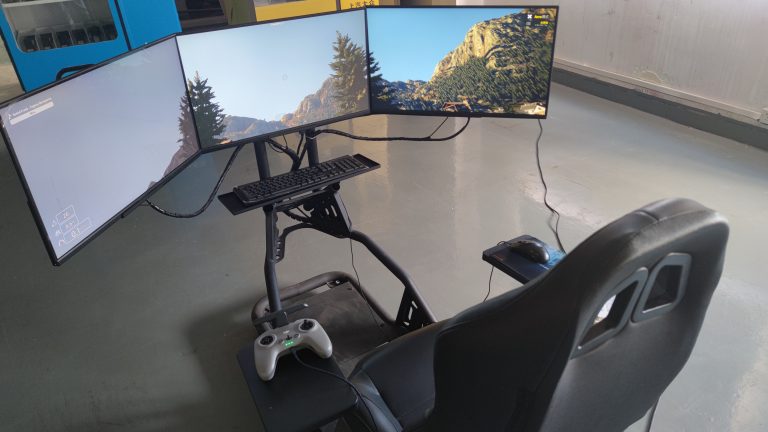
VR Warfire Elite Simulator Two-Player Shooting Battle Platform: A Complete Breakdown from Content DNA to Commercial Equipment
The product name “VR Warfire Elite Simulator Two-Player Shooting Battle Platform” actually connects two quite different threads. One comes from the VR content world—in 2016, Beijing Youniu Technology launched the Warfire Elite series of VR shooting games, which was one of the most closely watched homegrown FPS works in China’s early VR market. The other is rooted in the commercial amusement equipment industry—the two-player VR shooting battle platform, as a traffic-driving device for offline experience venues, has continued to iterate over the past few years as the VR experience venue market has expanded. Examining these two threads together reveals the answer to a question: when a VR shooting product with content DNA is placed inside the shell of commercial equipment, who is it really made for, how does it make money, and what real situation does it face?
I. Content Prehistory: A First-Mover Advantage That Was Not Sustained
To understand the value of the four words “Warfire Elite” in the commercial VR context, one must first return to the moment it was first recognized by the market. In June 2016, just one month after its founding, Youniu Technology launched the VR single-player game Warfire Elite, a military-themed first-person shooter. According to reports at the time, the game ranked sixth in sales on the HTC Vive platform in its first month online and was designated as an HTC Vive platform product at the Taobao Maker Festival. In September of the same year, the networked competitive version Warfire Elite OL was released, billed as “the country’s first real-time FPS battle game,” supporting multiplayer networking, real-time voice interaction, and motion simulation.
In 2016, when VR hardware had just entered consumer view, such results were not bad. Youniu Technology CEO Zhou Guangkai later attributed the success in an interview to “simple and brutal”—simple operation and intense combat, allowing users who were encountering VR for the first time to quickly gain immersion. This judgment was accurate at the time. Early customers at VR experience venues were mostly ordinary people with no VR experience; complex movement mechanics and interaction logic would only create dizziness and frustration. Warfire Elite‘s stationary shooting plus teleport-movement scheme precisely matched the technical constraints and user capabilities of that stage.
But the first-mover advantage at the content level did not continue to today. From public information, the last update of the Warfire Elite series on the Viveport platform remained in August 2017. Youniu Technology’s business focus thereafter gradually shifted to early childhood education, tourism services, and other fields, with VR games no longer the only direction. This means that when someone today promotes a commercial two-player battle platform under the name “Warfire Elite,” what it refers to is no longer an actively operated, living game IP, but more a content symbol that once had market validation, transplanted into the context of offline amusement equipment.
This is not to deny its value. On the contrary, for commercial VR experience equipment, a game’s “reputation” and “continuous updates” are two different dimensions. Consumers at experience venues mostly will not ask when a shooting game was last updated; what they care about is whether, in the ten minutes after putting on the headset, the visuals are exciting enough, the gun feel is satisfying enough, and the battle with a companion is lively enough. From this perspective, the FPS design experience accumulated by Warfire Elite—regardless of whether it is still being updated today—at least provides a gameplay framework that has been validated in offline scenarios.
II. Equipment Form: The Real Positioning of a Two-Player Battle Platform in Commercial Scenarios
Turning from content to equipment. The commercial platforms currently sold on the market under the “two-player VR shooting battle” selling point are already quite mature in form and operational logic. Referring to the specifications of similar products, a typical two-player VR shooting device usually includes two seats or standing platforms, two sets of VR headsets and simulated gun controllers, an external display screen for spectators, and a self-service operating system. Take Sega Amusements’ Alpha Ops VR Strike as an example: its configuration includes dual 65-inch 4K spectator screens, 4.1 surround sound, a motion platform, and lightweight one-handed gun controllers, designed to run continuously unattended. Similar products from domestic manufacturers such as MoviePower measure approximately 2.8 meters deep, 2.3 meters wide, and 2.5 meters high, weigh several hundred kilograms, and support QR-code payment and self-service startup.
These parameters point to the same fact: the two-player VR shooting battle platform is essentially an “attention-capturing device” designed for high-traffic commercial environments. Its competitors are not the VR headset at home, nor the free shooting games on mobile phones, but the claw machine next door, the mini KTV, and the gashapon machine in the same shopping mall. In this competitive dimension, the design logic of two-player battle becomes clear: single-player VR shooting has limited per-customer spend and replay rate, while two people playing together means higher single-visit spending (usually charged per person or per session but with a higher per-customer price), stronger social spread (after a round, they will tease or show off to each other), and longer dwell time (waiting for companions, discussing tactics, taking photos for social media).
The experience of a VR experience venue operator in Guangzhou corroborates this. In the venue’s description, the “Cyber Warfire two-player VR shooting battle machine” is positioned as having “strong social confrontation attributes, high playability for couples, friends, and parent-child teams, cool appearance that brings traffic on its own, and QR-code self-service unmanned operation.” This passage almost covers the several indicators that commercial VR equipment operators care about most: social attributes bring team consumption rather than single-person consumption; cool appearance solves the “three-second attraction” problem in mall environments; and self-service unmanned operation directly compresses labor costs—for an experience venue business with thin profits and fluctuating foot traffic, saving one person means saving one fixed expense.
However, the maturity of equipment form has also brought homogenization. When multiple manufacturers can all provide two-player VR shooting platforms with similar dimensions, similar configurations, and similar game types, the operator’s selection criteria will shift from “whether it exists” to “whether it is worth it.” At this point, if the name “Warfire Elite” can still play a role, it is not about how high its reputation is, but about whether it can make operators believe that the game content on this device is more fun, more durable, and more likely to make customers want to come back than the machine next door.
III. Operational Reality: The Tension Between Payback Period and Traffic Quality
Regarding the profitability of VR experience venues, public information presents a thought-provoking unevenness. On the one hand, reports show that leading operators are expanding at a considerable pace: one experience venue owner said in an interview that a fifth store is being launched, with fixed investment expected to be recovered in 3 to 6 months and profitability within a year; another entrepreneur who started from a stall grew from 1 headset to 8. In the first half of 2025, more than 100 large-space VR projects were implemented, and the total number of stores of the 20 recognizable operators exceeded 1,000.
On the other hand, these success cases are mostly concentrated in “large-space VR” (that is, free-roaming, multi-person collaborative VR experiences) and projects with strong IP or strong content differentiation. Large-space VR works represented by The Disappearance of the Pharaoh have pulled the per-customer price to more than 300 yuan with a 45-minute long experience and an 800-square-meter space scale, yet still remain in short supply. The two-player VR shooting battle platform belongs to another category of product: experience duration is usually 5 to 10 minutes, per-customer price is in the tens of yuan range, and it relies on high turnover and high-frequency consumption.
This creates an easily overlooked operational contradiction. The experience duration of two-player VR shooting determines its revenue ceiling: assuming one device can serve 6 groups of two-player players per hour (each group 10 minutes including boarding and alighting switching), operating 10 hours a day with a 70% occupancy rate, it serves about 42 groups per day. At 60 yuan per group, daily revenue is about 2,520 yuan. After deducting venue rent, equipment depreciation, platform commissions, and consumable maintenance, the payback period depends on equipment procurement cost. If the equipment price is in the tens of thousands of yuan range, at a mall location with stable traffic, payback within about a year is possible; but if the location has insufficient traffic or dense nearby competitors, the period will be significantly extended.
The more critical issue is replay rate. The core experience of shooting games is “thrill,” but the marginal diminishing speed of thrill is very fast. First-time VR shooting customers will be shocked by immersion; by the third time, they may begin to notice visual aliasing, rough gun modeling, and repetitive level design. In a review of Warfire Elite at the time, players pointed out that the gun modeling was “somewhat casual,” shooting lacked real recoil, and sound effects were “not realistic and three-dimensional enough.” These problems were tolerable in the 2016 VR content ecosystem, but today—when customers are already accustomed to high-frame-rate shooting mobile games on phones and have experienced AAA-level gun battle titles on consoles—the same roughness will directly affect repurchase intention.
Therefore, for operators intending to purchase a two-player VR shooting battle platform, a more practical question is not “is the Warfire Elite IP good,” but “how often is the game content on this device updated, whether the number of levels is enough to support operations for more than a month, and whether there is a leaderboard or season mechanism to stimulate replay.” Unfortunately, it is difficult to find evidence of continuous content updates for the Warfire Elite series on commercial equipment from public information. If the device still carries a static game library from several years ago, then it is better positioned as a “traffic-driving experience item” rather than a “long-term revenue mainstay”—use its novelty to pull customers into the store, then rely on other products with higher per-customer prices or higher replay rates to complete secondary conversion.
IV. Purchasing Logic: What a Device Should Be Expected to Do, and What It Should Not
If “VR Warfire Elite Simulator Two-Player Shooting Battle Platform” is examined within a procurement decision framework, its reasonable positioning becomes clearer.
What it should be expected to do: provide a plug-and-play two-player VR shooting experience within limited space, lowering the threshold for starting a VR category in an experience venue or amusement arcade. Compared with large-space VR, which requires dozens or even hundreds of square meters of venue renovation and dedicated guides, a two-player shooting platform usually occupies 6 to 10 square meters, is playable by QR code, and requires no dedicated staff. For small and medium-sized operators who want to test the VR category but have limited budget and space, it is a low-risk entry point. Its two-player design is naturally suitable for couples, friends, and parent-child scenarios; in scenarios such as mall atriums or cinema waiting areas where “waiting time needs to be filled,” conversion rates are often higher than for single-player devices.
What it should not be expected to do: become the long-term core competitiveness of an experience venue. Competition in VR offline entertainment is shifting from “whether there is VR” to “whether the VR experience is unique enough.” When large-space VR projects are already using cinematic content, millimeter-level scene restoration, and complete narratives of several tens of minutes to compete for consumers, a product centered on short-duration shooting battles has a natural shortcoming in experience depth. Treating it as a traffic-driving tool, an experience entry point, or a “fast-moving consumer goods” link in a product matrix is reasonable; treating it as the only main device carries obvious risks.
Another easily overlooked dimension is the maintainability of the equipment itself. A commercial VR shooting platform involves multiple components such as headsets, tracking systems, gun controllers, motion platforms (if any), displays, and host machines; a problem in any link will cause the entire device to stop operating. When purchasing, it is necessary to confirm the supplier’s spare parts supply cycle and response speed. The industry’s common practice is 12-month hardware warranty and lifetime software maintenance, but for locations with high daily usage intensity, maintenance costs after 12 months should be included in the investment return calculation in advance.
Returning to the name “Warfire Elite.” The trace it left in the earliest stage of China’s VR industry is an exploration worthy of respect: a group of people from the mobile game industry, in an era when hardware was still immature and user awareness was almost zero, made a product that allowed ordinary people to pick up a gun, pull the trigger, and feel a moment of immersion in the virtual world. But the logic of commercial equipment never rewards sentiment. Whether a two-player VR shooting battle platform can survive in an experience venue today depends on its failure rate, the richness of its game library, the convenience of its operating system, and, most fundamentally, whether customers will say “one more round” to their companions after playing.
If “Warfire Elite” can become the reason customers say “one more round,” its content DNA will have found a new landing point. If not, then it will ultimately be just a name printed on an equipment nameplate, belonging to another era. For operators, distinguishing between the two requires asking the supplier only one question: when was the game on this device last substantially updated? The answer will be more honest than any promotional copy.
RELATED POSTS
Future Development Trends of Aircraft Flight Simulators
New Immersive Media: Diverse Application Scenarios and Industrial Value of Track Cinemas

VR Large-Space Full-Sensory Cinema: Breaking the Boundaries of Virtual and Reality, Reshaping a New Ecosystem of Immersive Movie Viewing
VR Shenzhou Spacecraft Simulator: Innovative Practice and Educational Value of Immersive Aerospace Popular‑Science Education
Beyond Popular Science: The Four Core Application Scenarios and Value of VR Fire Experience Halls