Racing Simulators: A Full-Chain Operating Plan from Traffic Driver to Profit Loop
Core Conclusion
Racing simulators are undergoing a transition from a “niche hardcore hobby” to “mass-market experiential consumption.” The core logic of traffic generation is “lowering the barrier + strong physical sensation + social fission”: use low-barrier experiences to attract passersby, use six-degree-of-freedom motion to create an “addictive” moment, and use short-video传播 to achieve organic fission. The key to profitability lies in layered monetization: the experience layer earns traffic money, the advanced layer earns repeat-purchase money, the professional layer earns high-ticket money, and the derivative layer earns ecosystem money. The following expands on three dimensions: market judgment, traffic strategy, and profit model.
I. Market Judgment: Why Now Is the Window for Racing Simulators
The racing simulator market is in a steady growth channel. In 2025, the global market size is approximately USD 930 million, and it is expected to reach USD 1.31 billion by 2030. The core driver of growth is not hardware enthusiasts, but a structural shift in the experience economy—young people are moving from “buying things” to “buying experiences.” Traditional arcades and ice rinks are losing appeal, while immersive competitive experiences represented by go-karts and simulators are becoming new consumption hotspots.
A repeatedly verified data point: after a racing experience venue in a first-tier city introduced a six-degree-of-freedom driving simulator, monthly foot traffic increased by 180%, and cumulative views of related Douyin videos exceeded 2 million. The device itself is the best traffic tool—a first-person video of a player drifting through a corner on a simulator naturally has viral genes.
At the same time, racing esports is moving from niche to mass market. The continuous operation of events such as the F1 Esports Series and GT World Tour has gradually made “driving a simulator” accepted as a form of competition, with the global racing esports audience exceeding 500 million. This means simulators no longer need to educate the market about “what this is”; they only need to solve “where can I play it” and “is it worth posting on Moments.”
II. Traffic Strategy: A Three-Layer Funnel, from Traffic to Retention
Layer 1: Passerby Traffic—Break Hesitation with “Addiction in Five Seconds”
The core problem in mall scenarios is: why should a passerby sit down? The answer is not “professionalism,” but immediate sensory impact.
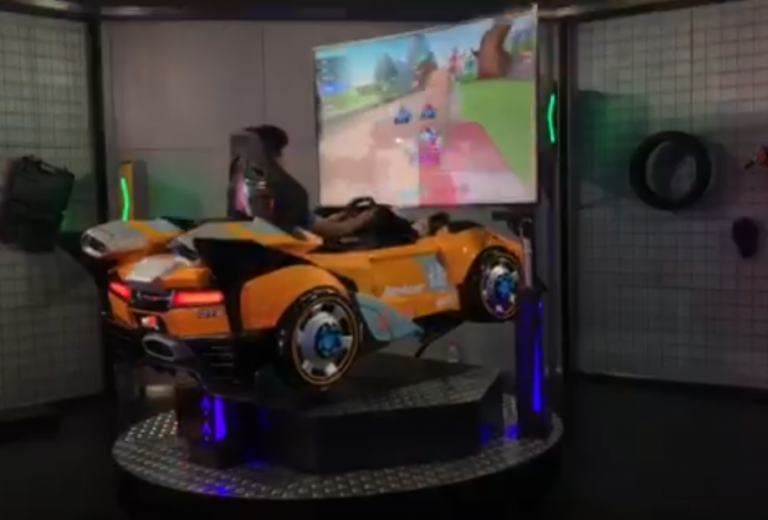
The advantage of a six-degree-of-freedom electric cylinder platform is: the push-back feeling during acceleration, the lateral tilt during cornering, and the fine vibrations when running over curbs—these physical sensations cannot be provided by a home steering wheel or traditional arcade machines. In terms of operational strategy, do not try to make passersby “understand the charm of sim racing”; instead, use a “free 60-second experience” hook to push them into the seat. Sixty seconds is enough to complete one acceleration, one corner, and one curb strike—most people will change their expression within 30 seconds.
In terms of equipment selection, commercial entertainment scenarios should prioritize electric cylinder solutions. Hydraulic systems are noisy (75dB+), which will trigger complaints in malls; pneumatic systems have poor precision and stiff motion, resulting in a cheap experience. Electric cylinders are quiet (<60dB), respond quickly, and are maintenance-free, making them the optimal solution for commercial scenarios.
Layer 2: Short-Video Traffic—Turn the Device into a Content Production Tool
The traffic advantage of racing simulators is that they are naturally suited to short videos. First-person perspective, motion shaking, and the steering wheel counter-steering during drifts are all algorithm-friendly content materials.
Operationally, three things should be done: First, set up a fixed phone holder next to the device to encourage players to film themselves; Second, arrange for staff to capture “highlight moments” (fastest lap, brilliant save, crash moment) and generate shareable short videos or GIFs on site; Third, establish a “post on Douyin for a free session” mechanism, directly converting传播 behavior into discount incentives. Data from one experience venue shows that after introducing simulators, cumulative Douyin video views exceeded 2 million, and the natural in-store conversion brought by this far exceeded paid traffic投放.
Layer 3: Community Traffic—Use Events and Leagues to Create Reasons for Repeat Purchases
Experience is one-time; competition is the engine of repeat purchases. In the sim racing ecosystem, event platforms are the core node for maintaining user stickiness. Taking China’s leading platform HiPole as an example, the annual number of participating players exceeds 5,000, with more than 2,000 core competitive players, relying on continuous event operations and community culture cultivation.
In terms of operational rhythm, it is recommended to adopt a “weekly + monthly + quarterly finals” event system. Weekly races have low barriers and small rewards (free experience vouchers, drink coupons), with the purpose of maintaining activity; monthly races upgrade rewards (device accessories, brand co-branded merchandise) to create topics; quarterly finals can connect with local car dealerships and go-kart tracks for cross-category traffic. The events themselves do not necessarily need to make money; they are triggers for repeat purchases—a player who practices for three nights for a weekend race will spend far more than a single experience.
III. Profit Methods: Four Layers of Monetization, from One-Time Experience to Long-Term Value
Layer 1: Experience Revenue—Pricing Strategy Matters More Than Equipment
Experience revenue is the base, but pricing needs careful design. Refer to the lesson from the Chengdu market: priced at 60 yuan/hour, internet cafe customers reacted with “not as cost-effective as the arcade,” because beginners on hardcore simulators cannot even get started, and frustration far exceeds pleasure.
A more effective strategy is layered pricing + software-hardware matching:
| Tier | Equipment Configuration | Software Choice | Pricing Logic |
|---|---|---|---|
| Traffic Layer | Entry-level steering wheel + fixed seat | Entertainment-oriented games like Forza Horizon | 15-30 yuan/15 minutes, lowering the barrier |
| Standard Layer | Mid-range direct drive + entry-level motion | GT, Assetto Corsa beginner mode | 60-80 yuan/30 minutes |
| Professional Layer | Six-degree-of-freedom + high-end direct drive | ACC, iRacing | 150-200 yuan/hour |
The core logic is: do not let beginners use professional equipment to play hardcore software. What beginners need most is guidance and immediate positive feedback, not the precision of the physics engine. Using entertainment-oriented software to reduce frustration and motion equipment to create the “wow moment” is the correct way to open the experience layer.
Layer 2: Membership and Training—The Key Conversion from Traffic to Retention
The ceiling of experience revenue is very low; membership is the core means of amortizing equipment and rent costs. The membership system can be designed in three tiers:
Monthly Card (300-500 yuan): Unlimited standard-layer experiences, suitable for users in the habit-building phase. Quarterly Card (1,000-1,500 yuan): Includes 4 professional-layer device hours + 2 coaching sessions, aimed at advanced players. Annual Card (3,000-5,000 yuan): Includes event registration fees, equipment purchasing consultation, and priority for offline activities, binding the core community.
Training is the value-added anchor of the membership system. Uruguay’s Simzone model is worth referencing: founded by a professional driver, it provides real-time data analysis—monitoring brake pressure, throttle opening, and G-force changes, analyzing corner by corner like a real racing team. In the Chinese market, players with a racing foundation “have money but lack professional guidance,” and a coaching fee of 300-500 yuan per hour is acceptable, provided the coach has a racing background or lap-time credibility.
Layer 3: Events and Brand Cooperation—B-End Revenue Hedges C-End Fluctuations
C-end experience revenue has obvious peaks and troughs (busy on weekends, slow on weekdays); B-end revenue is the key to smoothing cash flow.
In terms of brand cooperation, car dealerships need test-drive traffic, and simulators are a natural springboard for “simulate first, test-drive later”; esports brands, monitor brands, and peripheral brands need offline experience scenarios, and simulator venues are precise touchpoints. The cooperation model between Evnia and MOZA is an example: the monitor brand provides equipment, the venue provides the scenario, and both share traffic and communication materials.
In terms of event hosting, corporate team building, brand esports competitions, and campus leagues are all standardized products. A team-building event with 20 people can achieve a customer unit price of 3,000-5,000 yuan, including venue, equipment, referees, livestreaming, and prize packages. Compared with individual customer experiences, event activities have higher space efficiency and premium.
Layer 4: Equipment Sales and Consulting—A Natural Extension from “Playing” to “Buying”
Simulator experience venues have a unique advantage: if users enjoy playing, they will really buy one for home. Simzone’s founder discovered in the first month of opening that in addition to rental demand, “some people even wanted to buy the entire set of equipment.”
The key to equipment sales is the “experience-trust-conversion” chain. If a player uses a certain brand’s direct-drive steering wheel in your venue and feels the delicacy of force feedback, they will naturally tend to buy the same model when they go home. The venue can become the brand’s offline experience + sales channel, earning equipment margins or commissions. The advanced service is customized configuration consulting: based on the user’s budget, space, and game preferences, providing a complete solution from steering wheel to seat to screen, charging a consulting service fee or packaged profit.
IV. Risks and Responses
The biggest pitfall in racing simulator operations is “using an enthusiast’s mindset to do mass-market business.” Enthusiasts think “the more hardcore, the more valuable,” but mass consumers want “the more thrilling, the more worth posting on Moments.” No matter how expensive the equipment, if a beginner cannot achieve a thrilling experience of “almost losing control but saving it” within five minutes, they will not come back.
The second risk is location and scenario mismatch. Placing five Fanatec devices in a corner of an internet cafe and expecting internet cafe customers to convert is a path already proven to fail. Simulators require independent spatial atmosphere—lighting, sound, and a sense of isolation are all part of the experience. Open booths in mall atriums are suitable for traffic generation but cannot retain people; an independent experience venue or club format can support membership and events.
The third risk is over-reliance on C-end individual customers. Individual customer experiences are one-time business; venues without membership systems and B-end revenue support will quickly fall into an off-season predicament after the opening hype fades.
Conclusion
The business logic of racing simulators is not “selling device hours,” but operating a funnel from experience to competition to community. Traffic generation relies on physical impact and short-video传播; profitability relies on layered pricing, membership retention, B-end cooperation, and equipment conversion. There are only two key decisions: choose electric cylinder solutions for equipment, and do not run a noisy hydraulic business; layer the software, and do not let beginners use hardcore simulators to discourage themselves. Get these two things right, and the rest is a matter of operational rhythm.
RELATED POSTS
Detailed Introduction to Natural Disasters Available in VR Typhoon & Earthquake Experience Safety House Popular Science Museum
Diverse Applications and Educational Value of VR Campus Safety Experience Halls in Schools
Analysis on Technical Characteristics and Future Development Prospects of Four-Axis Driving Simulators
Technology Empowers Fire Safety Education: Immersive Protection for Life Safety — Application Practice and Development Prospect of VR Fire Experience Halls