Application Exploration and Practice of Car Simulators in Experience Halls
With the rapid iteration of technology and the upgrading of consumer demand, immersive experience has become the core competitiveness in fields such as cultural tourism, education, and entertainment. Car simulators, with their advantages of high simulation, high safety, and strong interactivity, have gradually become the core experience projects of various experience halls. From popular science education in traffic safety experience halls, brand display in automotive culture experience halls, to interesting interaction in entertainment experience halls, car simulators have broken the time and space limitations of traditional experiences, deeply integrated virtual driving with real feelings, not only enriched the service content of experience halls, but also expanded the communication path of the automotive-related industry. Combining the current technical characteristics of car simulators and the application scenarios of various experience halls, this article deeply explores their application value, practice mode, existing problems and development trends, providing reference for the development of the industry.
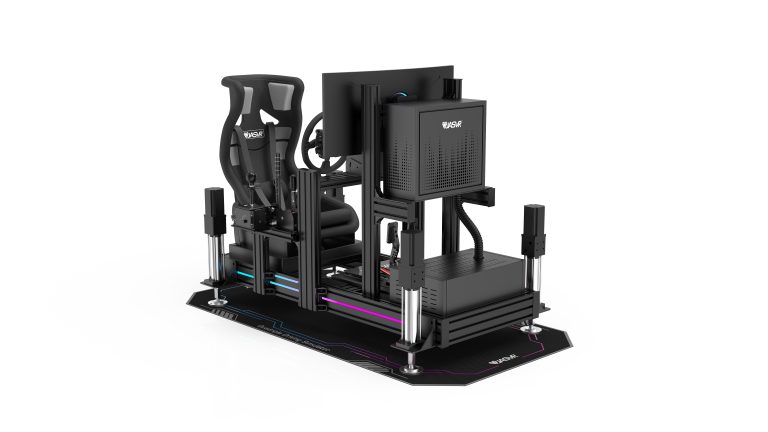
A car simulator is a comprehensive device integrating virtual reality (VR), augmented reality (AR), sensors, computer graphics, vehicle dynamics and other multi-field technologies. Its core value lies in “simulation restoration” and “safe controllability”. Compared with real driving, car simulators do not require a large area of land, do not bear the costs of vehicle wear and tear, fuel consumption and safety risks, and can simulate driving scenarios of different vehicle models, road conditions and weather according to needs, realizing full-scenario simulation from basic operations to complex emergencies. Currently, mainstream car simulators are mainly divided into three categories: basic simulators, which take steering wheel, pedals and display screen as the core to meet the needs of basic driving operation experience; dynamic simulators, equipped with a six-axis motion platform, which can simulate the changes of vehicle posture during acceleration, braking and turning, improving the sense of immersion; high-end VR/AR composite simulators, combined with head-mounted devices and environmental projection, realize the superposition of virtual scenes and real environments, creating an immersive driving experience. Some products have a simulation degree of more than 90%, which can accurately restore the power response, road feedback and surrounding environment details of the vehicle. These technical characteristics have laid a solid foundation for their wide application in various experience halls.
I. Diversified Application Scenarios of Car Simulators in Various Experience Halls
Different types of experience halls have different positioning and service groups, and the application modes of car simulators also show personalized and differentiated characteristics. They are mainly concentrated in four major scenarios: traffic safety education, automotive culture communication, entertainment and leisure experience, and vocational skills training, covering all age groups and realizing the integration of education, culture, entertainment and training.
(I) Traffic Safety Experience Halls: Strengthening Safety Awareness through Simulated Experience
The core goal of traffic safety experience halls is to popularize traffic safety knowledge and improve the traffic safety awareness of the whole people. As an immersive popular science tool, car simulators have completely changed the limitations of traditional “didactic” education, allowing experiencers to feel traffic risks and master safety skills in “personal driving”. The application of car simulators in such experience halls mainly focuses on three directions: popularization of basic traffic rules, response to dangerous scenarios, and safety education for special groups, adapting to the needs of experiencers of different ages.
For teenagers and children, experience halls usually set up interesting simulation projects such as “Traffic Sign Primary School” and “Car Car World”. For example, the “Traffic Sign Primary School” simulator launched by the Beijing Automotive Museum allows experiencers to drive virtual go-karts to race on the track. In the process, they need to identify various traffic signs to get good results, and remember the meaning and function of traffic signs in interesting interaction; “Car Car World” is aimed at children under 1.4 meters, creating a virtual urban driving scene, allowing children to initially understand basic driving knowledge in a relaxed atmosphere and cultivate the awareness of civilized travel. For teenagers over 1.4 meters, there is also a youth driving training camp, which allows teenagers to understand the working principle and driving skills of cars through simulating urban road driving, and establish a correct driving concept.
For adults, traffic safety experience halls focus on setting up dangerous scene simulation and emergency skills training projects. The “Collision Experiment” simulator of the Beijing Automotive Museum allows experiencers to operate the equipment to feel the violent vibration during car collision, understand the working principle and triggering conditions of airbags, and deeply realize the importance of safe driving; the “Driving Expert” project simulates various dangerous scenarios in road driving, such as pedestrians suddenly crossing the road and non-motor vehicles changing lanes irregularly, allowing experiencers to practice emergency judgment and avoidance skills in a high-pressure environment, and improve their ability to respond to sudden situations. In addition, some experience halls also have a “Safe School Bus Experience Camp”, which combines 1:1 school bus simulation with videos to allow experiencers to learn school bus safety knowledge and improve students’ self-rescue and escape abilities, covering the traffic safety education needs of all age groups.
The core advantage of such applications is “scenario-based warning”. By simulating the consequences of illegal behaviors such as drunk driving, fatigue driving and speeding, experiencers can intuitively feel the harm of traffic violations, which is more impactful than traditional posters and video explanations, and effectively improves the effect of traffic safety education. According to relevant data, the awareness rate of traffic rules and emergency response ability of people who have experienced immersive car simulator experience have increased by more than 60%, which fully reflects its important value in traffic safety popular science.
(II) Automotive Culture Experience Halls: Conveying Brand Value through Immersive Experience
Automotive culture experience halls are important carriers for displaying the development of the automotive industry, conveying automotive brand culture, and connecting automotive enterprises with consumers. The application of car simulators has transformed automotive culture from “static display” to “dynamic experience”, enhancing the interest and appeal of cultural communication. The application of car simulators in such experience halls mainly focuses on three directions: brand display, vehicle model experience and event culture communication, accurately targeting automotive enthusiasts and potential consumers.
In terms of brand display and vehicle model experience, cultural experience halls under automotive enterprises generally introduce high-end car simulators to simulate the driving experience of various models under the brand, allowing consumers to experience the performance and control of different models without test-driving real vehicles. For example, the “VR Driving Café” driving test simulator launched by Guangzhou Nantuo Software Technology can not only be used for driving training, but also be adapted to automotive culture experience halls. It allows experiencers to wear VR glasses to experience the driving texture of different brand models in virtual scenes and understand the various configurations and performance advantages of the vehicles. The LeMay – America’s Car Museum in the United States has introduced the CXC MP3 sports professional racing simulator, which combines professional racing software to accurately simulate the aerodynamics and vehicle dynamics of real tracks, allowing experiencers to feel the acceleration, braking and cornering experience of high-performance racing cars and convey the automotive sports culture.
In terms of event culture communication, automotive culture experience halls create “virtual racing event” experiences through simulators, allowing experiencers to feel the charm of racing sports. The “Extreme Driving” project of the Beijing Automotive Museum is divided into primary and advanced versions, simulating the Shanghai F1 track, allowing experiencers of different ages (teenagers over 1.4 meters and adults) to personally drive virtual racing cars and experience the excitement and thrill of the F1 race; the “Super Racer” project allows experiencers to choose different tracks and vehicles, participate in various virtual events, learn racing skills and understand event culture. This method not only enriches the form of automotive culture communication, but also attracts a large number of racing enthusiasts to participate, improving the attractiveness and influence of the experience hall.
In addition, some automotive culture experience halls also combine simulators with the display of automotive history. By simulating the driving scenes of classic models of different eras, experiencers can feel the development process of the automotive industry while driving “vintage models”, enhancing the sense of depth and appeal of automotive culture. For example, the “Dancing Car” project set up in some experience halls uses VR technology to three-dimensionally present the nine gates of old Beijing, combined with classic vehicle simulation, allowing experiencers to feel the integration of history and modernity while driving, enriching the experience dimension of automotive culture.
(III) Entertainment and Leisure Experience Halls: Meeting Consumer Demand through Interesting Experience
With the upgrading of consumption, entertainment and leisure experience halls have gradually become important places for people to relax and interact with their families. Car simulators, with their characteristics of strong interactivity and high interest, have become popular projects in such experience halls, mainly targeting family groups and young consumer groups, creating immersive entertainment experiences. Its application modes are mainly divided into three categories: parent-child interaction, competitive entertainment and scenario-based experience, which take into account both interest and participation.
Parent-child interaction applications are mainly aimed at family groups, creating driving simulation projects suitable for children and parents to participate in together. For example, the “Parent-Child Driving Park” set up in some entertainment experience halls uses car simulators with simplified operations to reduce driving difficulty, allowing children to simulate urban road driving, parking in parking lots and other scenarios under the guidance of their parents. This not only exercises children’s hands-on ability and reaction ability, but also enhances the interaction between parents and children. The “One Step到位” (One Step Perfect) project of the Beijing Automotive Museum simulates various parking space scenarios, allowing parents and children to practice parking skills together, learn driving knowledge in interaction, and realize the dual value of “entertainment + education”.
Competitive entertainment applications are mainly aimed at young consumer groups, creating virtual racing competitions, driving challenges and other projects to meet the competitive needs of young people. For example, some experience halls have introduced multiple dynamic racing simulators and built a local area network competitive platform, allowing experiencers to form teams to participate in virtual racing competitions, displaying race results and rankings in real time, enhancing the interest and excitement of the competition; other experience halls have set up “driving checkpoints” projects, simulating road conditions and tasks of different difficulties, and experiencers can get corresponding rewards after completing the checkpoints, improving their sense of participation and accomplishment. In addition, the “Cars in Movies” project allows experiencers to sit on a dynamic platform and watch 3D movies with cars as the theme, immersively feeling the intensity of racing competitions and enriching the form of entertainment experience.
Scenario-based entertainment experience creates a differentiated entertainment feeling by simulating special scenarios. For example, some experience halls combine VR technology to simulate special driving scenarios such as off-road and rally, allowing experiencers to feel the fun of driving under complex road conditions; others simulate “future urban driving” scenarios, integrating intelligent driving elements, allowing experiencers to feel the convenience and magic of future transportation and meet people’s imagination of future travel. This scenario-based entertainment experience breaks the limitations of traditional driving simulation and further improves the entertainment value of car simulators.
(IV) Vocational Skills Training Experience Halls: Improving Training Efficiency through Accurate Simulation
Vocational skills training experience halls mainly provide targeted driving skills training services for driving beginners, professional drivers and other groups. With their advantages of safety, efficiency and repeatability, car simulators have become important tools for vocational skills training, mainly used in three fields: driving test training, special vehicle driving training and emergency response training.
In terms of driving test training, car simulators have completely changed the limitations of traditional driving training models, solving the problems of “difficulty in practicing driving, long waiting time and high safety risks”. The “VR Driving Café” driving test simulator launched by Guangzhou Nantuo Software Technology adopts a new model of “VR driving learning + intelligent electronic coach”. Students can wear VR glasses to conduct full-process simulation training from Subject 1 to Subject 4 in virtual scenes. The intelligent electronic coach will provide real-time guidance on operations, correct wrong actions, and conduct simulated exams, allowing students to know their own shortcomings at any time. This model not only reduces the demand for manual accompany training, but also saves fuel and vehicle wear and tear costs. According to statistics, the mixed training mode combining simulators and real vehicles can increase the pass rate of students’ Subject 2 by 14.7 percentage points and reduce the unit training cost by 37.6%. The “Adult Driving Training Camp” of the Beijing Automotive Museum simulates real urban road scenes, allowing experiencers to establish correct driving behaviors and develop the habit of abiding by traffic rules and civilized travel, providing a supplement for driving test training.
In terms of special vehicle driving training, the application of car simulators has effectively solved the problems of high cost and high risk of special vehicle training. For example, for the driving training of special vehicles such as fire engines and ambulances, the traditional mode requires the use of real vehicles, which is not only costly but also has safety risks. Through simulators, it can accurately simulate the driving characteristics and operation scenarios of special vehicles, allowing drivers to practice emergency response, complex road driving and other skills in a safe and controllable environment. Some high-end simulators also simulate the liquid sloshing effect of fire engines through the SPH algorithm, integrating multi-body dynamics and structural vibration coupling, which significantly improves the success rate of task operation.
In terms of emergency response training, vocational skills training experience halls simulate various sudden driving scenarios such as vehicle failures, bad weather and traffic accidents through simulators, allowing drivers to practice emergency response skills and improve their emergency response capabilities. For example, simulators can simulate driving scenarios under bad weather such as heavy rain, heavy fog and ice and snow, allowing drivers to learn how to control vehicle speed, keep a safe distance and brake urgently; they can also simulate fault scenarios such as vehicle tire blowout and brake failure, allowing drivers to practice emergency avoidance skills and reduce safety risks in real driving. This accurate simulation training is more practical than traditional theoretical explanations and can effectively improve the professional skill level of drivers.
II. Core Value of Car Simulators in the Application of Experience Halls
The application of car simulators in various experience halls not only enriches the service content of experience halls, improves their attractiveness and competitiveness, but also realizes multi-field value empowerment such as education, culture, entertainment and training. Its core value is mainly reflected in the following four aspects.
First, reduce experience and operation costs and improve cost performance. For experience halls, introducing car simulators does not require a large area of land, does not bear the costs of purchasing, maintaining and fueling real vehicles, and does not need to worry about safety accident risks during the experience, so the operation cost is greatly reduced. For example, opening a racing simulator experience hall, the initial investment is mainly for equipment purchase, and the later operation only needs to pay electricity fees and equipment maintenance fees. Compared with a real racetrack, the cost is reduced by more than 70%. At the same time, simulators can operate 24 hours a day, improving the operation efficiency and venue utilization rate of the experience hall, and further improving the operation cost performance. For experiencers, they can experience the fun of driving without having a real driving license or bearing the costs of fuel and vehicle wear and tear, which reduces the experience threshold and expands the scope of experiencers.
Second, realize a safe and controllable immersive experience and improve the sense of experience and effectiveness. Real driving has many safety risks, especially for driving beginners and teenagers, it is difficult to practice complex operations and emergency responses in real scenarios. Through virtual scene restoration, car simulators can simulate various complex road conditions and dangerous scenarios. In a safe and controllable environment, experiencers can fully devote themselves to the experience and feel real driving feedback. For example, the six-axis motion platform of the dynamic simulator can accurately simulate the body tilt and vibration during acceleration, braking and turning, and combine with the 360-degree sound field environment constructed by the spatial audio engine to create a “visual, auditory and tactile” trinity immersive experience, making experiencers feel as if they are in a real driving scene. This immersive experience not only improves the interest of the experience, but also allows experiencers to truly master relevant knowledge and skills in the experience process, improving the effectiveness of education and training.
Third, adapt to diverse groups and scenarios, and enhance the inclusiveness and attractiveness of the experience hall. Car simulators can adjust driving difficulty, scene settings and operation modes according to the needs of different groups, adapting to different age groups such as children, teenagers, adults and the elderly, as well as different driving levels such as beginners and professional drivers. For example, simplified operations and interesting scenarios are set for children; high-difficulty competitions and complex road condition simulations are set for professional drivers; low-speed and stable driving scenarios are set for the elderly to meet the experience needs of different groups. At the same time, car simulators can be flexibly adapted to different types of experience halls such as traffic safety, automotive culture, entertainment and leisure, and vocational training, enriching the service content of experience halls, enhancing their inclusiveness and attractiveness, and improving customer flow and user stickiness.
Fourth, promote digital transformation and help the innovative development of the industry. The application of car simulators has promoted the transformation of various experience halls from “static display” to “dynamic experience” and “digital experience”, breaking the development limitations of traditional experience halls. For example, automotive culture experience halls have realized the digitalization of brand display and vehicle model experience through simulators, improving the efficiency and effect of brand communication; traffic safety experience halls have realized the digitalization and scenario-based of popular science education through simulators, improving the interest and effectiveness of education. At the same time, the massive experience data generated during the operation of the simulator can be used to analyze the needs and preferences of experiencers and their operating habits, providing data support for experience halls to optimize service content and adjust operation strategies, and promoting the refined operation and innovative development of experience halls. In addition, the integration of car simulators with new technologies such as 5G, AI and VR/AR can also promote the in-depth integration of the experience hall industry with the automotive industry and the technology industry, giving birth to new experience models and formats.
III. Existing Problems in the Application of Car Simulators in Experience Halls
Although the application of car simulators in various experience halls has achieved remarkable results, with the continuous expansion of the application scope, some problems have gradually emerged, mainly concentrated in three aspects: technical level, content innovation and operation management, which restrict the further exertion of their application value.
First, the technical level is uneven, and the simulation degree of some simulators is insufficient. Currently, there is a large difference in the quality of car simulators on the market. Mid-to-low-end simulators generally have the problem of low simulation degree, which is mainly reflected in inaccurate driving operation feedback, unrealistic scene restoration, poor dynamic effect, etc. For example, some basic simulators can only simulate simple driving operations, unable to restore details such as road bumps and vehicle vibrations, resulting in poor experience; some low-end dynamic simulators have high response delay of the motion platform, unable to timely feedback driving operations, affecting the authenticity of the experience. In addition, the hardware quality of some simulators is poor, which is prone to failure and high maintenance costs, affecting the normal operation of the experience hall. Although high-end simulators can achieve a high degree of simulation experience, the equipment price is expensive, often hundreds of thousands or even millions of yuan, which many small and medium-sized experience halls cannot afford, limiting the popularization and application of high-end technologies.
Second, insufficient content innovation and serious homogenization of experience forms. At present, the application of car simulators in most experience halls is relatively single in content, mainly focusing on traditional scenarios such as racing competitions, basic driving and subject practice, lacking personalized and differentiated experience content. For example, the simulator projects of most entertainment experience halls are racing competitions, lacking characteristic projects for families, the elderly and other groups; the simulation scenarios of some traffic safety experience halls are relatively fixed, lacking novel interaction forms and popular science content, making it difficult to attract experiencers to participate repeatedly. At the same time, the application modes of simulators in different experience halls are similar, lacking unique brand characteristics and core competitiveness, which is likely to lead to aesthetic fatigue of experiencers and affect the long-term development of experience halls.
Third, imperfect operation management and shortage of professional talents. The normal operation of car simulators requires professional technical maintenance and operation management, but many current experience halls lack professional technical personnel and operation personnel. On the one hand, the staff of some experience halls lack the maintenance knowledge of simulator equipment, unable to timely handle equipment failures, leading to equipment idleness and affecting operation efficiency; on the other hand, there is a lack of professional operation personnel, unable to optimize experience content and organize interactive activities according to the needs of experiencers, making it difficult to improve the satisfaction and stickiness of experiencers. In addition, the pricing strategy of some experience halls is unreasonable, either the price is too high, exceeding the acceptable range of experiencers; or the price is too low, making it difficult to cover the operation cost, affecting the sustainable development of the project.
Fourth, insufficient integration of technologies and room for expansion of application scenarios. Currently, the integration of car simulators with new technologies such as 5G, AI and big data is not in-depth enough. Most simulators can only realize basic simulation functions, failing to give full play to the advantages of new technologies. For example, AI technology is not used to automatically adjust scene difficulty and training content according to the experiencer’s operation level; big data technology is not used to analyze experiencer needs and optimize experience content and operation strategies. At the same time, the application scenarios are still limited, mainly concentrated in the traditional fields of education, entertainment and training, and the application in emerging fields such as autonomous driving education, virtual test drive and special vehicle training is not extensive enough, failing to fully tap the application potential of car simulators.
IV. Development Trends of the Application of Car Simulators in Experience Halls
With the continuous progress of science and technology and the continuous upgrading of consumer demand, the application of car simulators in experience halls will show the development trends of high-end technology, personalized content, diversified scenarios and refined operation, gradually solving the current problems, further improving the application value, and promoting the coordinated development of the experience hall industry and the automotive-related industry.
First, in-depth integration of technologies and continuous improvement of simulation and intelligence levels. In the future, car simulators will further integrate new technologies such as VR/AR, 5G, AI and big data to improve the simulation and intelligence levels. For example, combining AR technology to superimpose virtual information with the real environment, allowing experiencers to feel the fun of virtual driving in the real scene; using the low-latency characteristics of 5G to realize remote collaborative experience of multiple simulators and create cross-regional virtual competitive events; through AI technology to analyze the experiencer’s operation data, automatically adjust the scene difficulty and provide personalized guidance and suggestions, improving the pertinence and effectiveness of the experience. At the same time, hardware technology will continue to upgrade, and the localization substitution process of core components such as high-precision six-degree-of-freedom motion platforms and MEMS inertial units will accelerate, reducing the cost of high-end simulators and promoting the popularization and application of high-end technologies. It is expected that by 2025, the local supply rate of core components will increase to 60%, and the application scope of high-fidelity simulators will be further expanded.
Second, content innovation and upgrading to create personalized and differentiated experiences. In the future, experience halls will pay more attention to the innovation of experience content, combining their own positioning and target groups to create personalized and differentiated simulation projects. For example, for young consumer groups, launch trendy projects such as immersive VR racing and future driving experience; for family groups, create parent-child interactive driving simulation, automotive popular science mini-games and other projects; for automotive enthusiasts, launch classic model reproduction, professional event simulation and other characteristic projects. At the same time, integrate car simulators with culture, tourism, sports and other industries to create new formats such as “car simulation + cultural tourism” and “car simulation + sports”, enrich experience content and improve the core competitiveness of experience halls. For example, automotive culture experience halls can combine local cultural characteristics to create driving simulation scenarios with regional characteristics, conveying the beauty of the integration of local culture and automotive culture.
Third, continuous expansion of scenarios to achieve full coverage in multiple fields. The application scenarios of car simulators will be further expanded, extending from the current four major fields of traffic safety, automotive culture, entertainment and leisure, and vocational training to emerging fields such as autonomous driving education, special vehicle training, virtual test drive and elderly driving training. For example, with the development of autonomous driving technology, experience halls will introduce autonomous driving simulators to allow experiencers to feel the convenience and safety of autonomous driving and popularize autonomous driving knowledge; launch exclusive driving simulation training projects for the elderly to help the elderly adapt to the operation of intelligent cars and improve the driving safety level of the elderly; automotive enterprises can provide consumers with virtual test drive services through simulators in experience halls, allowing consumers to intuitively experience vehicle performance before purchasing cars and improve the car purchase experience. In addition, simulators will also be applied in fields such as emergency rescue training and traffic management training to further tap their application value.
Fourth, refined operation to improve service quality and operation efficiency. In the future, experience halls will strengthen operation management and improve the level of refined operation. On the one hand, strengthen the training of professional talents, recruit and train professional technical maintenance personnel and operation personnel to ensure the normal operation of equipment and optimize the experience service; on the other hand, use big data technology to analyze the needs and preferences of experiencers and their operating habits, optimize experience content, adjust pricing strategies and operation modes, and improve the satisfaction and stickiness of experiencers. For example, through analyzing experience data, understand the needs of different age groups and consumer groups, and launch characteristic projects targeted; according to equipment operation data, reasonably arrange equipment maintenance time and reduce maintenance costs. At the same time, implement membership system, package system and other operation modes to improve user loyalty and realize sustainable development. In addition, strengthen the construction of industry norms, formulate unified technical standards and operation norms, and promote the standardized application of car simulators in experience halls.
V. Conclusion
The application of car simulators in experience halls is a product of the in-depth integration of technology and experience consumption. With their advantages of safety, efficiency and immersion, they have injected new vitality into various experience halls and provided a new path for the communication and development of the automotive-related industry. From the scenario-based popular science of traffic safety education, to the immersive communication of automotive culture; from the interesting interaction of entertainment and leisure, to the accurate training of vocational skills, car simulators continue to expand the application boundary and realize multi-value empowerment. Although there are still some problems in technical level, content innovation, operation management and other aspects, these problems will be gradually solved with the continuous integration of new technologies and the development of the industry.
In the future, car simulators will develop in the direction of high-end, intelligent, personalized and diversified, integrate deeply with various experience halls, create more high-quality experience projects, and meet the experience needs of different groups. At the same time, it will further promote the digital transformation of the experience hall industry, promote the coordinated development of the automotive industry, the technology industry and the cultural tourism industry, and inject new impetus into the development of the industry. For experience halls, they should seize the development opportunities, reasonably introduce car simulators according to their own positioning, strengthen technological upgrading and content innovation, optimize operation management, give full play to the application value of car simulators, and create an immersive experience space with core competitiveness; for relevant enterprises, they should increase investment in technological research and development, improve the quality and performance of simulators, reduce costs, promote technology popularization, and provide more powerful support for the application of car simulators in experience halls. It is believed that with the joint efforts of all parties, car simulators will achieve greater breakthroughs in the application of experience halls, bringing people more high-quality and rich immersive experiences.
RELATED POSTS
Diversified Popular Science Applications and Social Value of VR Automobile Collision Simulators
Six-Axis Dynamic Attitude Simulation Technology: Redefining New Experiences of UAV Aerial Photography and eVTOL Flight Simulation
Research on Technical Characteristics and Multi-field Applications of 4-Axis Dynamic Simulators
Diverse Application Scenarios and Practical Value of VR Skydiving Simulators
The Future is Here: A Deep Dive into the Flying Theater Market and Forecasting Industry Transformation at the Technological Singularity