Exploration of the Application of VR Experience Equipment in Arcades
In the rapidly evolving digital entertainment industry, Virtual Reality (VR) technology, with its core strengths of immersion and interactivity, has broken the boundaries of traditional entertainment and become a key driver in upgrading offline entertainment experiences. As a classic venue for public leisure and recreation, arcades once gained great popularity with arcade machines, racing simulators, claw machines, and other traditional equipment. However, as consumer demands rise and entertainment options diversify, traditional arcades are increasingly challenged by monotonous experiences, severe homogenization, and declining appeal. Against this backdrop, the deep integration of VR experience equipment and arcades has not only injected new vitality into arcades but also reshaped consumption scenarios and business models for offline entertainment, promoting the transformation of arcades from “traditional entertainment venues” to “immersive experience spaces”.
This article comprehensively explores the application status and development potential of VR experience equipment in arcades from the perspectives of application background, core equipment categories, practical scenarios, advantages and values, existing problems and optimization strategies, as well as future trends, providing references for arcade operators and VR equipment suppliers.
I. Background of VR Experience Equipment in Arcades
With improving living standards, public entertainment demand has shifted from basic leisure to quality-oriented experiences. Simple mechanical operations and repetitive gameplay can no longer satisfy consumers’ pursuit of novelty, immersion, and interaction. Traditional arcades now face prominent pain points:
- Severe homogenization, with similar equipment and gameplay across venues, making differentiated competition difficult.
- Limited sensory experience, as traditional devices rely mainly on flat visuals and simple controls, failing to deliver deep immersion.
- Narrow customer base, primarily attracting teenagers with limited appeal to young adults, middle-aged groups, and families.
- Over-reliance on coin-operated revenue and membership recharge, resulting in a single profit model and weak risk resistance.
Meanwhile, the rapid maturation and industrialization of VR technology have provided a viable path for arcade transformation and upgrading. In recent years, VR hardware costs have continued to decline while performance has improved significantly, evolving from bulky, high-latency devices to lightweight, high-definition, low-latency products with greatly enhanced user experience. The VR content ecosystem has also become increasingly diverse, covering competitive, adventure, leisure, and parent-child categories to meet the needs of different groups.
According to industry data, China’s immersive entertainment market is expected to exceed 45 billion yuan in 2024, with an annual growth rate of 130%. Offline VR experiences represent the fastest-growing segment, and arcades, as major offline entertainment carriers, have become important landing scenarios for VR equipment.
In addition, government policies encourage the deep integration of the digital economy and the real economy, support innovative applications of virtual reality in culture and entertainment, and promote the digital and intelligent upgrading of offline entertainment. Against this background, more arcade operators are building dedicated VR experience zones and introducing VR equipment, adopting a “traditional arcade + VR experience” model to break development bottlenecks and achieve differentiated competition.
II. Common Types of VR Experience Equipment in Arcades and Core Features
VR experience equipment comes in various forms. Based on space constraints, customer needs, and profitability goals, arcades typically use the following categories of VR equipment, each serving different experience demands.
(1) Immersive Single-Player VR Experience Equipment
Designed for individual users, these devices are compact, efficient, and space-saving, making them ideal entry-level options for arcades.
- VR All-in-One HeadsetsStandalone and easy to operate, they require no PC connection. High-performance models used in arcades feature 2.5K high-resolution displays, 105° ultra-wide field of view, and 6DoF tracking for precise motion feedback. Lightweight design reduces fatigue during extended use. Content is mostly short, fast-paced games such as VR shooting, racing, and roller coasters, with sessions lasting 5–15 minutes, matching the fragmented consumption pattern of arcades.
- VR Single Player Dynamic SeatsEquipped with vibration, air blast, water spray, and other tactile effects, these seats enhance immersion. For example, in VR racing, the seat vibrates with acceleration, turns, and brakes, simulating real driving sensations. VR flight seats tilt and lift to recreate flying or skydiving. These mid-to-high-end offerings support higher pricing and attract experience-seeking users.
(2) Multiplayer Interactive VR Experience Equipment
Centered on social interaction and team collaboration, these devices break the isolation of single-player VR and are highly suitable for groups, friends, and family outings.
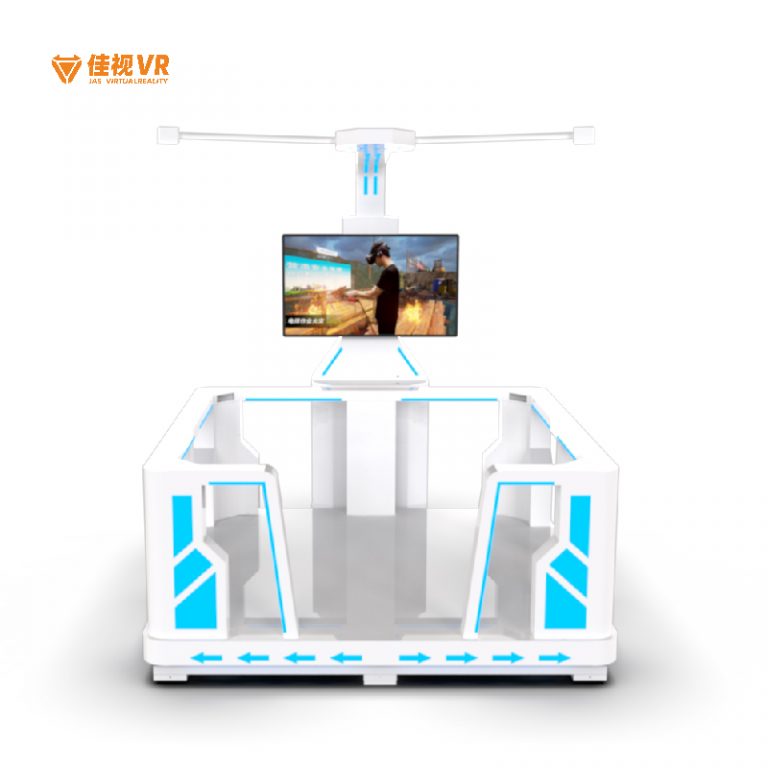
- VR Multiplayer Online PodsSupport 2–4 simultaneous players connected via a local area network. Users can team up for competitive shooting, cooperative adventures, and mission-based gameplay, significantly boosting interactivity and fun.
- Free-Roaming VR SystemsRepresented by wireless free-roaming solutions, these systems eliminate cable restrictions and space limitations. A 4.5m × 4.5m area supports 4 players, while 6m × 9m can accommodate 8 people for team battles or escape-room-style experiences. Users can walk, run, and jump freely within the designated area, delivering a far more realistic experience than traditional VR. Sessions last 10–15 minutes, combining fragmented entertainment with strong social sharing potential.
- VR Interactive TablesDesigned for families and young children, these tabletop devices use touch and gesture control without requiring headsets. Functions include interactive drawing, virtual animation, and educational games, blending entertainment with learning.
(3) VR Somatosensory Fitness & Entertainment Equipment
Combining VR with fitness, this category caters to the “healthy entertainment” trend and expands the audience to fitness-focused young and middle-aged groups.
- VR Fitness MachinesSensors capture body movements and integrate them into games. Users throw punches, run, or dodge in virtual environments, turning exercise into fun gameplay.
- VR Dance MachinesUpgrade traditional dance machines with virtual stages and real-time motion scoring, supporting multiplayer competition and attracting trend-seeking young users.
(4) VR Science & Education Equipment
Positioned as “entertainment + education”, these devices attract families and students, adding cultural value to arcades.
- VR Science Popularization PodsSimulate space, oceans, and natural environments for immersive science learning.
- VR Historical Scene RestorationUses 3D modeling to reconstruct ancient battlefields, famous cities, and cultural sites, allowing users to “travel through time” and experience history.
These devices not only broaden the customer base but also enable partnerships with schools and communities for educational activities, enhancing the arcade’s social image.
III. Practical Application Scenarios and Cases in Arcades
The application of VR equipment in arcades requires scientific layout rather than simple placement. Below are typical scenarios and real-world results.
(1) Core Experience Zone – Flagship Immersive VR Attraction
Located near entrances or in central areas, this zone features high-end free-roaming VR, multiplayer pods, and dynamic seats to create eye-catching “check-in spots”.
Case: A long-established arcade suffering from declining foot traffic upgraded its core area with a VR space flight theater and large-scale multiplayer arena. The flight theater delivered 360° immersive space adventures with dynamic motion feedback. The free-roaming arena supported team-based missions. Live demo screens showcased user experiences to attract passersby. After renovation, footage increased by 200% and revenue doubled within six months.
(2) Leisure Experience Zone – Fragmented Quick VR Experiences
Single-player VR headsets are placed along corridors and idle corners for low-cost, short-session entertainment. Users can play while waiting or resting, improving space utilization.
Case: A chain arcade offered “¥5 for 10 minutes” VR trials and bundled VR with arcade token packages. Leisure-area revenue rose by 30%, and average customer dwell time increased by 20 minutes.
(3) Family Entertainment Zone – Parent-Child VR Experience
Dedicated areas with child-friendly, low-difficulty VR interactive tables, science pods, and cooperative games create a safe, educational environment.
Case: An arcade built a VR parent-child zone with drawing tables and animal science experiences. Family-friendly packages increased the family customer share from 15% to 35%, driving weekend and holiday crowds.
(4) Competitive Arena – Boosting Repeat Visits
Multiplayer VR shooting, dance, and competitive games are arranged to host weekly tournaments with prizes such as free play time and merchandise.
Case: An arcade held regular VR shooting contests and built an online fan community. Young customers reached 60%, and repeat purchase rates rose by 40%.
(5) Pop-Up Experience Zones – Holiday & Event Marketing
Portable VR devices are deployed in mall atriums or campuses during festivals for flash promotions, attracting new customers and increasing brand exposure.
Case: Holiday pop-ups boosted arcade footfall by 50% during peak periods and significantly increased new membership sign-ups.
IV. Advantages and Value of VR Equipment in Arcades
The integration of VR brings comprehensive improvements to arcade operations.
(1) Richer Experiences & Higher Satisfaction
VR creates true immersion through 3D environments, somatosensory interaction, and dynamic feedback, far beyond traditional arcade machines. Surveys show user satisfaction increased by 65%, with 80% of users willing to revisit.
(2) Expanded Customer Demographics
VR appeals to ages 5–45, expanding beyond the traditional teenage base. Families, young professionals, and students become stable customers.
(3) Higher Revenue Per Square Meter & Improved Profit Structure
VR commands higher pricing: ¥5–15 for single-player and ¥20–50 for multiplayer experiences. Revenue from VR typically accounts for 25%–35% of total arcade income, with overall revenue increasing by 40%–60%.
In terms of revenue per square foot, VR zones generate **$800–1200** annually, compared to just $100–300 for traditional arcade areas.
(4) Differentiated Competition & Stronger Brand Image
VR-themed arcades stand out from homogenized competitors, becoming local landmarks and social-media hotspots.
(5) Industry Upgrading & Industrial Integration
VR accelerates the digital transformation of arcades and promotes the development of the VR content, hardware, and service chain, forming a complete industrial ecosystem.
V. Existing Problems and Optimization Strategies
Despite clear benefits, several challenges remain in actual operation.
Main Problems
- High upfront and maintenance costs, especially for premium free-roaming systems.
- Slow content updates leading to user fatigue.
- Inadequate staff training and inconsistent service quality.
- Discomfort, motion sickness, and high learning curves for some users.
- Safety and hygiene risks from blocked vision and shared equipment.
Optimization Strategies
- Cost control: Adopt phased investment and “lease + revenue share” models.
- Content updates: Refresh games every 3–6 months to maintain repeat visits above 60%–70%.
- Staff training: Provide professional operation, maintenance, and customer service training.
- Experience optimization: Use lightweight, low-dizziness headsets and simplify controls for children and seniors.
- Safety & hygiene: Install safety barriers, display warnings, and regularly disinfect equipment with disposable covers.
VI. Future Development Trends
(1) Smarter, Lighter, Wireless VR Devices
Next-generation VR will feature AI personalization, higher resolution, improved tracking, and full wireless freedom, further reducing motion sickness.
(2) Diversified “Entertainment +” Content Integration
VR will expand into education, fitness, culture, and tourism, creating immersive research, virtual travel, and professional fitness experiences.
(3) Innovative Membership & Digital Operations
Arcades will use membership systems, online group buys, big data analysis, and commercial events (team building, parties) to build diversified income streams.
(4) Themed Immersive Spaces
VR will be fully integrated into interior design to create sci-fi, adventure, or ancient-style themed arcades, blending traditional machines with VR innovations.
(5) Standardized Industry & Complete Ecosystem
Industry standards for equipment safety, content review, and operation management will gradually take shape, supporting healthy, sustainable development.
VII. Conclusion
The application of VR experience equipment in arcades represents an inevitable trend in digital entertainment and a crucial path for arcade transformation. VR technology breaks the limitations of traditional arcades, enriches experiences, expands audiences, optimizes profit models, and enhances brand value. Although challenges such as cost, content updates, and operation management still exist, continuous technological progress, business model innovation, and industry standardization will gradually resolve these issues.
In the future, as VR becomes smarter, content more diverse, and scenarios more integrated, VR equipment will be deeply embedded in arcade operations, promoting the shift from traditional to digital entertainment. For operators, scientific VR layout, refined management, and quality services will be key to gaining competitive advantages. For equipment suppliers, user-centric R&D and content innovation will unlock greater market potential. Together, both sides can achieve win-win development in the booming immersive entertainment industry.
RELATED POSTS
Analysis on Diversified Applications and Industrial Development Value of VR Aerospace Science and Technology Museum
Multiple Application Scenarios and Social Value of the J-20 National Defense Education Simulator
Dynamic Military Battlefield Driving Simulator – Application Overview of Training Equipment for New Recruit Tank, Airship and Heavy Truck Training
Diverse Applications and Educational Value of VR Campus Safety Experience Halls in Schools
Diverse Applications and Practical Values of Simple Driving Training Simulators