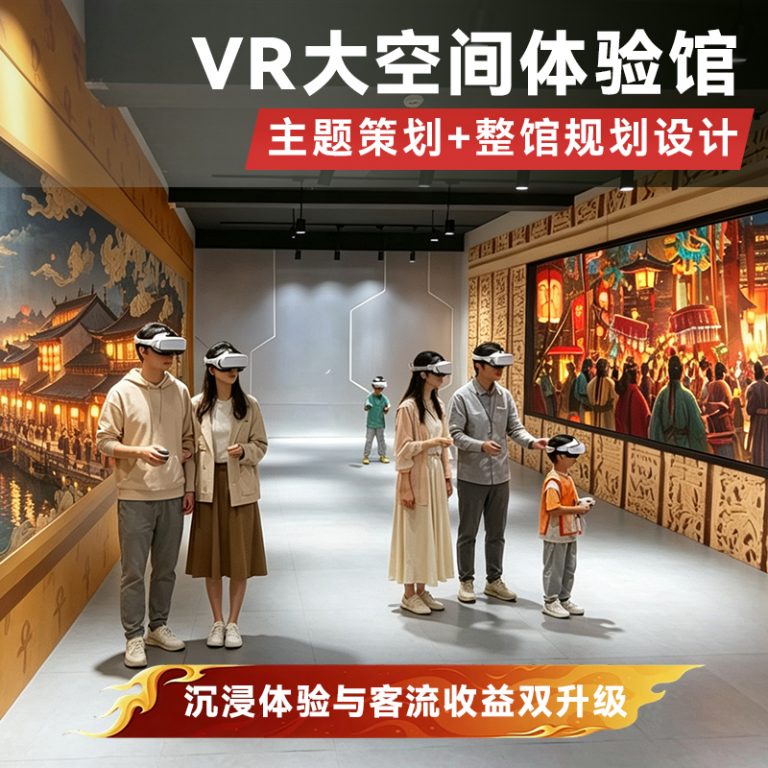
Profit Plan for VR Full-Space Experience Store
A full-space VR venue differs from seated XR cinemas and ordinary VR stores not merely by pricier equipment, but by selling shared immersive experiences: a single play zone, one 30-minute session, with 6–8 players moving freely and collaborating inside together. This format defines its profit model: spread high fixed costs by maximizing session turnover, and lift per-customer revenue through repeat visits and secondary consumption. Ticket sales are only the entry point. What truly decides profitability is how many sessions you run daily, how full each session is, and how soon guests come back.
Core Logic: Four Key Profit Variables
The simplified profit formula for a single store: Monthly Profit = (Daily Sessions × Average Guests per Session × Average Customer Price) × 30 − Monthly Fixed & Variable Costs
Costs are mostly locked once you sign the lease, so the adjustable levers are the first three items, ranked by priority below:
- Session turnover is the top leverage. Fixed costs accrue daily. Running 6 sessions a day versus 12 halves your unit cost. Boosting sessions relies on reservation scheduling and on-site coordination, not extra staffing.
- Guests per session determine space efficiency. An 8-player session with only 3 guests cuts revenue by 40% while costs stay unchanged. Match-making for shared sessions, group bookings and off-peak price guidance are core solutions.
- Average customer value comes from product bundling, not raw price hikes. Simply raising ticket prices suppresses foot traffic. The better approach is building tiered pricing: single ticket, couple ticket, private buyout and membership packages, letting customers voluntarily upgrade.
- Repeat visit rate sets the revenue ceiling. Game content wears out quickly; most themes get repetitive after 2–3 plays. Consistent content updates and membership benefits sustain long-term business.
The primary goal of this plan: build a replicable model with over 50 daily visitors and 60% session utilization rate, then consider opening a second outlet and external service cooperation.
Revenue Streams: 5 Income Channels
Stores relying only on walk-in ticket sales rarely hit a profit margin above 20%. A sustainable structure reuses the same venue and hardware across five revenue sources: walk-in guests, members, groups, on-site add-ons and external partners.
表格
| Revenue Stream | Product Form | Reference Pricing | Target Revenue Share | Implementation Notes |
|---|---|---|---|---|
| Walk-in Ticket Sales | Single ticket, couple ticket, family package; online group-buy & walk-in payment | Weekday ¥128, Weekend ¥158, Couple package ¥288 | 55%–65% | Price online packages ¥10–15 lower than counter price; redirect group-buy customers to private domain communities |
| Membership & Prepaid Top-up | Multi-visit passes, monthly passes, quarterly passes, recharge bonus | Monthly pass ¥399, Quarterly pass ¥899, Recharge ¥1000 get ¥200 extra | 15%–20% | Target high-frequency visitors only; avoid cannibalizing regular ticket sales with low-price memberships |
| Private Group Buyout | Corporate team building, birthday parties, study tours, private gatherings, full venue rental | Weekday ¥1200 per session, Weekend ¥1800 per session (hosting & photo service included) | 10%–15% | Highest gross margin; schedule separately without occupying peak hours for regular guests |
| On-site Secondary Sales | Highlight gameplay clips, themed photos, drinks, co-branded merchandise | Game recording ¥38, Beverages ¥15–25 | 5%–8% | Game recording is high-margin low-cost product; place sales booths on the exit path |
| Off-site Service Rental | Equipment rental, mall pop-up events, brand activation | Quotation by day / per session | 5%–10% | Deploy on idle weekday daytime slots to create incremental revenue |
There is a clear launch sequence for these streams. Focus on walk-in tickets in the opening ramp-up phase to build brand awareness. Push membership and private buyout once operations stabilize. Launch off-site rental services only at the mature stage. Prematurely pushing high-margin add-ons may damage public reputation and disrupt pricing systems.
Cost Structure & Break-Even Analysis
Full-space VR stores carry heavy upfront investment but lighter recurring costs: equipment is a one-time purchase depreciated monthly, rent is fixed monthly, labor is semi-variable, while platform commission and marketing fees fluctuate with revenue. The table below is a sample calculation for a standard 300㎡ store. Adjust figures according to your local rent, ticket price and hardware quotation.
表格
| Cost Item | Monthly Sample Cost | Cost Type | Cost Reduction Strategy |
|---|---|---|---|
| Venue Rent & Property Fee | ¥18,000 | Fixed | Negotiate rent-free periods, revenue-sharing rent; choose secondary commercial zones adjacent to anchor stores |
| Labor Cost (1 Store Manager + 4 Full-time + Part-timers) | ¥45,000 | Semi-variable | Hire part-timers for peak hours, keep minimal full-time staff; cross-train staff: game host, cashier & photographer combined |
| Equipment Depreciation | ¥19,000 | Fixed | 5-year depreciation cycle; choose modularly upgradable headsets & tracking systems to reduce renewal costs |
| Content Licensing & Updates | ¥8,000 | Semi-variable | Purchase annual content libraries instead of single-theme licenses to cover multiple scenarios |
| Maintenance & Consumables | ¥5,000 | Variable | Standardize hygiene supplies like headset face cushions; implement daily self-inspection to prevent unexpected breakdowns |
| Platform Commission | ~¥15,000 | Variable | Convert platform customers to private domain to gradually reduce platform dependency |
| Marketing & Promotion | ¥15,000 | Variable | Produce in-house short videos; concentrate ads on grand opening and new theme launches |
| Utilities & Miscellaneous | ¥8,000 | Fixed | Power management for standby devices, off-peak power usage |
| Total | ~¥128,000 | — | Fixed costs account for roughly 60% |
With an average transaction price of ¥135, the break-even point is around 950 visitors per month, or 32 visitors daily, equivalent to running 4–5 full sessions per day. This threshold is manageable, yet most stores fail between Month 2 and Month 4 once opening hype fades.
If you steadily hit 60 visitors daily, monthly ticket revenue reaches approximately ¥243,000. With add-on sales and private bookings, monthly profit can hit roughly ¥110,000 at a margin of ~45%. For a total upfront investment of ¥1,000,000 on hardware and renovation, the static payback period is 9–10 months. This projection hinges on sustaining session utilization above 60%, rather than high ticket prices.
Product & Pricing Framework
Pricing strategy is not about maximizing unit price, but designing tiers for different customer groups so every segment feels fairly priced.
Time-Based Tiered Pricing
Introduce off-peak weekday afternoon discounts (30% lower than weekends) to fill empty slots. Keep standard pricing on weekends and holidays without unlimited discounts; a mild premium can apply to evening slots for couples and friend groups. Differentiate pricing by time slot, not promotional campaigns, to train customers away from waiting for discounts.
Bundled Packages
Single tickets serve as loss leaders; couple and family packages are core revenue drivers; private venue buyouts are high-profit products. Maintain reasonable price gaps so bundled packages are visibly cheaper than buying separate tickets. Add photo clips or drinks into bundles to lift average spend subtly, better than direct price increases.
Membership Design
Only sell memberships to returning guests who have already experienced the venue. The value of monthly/quarterly passes lies in flexible access, not steep discounts. Set expiry dates for recharge promotions to avoid long-term financial liabilities. A core membership perk: early access to new themes, the strongest driver of repeat visits.
Customer Acquisition & Conversion
Build a three-layer traffic structure; over-reliance on any single channel brings huge risk:
- Platform Channel: Meituan, Douyin and Dianping for new customer discovery. Review volume and rating are critical here; actively manage reviews for the first 3 opening months.
- Private Domain Channel: Invite all in-store guests to join WeChat groups and follow social accounts, send booking reminders and new-theme alerts. Private domain cuts repeat customer acquisition cost close to zero.
- Cross-industry Partnership: Local restaurants, escape rooms, parent-child studios and corporate trade unions for joint packages. Corporate and school tour bookings stabilize weekday daytime occupancy.
Common conversion leakage points and fixes:
- Hesitation before ordering online: highlight beginner-friendly guides, full instructor support and 30-min session length on listing cover images.
- Long waiting times on site: adopt reservation + standby matching system to limit waiting time under 10 minutes.
- No secondary purchase after gameplay: set up photo pickup and membership counters at the exit.
Session & Labor Efficiency
Session slots are perishable inventory — an empty session is pure loss. Three actionable ways to lift efficiency:
- Session Scheduling: Standard session runtime is 35 minutes including safety briefing & equipment fitting, with a 10-minute buffer for sanitization and reset. A 10-hour operating day supports up to 13 theoretical sessions. Dynamically open booking windows based on reservation density.
- Shared Session Matchmaking: Do not open private sessions for groups smaller than 3. Add them to a matching pool and pair guests within a 30-minute window, raising occupancy and reducing waiting time for solo visitors.
- Labor Efficiency Control: Keep core full-time staffing lean, build a pool of on-call part-timers for rush hours, and implement cross-functional training for all team members.
Repeat Visits & Content Refresh Plan
Repeat visits are driven by fresh content, not discounts. Recommended update rhythm: launch one new theme quarterly, upgrade gameplay mechanics semi-annually, and host small community events bi-monthly. Purchase annual content libraries instead of single expensive themes to control licensing cost.
Three membership retention tactics: early access to new releases, exclusive member time slots, and referral rewards for both referrer and new guest. Community group content should focus only on new theme announcements, session matching and gameplay highlight sharing, avoiding spamming sales posts.
Three-Stage Profit Roadmap
| Stage | Timeline | Core Target | KPI | Key Actions | | —- | —- | —- | —- | | Ramp-up Stage | Month 1–3 | Hit and exceed break-even visitor volume | ≥35 daily visitors, rating ≥4.8, ≥200 valid reviews | Opening promotions, KOL creator visits, review operation | | Stabilization Stage | Month 4–12 | Diversify revenue structure, profit from mixed income | ≥55 daily visitors, membership ratio ≥18%, ≥8 private bookings monthly | Launch membership program, develop corporate channels, quarterly content updates, optimize secondary sales layout | | Expansion Stage | Month 13+ | Replicate the model & launch external rental revenue | Single-store margin ≥40%, off-site income ≥10% of revenue | Compile operation SOP manual, scout second store location, run pop-up & equipment rental service, cross-store valid membership |
Do not skip stages. Pursuing expansion in the ramp-up phase strains cash flow; stagnating without structural upgrades in the stable phase leaves you with decent traffic but poor profits.
Main Risks & Mitigation
表格
| Risk | Manifestation | Solution |
|---|---|---|
| Hype Drop-off after Opening | Visitor volume plummets Month 2–4, misread as seasonal slump | Build private domain & review system from day one; schedule first new theme launch before hype fades |
| Homogenized Competition | Nearby competitors launch identical themes | Differentiate via service quality: instructor skill, session flow, photo service and community operation; maintain steady content updates |
| Equipment Failure & Safety Incidents | Tracking drift, headset disconnects, player collision | Daily & weekly hardware inspection, backup hardware, standardized safety briefing; never rush training time even with low occupancy |
| Out-of-Control Labor Cost | Over-hiring full-time staff for peak demand | Cap permanent headcount, build part-time talent pool, tie performance indicators to labor efficiency |
| Over-reliance on OTA Platforms | Platform commissions eat into profits | Set a maximum proportion for platform-sourced customers; convert buyers to private domain; grow private booking and group revenue independent of platforms |
90-Day Implementation Checklist
Split the roadmap into 30-day milestones:
Day 1–30: Foundation Setup
- Finalize hardware calibration, safety script and session SOP: 35-min gameplay + 10-min turnaround
- Confirm tiered pricing and opening promotion packages; highlight beginner-friendly service on all online listings
- Launch reservation and session matching workflow; train front desk staff for on-the-spot guest matching
- Start review operation, assign dedicated staff, target 80 authentic reviews in the first month
Day 31–60: Traffic Growth
- Concentrate KOL collaboration and local livestream ads within 2 weeks to gain local exposure
- Standardize exit conversion workflow: invite guests to join community, follow accounts and redeem revisit coupons
- Start outreach for corporate groups, parent-child institutions and school study tours, secure 3 pilot clients
- Launch gameplay highlight photo & clip service, remodel exit sales layout
Day 61–90: Revenue Structure Upgrade
- Roll out membership program, only promote passes to past visitors instead of broad ads
- Launch the first new theme, host a small launch event
- Establish monthly business review: track session utilization, average guests per session, customer price, membership share and platform traffic ratio
- Data-driven decision: scout second store if stable ≥50 daily visitors; optimize scheduling and content if stuck around 35 visitors
All monetary figures in this plan are examples. Recalculate your break-even threshold using your local rent, hardware quotation and regional ticket pricing before signing contracts. The signal of a viable business model: two consecutive months of simultaneous growth in daily visitors, session utilization rate and membership proportion.
RELATED POSTS
Research on Site Planning, Design and Construction of Automobile Driving Simulators
Experience in Basic Operation Skills of the VR Bullet Simulator
A New Benchmark in Immersive Racing: Versatile Functions and Application Values of Three-Screen Six-Axis Racing Simulator
Beyond Popular Science: The Four Core Application Scenarios and Value of VR Fire Experience Halls