What Are the Application Scenarios for 720° Flight Simulators?
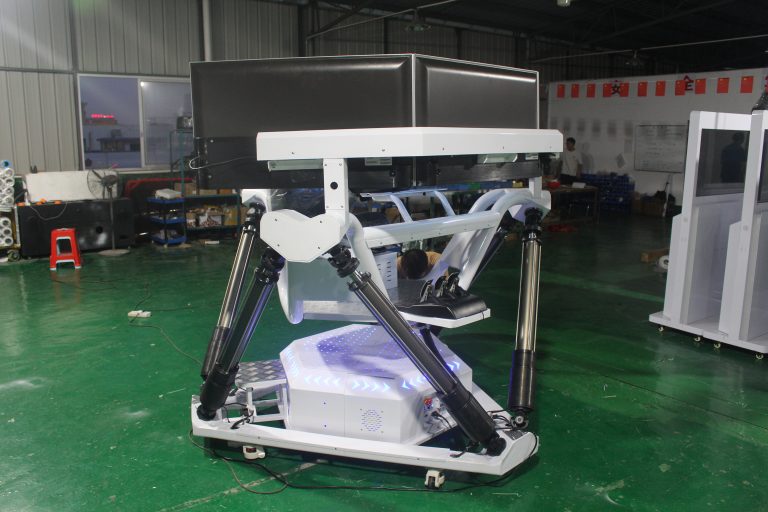
Technically defined, a 720° flight simulator is a motion device that, through a mechanical structure capable of continuous 360° rotation along both axes (lateral and longitudinal), combined with computer modeling and visual simulation, realistically reproduces aircraft flight attitudes such as pitch and roll on the ground. Its core value lies in providing, at a relatively controllable cost, a sense of “weightlessness” and “spatial disorientation” that surpasses conventional flat-screen simulation. When this technology is placed in different application scenarios, the role it plays is entirely different: in military camps, it is a “combat power multiplier” that shortens the pilot training cycle; in amusement parks, it is a “screaming machine” that attracts crowds; in exhibition halls, it is an “educational tool” that ignites the aviation dreams of young people. To understand the scenario map of 720° flight simulators, one must look not merely at equipment parameters, but at what real problems it solves in different industries.
Military and professional flight training is the most “weighty” application scenario for 720° flight simulators. This scenario has the highest requirements for precision and fidelity; its logic is not to pursue thrill, but to pursue “muscle memory” and “psychological adaptation.” The training of modern air force pilots faces practical constraints such as high training costs, tight airspace resources, and high risks in difficult and dangerous subjects. Front-loading certain training subjects onto simulators has become a consensus among air forces of various countries. China Youth Daily reported that a certain flight brigade used flight simulators to “precisely set up various aerial scenarios such as complex weather, emergency handling, and tactical coordination,” allowing trainees to hone their skills on the ground and thereby significantly shortening the growth cycle in actual aircraft training. The significance of 720° rotation capability here lies in its ability to simulate unconventional attitudes such as rolling and inverted flight that occur during aerial combat maneuvering or extreme maneuvers. For example, when simulating close-range air combat or low-altitude penetration, pilots need to overcome severe spatial disorientation, and only a platform with full-directional rotation capability can allow pilots to repeatedly experience and adapt to that dizzying physiological impact in a safe ground environment. Xinhua Net once reported on a VR-720 simulated flight cockpit where participants not only had to deal with “enemy forces” but also had to overcome “the various discomforts brought by weightlessness and rotation.” This advance adaptation to physiological limits is precisely the part of actual aircraft training that is highest in risk and most difficult to practice repeatedly. In addition, professional simulators support multi-aircraft networking, allowing pilots to conduct collaborative training and simulated air combat, upgrading mere individual operation to tactical coordination drills. However, it should be noted that military-grade 720° simulators are often deeply coupled with VR visuals, six-degree-of-freedom platforms, and even professional flight simulation engines; their cost is not in the same league as simple entertainment equipment. What they solve is the problem of “training cost-effectiveness,” not the problem of “entertainment experience.”
Entertainment and theme amusement is the most commercially mature and widely accessible scenario for 720° flight simulators. In this scenario, the core metrics of the equipment shift from “fidelity” to “thrill” and “throughput rate.” Amusement parks, theme parks, esports venues, and even high-end clubs purchase such equipment for a very direct purpose: to create queuing effects. The visual and physical impact brought by 720° dual-axis rotation is far beyond what ordinary cinemas or racing simulators can match. When the cockpit completes a roll or dive together with the fighter jet on screen, the weightlessness and inversion experienced are genuinely occurring, and this physiological stimulation is difficult to replace with a flat screen. Some manufacturers explicitly list in their product descriptions that their applicable scope includes “various indoor amusement parks, theme parks, resort attractions, racing clubs, KTVs, game arcades, large cinemas, auto shows, aviation exhibitions,” and so on. This shows that the implementation forms of 720° flight simulators in entertainment scenarios are very flexible: they can serve as an independent paid attraction in a large theme park, or as an interactive installation at an auto show or aviation exhibition to attract foot traffic. From a business logic perspective, 720° simulators in entertainment scenarios often cannot and need not achieve the precision of professional training, but they must be sufficiently “photogenic” and “shareable”—in the age of social media, the image of an experiencer hanging upside down in a cockpit is itself the best advertisement. Therefore, the iteration direction of equipment in this scenario focuses more on exterior design, comfort of safety protection (such as adjustable protective seats and seat belts), and the update speed of software content, rather than the accuracy of aerodynamic models.
Aviation popular science and educational research constitute the third major scenario for 720° flight simulators, whose value lies in “enlightenment” rather than “training.” Science and technology museums, aerospace-themed exhibition halls, youth activity centers, and school science and innovation laboratories are the main destinations for such equipment. Unlike training scenarios that emphasize “correcting wrong actions,” the core goal of popular science scenarios is to “build interest” and “eliminate unfamiliarity.” A child who has never been on an airplane may, through a 720° simulator experience of a roll, remember the meaning of the word “roll” far better than by reading ten display boards. At the 2016 National Science and Technology Week, the exhibited VR-720 simulated flight cockpit was positioned to let the public “participate in combat immersively” and feel the charm of aviation through experience. Some equipment manufacturers also explicitly list “aviation popular science education” as one of the product’s application fields, and emphasize that it can be used for “primary pilot training and selection.” This means that popular science scenarios sometimes also carry an early screening function: through low-cost experience, young people who have a talent for or strong interest in flying can surface. However, popular science scenarios have extremely high requirements for equipment durability and fault tolerance. Facing ordinary members of the public, especially young people, who lack operational experience, the equipment must limit rotation angles and acceleration at the software level and provide adequate protection at the hardware level, ensuring that “thrill” does not turn into “accident.” From this perspective, 720° simulators in popular science scenarios are more like a carefully packaged “experience can”: they strip away the complexity and danger of flight, leaving only the most intuitive sense of speed and space for people to sample.
An easily overlooked but growing scenario is the role of flight simulators as an “entrance to general aviation consumption” and a “carrier of aviation culture.” Against the backdrop of the gradual opening of general aviation, consumer-level markets such as flight experiences and flight training are developing. Although 720° simulators cannot replace actual aircraft flight instruction, they can serve as a low-cost pre-experience product, appearing in flight clubs, general aviation airport terminals, or aviation camps. Before potential customers actually sit in a cockpit, establishing a preliminary understanding of flight operations through a simulator can effectively reduce the communication costs and psychological barriers of subsequent actual flight experiences. At the same time, at commercial events such as auto shows, aviation exhibitions, and brand launch events, 720° flight simulators are often used as a visual symbol of “technological feel”—what organizers value may not be how much it resembles an airplane, but that it is sufficiently “futuristic” and eye-catching. Research has pointed out that the development of flight simulator equipment has long focused solely on pilot training, while neglecting potential markets such as amusement park leisure, incentive flights for new flight crews, and passenger experience in advanced air mobility. This precisely shows that 720° flight simulators still have considerable room for scenario exploration in the “third space” beyond training and entertainment—whether it be popular science education, commercial display, or pre-experience for general aviation consumption.
Taken together, the scenario map of 720° flight simulators presents a clear spectrum: at one end is military training pursuing extreme fidelity and tactical value; at the other end is entertainment and amusement pursuing peak thrill and commercial return; and in between are scattered multiple variants of popular science education, commercial display, and consumer-level experience. The same rotation technology is used in military camps to forge combat power, in shopping malls to exchange for tickets, and in science museums to sow curiosity. Different scenarios determine entirely different trade-offs among precision, safety, content, and cost. Understanding this means that, for equipment manufacturers, one product cannot conquer all markets; and for purchasers, it means they must first figure out: are you buying a training tool, an entertainment device, or an educational installation? The answer differs, and so should the expectations of the three words “720°.”
RELATED POSTS
Experience of Basic Operation Skills of Automobile Driving Simulator
Comprehensive Practical Guide to Operating a VR Device Experience Center
How Big is the Market for Basic Racing Simulators?
Analysis on the Multi-dimensional Applications and Industrial Value of Six-axis Racing Simulators
A Thrilling Immersive Experience – The Fatal Attraction of Horror Scenes in VR Experience Stores