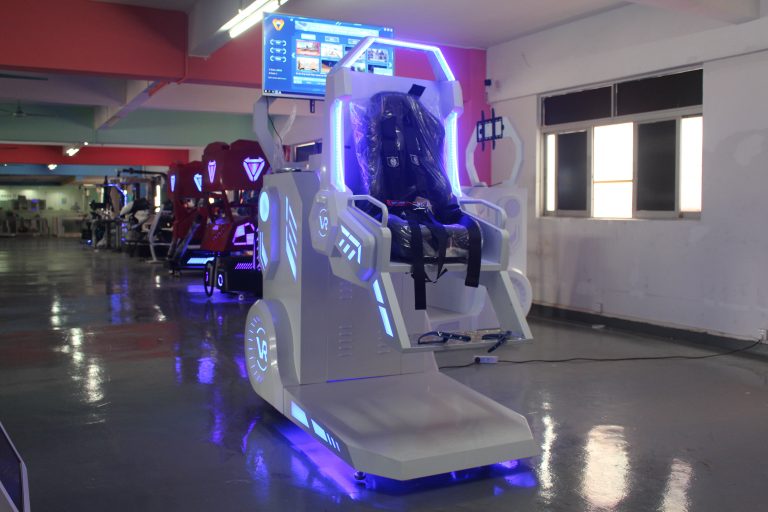
Profitability Pathways for VR Full-Sensory Cinema Large-Space Simulators
VR full-sensory cinema large-space simulators (hereafter “full-sensory large-space”) went through a turning point from technical validation to commercial expansion in 2025–2026. The industry’s focus has shifted from “can it be built” to “how to make money and whether it can be sustained.” As of September 2025, the number of large-space VR offline venues in China exceeded 1,000, with some venues achieving annual single-point revenue of 2–10 million yuan, surpassing the box office of a single traditional cinema hall at the same location. Yet another set of data is equally worth heeding: nearly 30% of venues have fallen into operational difficulties due to a lack of content, with a single profit model being one of the core causes. This means that the profitability of full-sensory large-space is not a simple business of “open the doors and collect money,” but a revenue structure that requires layered design and meticulous operation.
The following breaks down the actual profitability pathways of this business format across three levels: direct revenue, indirect revenue, and structural revenue.
I. Direct Revenue: Ticketing and Session Economics
The most intuitive source of profit for full-sensory large-space is ticketing. But unlike traditional cinemas or VR egg chairs, its revenue model is built on “spatial throughput efficiency.”
Per-session pricing and turnover rate. Currently, full-sensory large-space experiences on the market typically last 25–45 minutes, with per-customer prices ranging from a few dozen yuan to over 200 yuan. Taking data disclosed by Longcheng VR as an example, a certain scenic-area store charges 69 yuan per ticket and adopts a rolling-session operating model (12–24 people per session, 8–10 minutes between sessions). It received nearly 6,000 visitors in its first month and exceeded 10,000 in the second, recovering its fixed investment in a month and a half. The key to this model is that full-sensory large-space does not “sell seats” but “sells sessions.” Within a limited physical space, by shortening inter-session intervals and raising the per-session capacity ceiling, the efficiency per square meter is pushed to several times that of a traditional cinema hall. Leading projects can achieve efficiency of 3,000 to 20,000 yuan per square meter per year—a huge gap, with operational efficiency being the dividing line.
Layered pricing strategy. Mature operators do not price all time slots uniformly. Weekday daytime is aimed at study-tour groups and corporate team-building with bulk discounts; weekends and holidays are priced at full rate; nighttime slots can be bundled into “VR + dining” or “VR + nearby night tours” combo tickets. Some projects also offer two tiers—an “experience ticket” of about 20 minutes and an “in-depth ticket” of 40+ minutes with a full storyline—to serve customer groups with different willingness to pay. This layering is not simple price discrimination but the maximization of the same space’s value across different time slots.
The bottleneck of repurchase and how to break it. The natural ceiling of ticketing revenue lies in the repurchase rate. Industry data shows that the repurchase rate of ordinary large-space projects is not ideal; many users do not return after one experience, because content updates are slow and themes are homogeneous. Disruptors such as “Shunxi Universe” have achieved a repurchase rate exceeding 30% through self-developed IP and lightweight deployment. The logic is: the speed of content iteration determines repurchase frequency, while the hardware of full-sensory large-space can be reused, with marginal costs concentrated on the content side. When the content update cycle is compressed from half a year to two or three months, the same set of equipment can continuously generate new revenue.
II. Indirect Revenue: Spillover Effects Brought by Scenario Binding
The physical attributes of full-sensory large-space determine that it is not an isolated business. It is embedded in shopping malls, scenic areas, and cultural districts, and its revenue sources therefore go beyond tickets.
Linked consumption in cultural tourism scenarios. Among large-space VR projects, historical and cultural themes account for the highest proportion, about 38%. Such content has a natural binding relationship with scenic areas, museums, and cultural landmarks. Taking “The Mysterious Western Xia Tombs” as an example, about 30% of experiencers expressed an intention to visit the Western Xia Tombs scenic area in person after the experience. For scenic-area operators, full-sensory large-space plays the role of “pre-experience” and “emotional priming”: tourists are first moved by the story here, then walk into the real scene to consume. Conversely, scenic areas can also package the full-sensory experience as part of a ticket bundle to raise the per-customer spend. Shanghai Zhangyuan’s VR music film “Yao Ah Yao · 1995” attracted nearly 10,000 experiencers in 10 days, and many tourists generated secondary consumption in Zhangyuan and surrounding shops after the experience. Although this spillover effect is not directly recorded in the large-space venue’s books, it constitutes an important bargaining chip for negotiating rent sharing with venue owners and obtaining policy support.
The traffic-attraction value of mall scenarios. Shopping malls bring in full-sensory large-space not only for rent but also for its pull on dwell time. Data shows that commercial complexes containing cinemas, theaters, and sports venues see consumer dwell times 2.5 times that of pure retail projects. As a link in the experience-format chain, full-sensory large-space helps malls extend customer dwell time, thereby driving connected consumption in dining and retail. Therefore, some malls are willing to attract quality projects with below-market rents or even rent-free periods. But there is a trap to guard against: industry experts point out that many shopping malls recruit large-space projects essentially to “fill commercial real estate vacancies,” and once the free period ends, project operators may face closure and relocation. Mistaking a mall’s traffic-attraction value for one’s own profitability is one of the reasons many projects fail.
III. Structural Revenue: From “Doing Projects” to “Building Assets”
If one only focuses on tickets and venues, full-sensory large-space will ultimately remain a labor-intensive offline business. What truly widens the profitability gap is whether one-time project revenue can be converted into reusable content assets and brand assets.
Content licensing and revenue sharing. In the early days, the industry was dominated by project-based development: the producer delivers a set of content and charges a one-time development fee, with profits constantly eroded by payment cycles and rework. The mature path is migrating toward “content assetization”: the same set of VR content can be licensed to operators in different cities and scenarios, with the producer charging licensing fees or sharing box office revenue. Analysys analysis points out that the share of revenue sharing and IP derivative income in the revenue structure is continuously rising. This means that teams with sustained content production capacity will see their profitability curve rise as the licensing network expands, rather than relying on single-store foot traffic.
Chainization and supply chain integration. Scaling up is the most direct way to dilute costs. Daqian Mijing, with its “large-scale chain + supply chain integration” model, has achieved a volume of 350+ stores and 5,900 headsets. Centralized procurement lowers per-store equipment costs, standardized operating manuals lower staff training costs, and a unified ticketing system lowers customer acquisition costs. For single-store investors, although joining such a system requires paying brand fees, supply chain advantages and content update guarantees may actually shorten the payback period. Immersive World disclosed a single-store payback period of 8–12 months, a mid-range level in the industry that can serve as a reference.
IP derivatives and cross-format integration. The content IP of full-sensory large-space has the potential to extend into other formats. A successful VR narrative can spin off into physical escape rooms, scripted murder mystery games, merchandise, and even film adaptation. Sandbox VR’s path is more instructive: based on a global content platform, it accumulates user data through chain venues, then obtains licensing revenue through external IP collaborations, with global box office exceeding $200 million. Domestic projects such as the “Luoyang” full-sensory theater, relying on iQIYI’s film and television IP ecosystem, have seen revenue from its 40+ stores account for 38% of iQIYI’s related segment. The essence of this model is: VR experience is not the endpoint but a link in the IP value monetization chain.
Policy and subsidy income. A structural revenue source that cannot be ignored comes from the policy side. Large-space VR has been included in the support scope for cultural tourism digitalization and immersive experience formats in many places. Shanghai explicitly integrates technologies such as large models and the metaverse in its three-year action plan for high-quality tourism development. Some cultural tourism projects adopt a “resource and revenue sharing” model, where the venue party contributes space, decoration, and equipment and takes 75% of ticketing revenue, while the technology party contributes IP licensing and content as equity and takes 25%. For the technology party, this model shifts upfront investment pressure to the venue party and allows it to obtain long-term revenue sharing in a light-asset manner, making profitability more certain.
IV. The Overlooked Profitability Variable: Operational Capability
With the same equipment and the same content, different teams may see performance differ several-fold. Operational capability does not directly generate revenue line items, but it determines the actual conversion efficiency of all the revenue channels above.
Traffic acquisition efficiency. Platforms such as Douyin and Meituan have formed a standardized closed loop of “content seeding—online conversion—offline experience.” Operators who are good at short-video content and at designing photo-worthy spots can achieve significantly lower customer acquisition costs than peers. Conversely, stores that sit and wait for natural foot traffic can barely cover fixed costs on non-holidays.
Content iteration pace. Early industry projects were mostly custom-developed and difficult to replicate, leading to the predicament of “one piece of content lasting a year.” Today, leading operators treat content updates as fixed expenditure rather than project expenditure, rolling out new content on a quarterly basis. AI-assisted 3D modeling and scene generation have compressed development cycles from months to weeks, providing the technical conditions for continuous iteration.
Judgment in scenario selection. Leading scenic areas may receive thousands of visitors per day in peak season, but “massive tourist traffic is not necessarily your customers.” When choosing a location, one must distinguish “passing traffic” from “convertible traffic.” The conversion rate of VR experience venues near cinemas and arcades is 30%+ higher than that of ordinary locations, because the customer group there is already in a psychological state of “willing to pay for entertainment.”
Conclusion
The profitability of VR full-sensory cinema large-space simulators is not a question of “whether there is any” but a question of “at which layer to make money.” Ticketing is the survival line, scenario spillover is the amplifier, and content assetization and chainization are the true sources of profit. The industry remains highly fragmented, with CR10 below 20%, meaning the landscape is far from settled. For entrants, an honest question must be answered: are you building “a VR project to fill a vacant mall shop,” or are you accumulating a set of content and operational capabilities that can be monetized repeatedly? The ceiling of the former is the rent bill; the ceiling of the latter is the true imaginative space of this industry.
RELATED POSTS
Future Development Trends of Truck Cabin Driving Simulators
Multidimensional Skill Experience and Value Analysis of Professional Training on Automobile Driving Simulators
In-depth Application and Industrial Transformation of Driving Training Simulators in Driving Schools
All-Dimensional Immersive Racing Experience: In-Depth Analysis of Professional Sheet Metal Racing Simulator
Application Exploration and Practice of Car Simulators in Experience Halls