Technology Empowers Driving Training Innovation——In-depth Application and Development of Driving Simulators in Driving Schools
With the continuous increase in the number of motor vehicles in China, driving skills have transformed from an “optional skill” to an “essential ability”. While the driving training industry is developing on a large scale, it also faces many bottlenecks in the traditional teaching model: long waiting time for driving practice, high risk of on-road training, unbalanced teaching efficiency, and high costs of venues and energy consumption. These problems not only affect the learning experience of students but also restrict the high-quality development of driving schools. Against the background of the in-depth integration of intelligent transportation and artificial intelligence technologies, driving simulators, as new intelligent teaching equipment, have gradually entered major driving schools. With their advantages of safety, efficiency, economy and flexibility, they have reconstructed the driving training process, promoting the driving training industry from the traditional “mentorship” model to a new intelligent era of “technology-led, green and intelligent”, and becoming an important supporting force for the transformation and upgrading of driving schools.
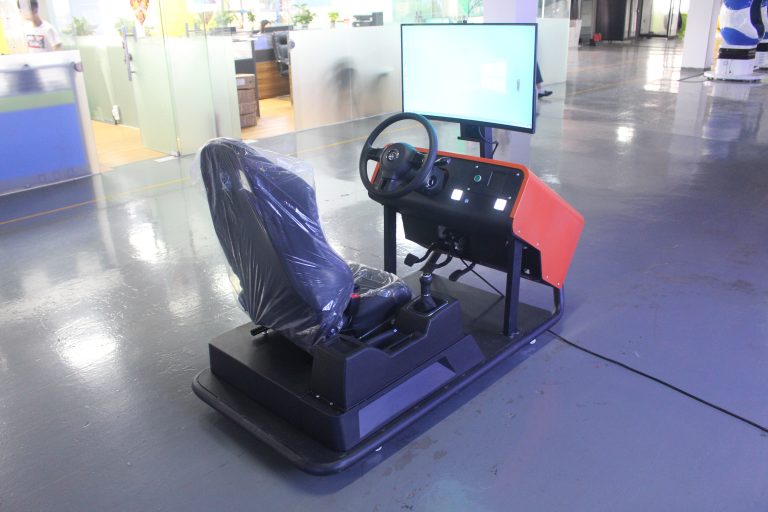
A driving simulator is not a simple “video game”, but a professional device that provides immersive driving training for students, based on technologies such as Virtual Reality (VR), multi-axis dynamic simulation, and high-precision physical engines, with the core of 1:1 restoration of real driving scenarios. Its core competitiveness stems from three advanced technical characteristics: first, immersive scene restoration technology. Through three-screen surround display, VR high-definition head-mounted displays and other equipment, combined with high-precision 3D modeling, it can 1:1 replicate real scenes such as urban roads, mountain bends, and examination venues. Some high-end equipment can achieve 2-centimeter-level precision in venue replication. At the same time, it can simulate complex weather such as heavy rain, ice and snow, and fog, as well as dangerous scenarios such as tire blowouts and sudden obstacles, filling the gap of high-risk scenarios that are difficult to cover in on-road training; second, precise operation feedback technology. The core components of the simulator, such as the steering wheel, accelerator, brake, and clutch, all adopt real vehicle accessories, combined with a six-axis motion platform and force feedback system, which can real-time simulate the physical feedback during vehicle acceleration, steering, and braking, ensuring that the operation feel is highly consistent with real driving and helping students quickly establish a sense of vehicle control; third, intelligent data analysis technology. The built-in AI teaching system can real-time record students’ operation data, generate personalized learning reports through big data analysis, accurately locate weak links, provide a basis for targeted guidance by coaches, and realize standardized teaching of “teaching students in accordance with their aptitude”.
Combined with the differences in driving schools’ teaching needs and budgets, the current driving simulators on the market are mainly divided into three categories, adapting to the development needs of driving schools of different scales. The basic fixed type has high cost performance, with a unit price of about 10,000-50,000 yuan, which can meet the entry-level needs of students such as gear operation, starting and stopping, and is suitable for batch purchase by small and medium-sized driving schools; the mid-range dynamic type is equipped with a six-degree-of-freedom motion platform and AI error correction system, with a unit price of about 50,000-150,000 yuan, supporting the full-process training of Subject 2 and Subject 3, which can automatically identify wrong operations and give voice prompts, making it the first choice for mainstream driving schools; the high-end immersive type integrates VR panoramic view, digital twin and other technologies, with a unit price of about 200,000-500,000 yuan, realizing 360° panoramic driving experience, mainly used in demonstration driving schools and large chain driving schools to enhance brand competitiveness. Up to now, the penetration rate of driving simulators in domestic driving schools is about 35%, among which the leading provinces such as Guangdong, Jiangsu and Zhejiang have reached 50%-70%, while the central and western regions are still in the initial stage of popularization, with significant room for sinking.
Today, the application of driving simulators has covered the entire process of driving school teaching, playing an irreplaceable role in many core scenarios and completely changing the pain points of traditional driving training. In the basic training link for new beginners, the simulator provides a zero-risk learning environment for zero-based students, effectively relieving their tension. Students who have just come into contact with driving can repeatedly practice basic operations such as holding the steering wheel, semi-linkage of the clutch, and gear shifting in a stress-free and scratch-free virtual environment. With the system’s progressive level-breaking mode and voice guidance, they can convert abstract driving skills into muscle memory, shorten the entry adaptation cycle, and enable students to have solid basic abilities before on-road training. A student from Chongyang County, Hubei Province once said: “I used to wait in line for an hour and practice driving for 5 minutes on the real vehicle. Now I can practice on the simulator at any time and correct mistakes repeatedly, which makes it much faster to get started.”
In the special intensive training for subjects, relying on the advantages of high scene restoration and repeatable training, the simulator has become a “weapon” to improve the passing rate of driving tests. The simulator has built-in full-process training modules for Subject 2 and Subject 3, which 1:1 restore the examination venue markings, test routes and evaluation standards. Students can independently choose difficult items such as reverse parking, side parking, and slope parking for repeated practice. After introducing intelligent simulators, the passing rate of Subject 2 and Subject 3 for students in Wuxi Xinyu Driving School has increased by about 15%; students in Yuhang Fangyuan Driving School accumulate experience in complex road conditions by simulating night driving, high-speed overtaking and other scenarios through the simulator, and the passing rate of Subject 2 has been increased to 90%. In addition, the simulator can accurately record every operation error of students, generate short videos of operation playback, make mistakes such as line pressing and flameout clear at a glance, and help students improve in a targeted manner.
Emergency training in complex scenarios is another major advantage of the simulator. In traditional on-road training, due to safety risks and venue restrictions, it is difficult to carry out targeted training for severe weather such as heavy rain, ice and snow, and fog, as well as dangerous scenarios such as tire blowouts and sudden obstacles, resulting in insufficient emergency handling capabilities of students after obtaining their driver’s licenses. However, the driving simulator can realize “one-click switching” of various complex scenarios, allowing students to practice emergency operations such as emergency braking and direction correction in a zero-risk environment, and strengthening their awareness of safe driving. The intelligent simulated driving classroom of Longyang District Yuchang Driving School can simulate scenarios such as rainy day skidding and mountain bends, helping students master driving skills under different road conditions; data shows that drivers who have undergone simulated emergency training have significantly reduced reaction speed and error rate on real roads, reducing the occurrence of traffic accidents from the source.
In addition to improving teaching effectiveness, driving simulators can also help driving schools reduce costs and increase efficiency, in line with the policy orientation of green driving training and intelligent driving training. Traditional on-road training consumes a lot of fuel, and the costs of vehicle wear and tear, venue occupation, and coach manpower are high. However, the simulator does not require fuel consumption, can reduce vehicle wear and tear and venue pressure, and the comprehensive training cost of a single driving school can be reduced by 30%-50%. At the same time, the simulator supports 24-hour operation, allowing students to flexibly book training time, effectively solving the problem of “difficulty in waiting for driving practice”; coaches can guide multiple students at the same time through the computer terminal, and carry out targeted personalized guidance combined with the student data reports generated by the system, greatly improving teaching efficiency. After introducing the simulator, the pilot driving school in Zhenhai District, Ningbo City increased the monthly training capacity of a single vehicle by 10% and achieved “zero complaints”, which is well received by young college students and other groups.
Of course, the application of driving simulators in driving schools also faces some challenges: low-cost products have serious homogenization, and the durability of hardware and software update capabilities are uneven; the standards for class hour recognition and equipment access are not unified in some regions, affecting the purchasing willingness of driving schools; small and medium-sized driving schools have limited budgets and are more sensitive to the input-output ratio of equipment. However, with the continuous maturity of technology and the continuous advancement of policies, these problems are gradually being solved. In the future, with the in-depth integration of technologies such as VR/AR, AI large models, and digital twins, driving simulators will develop in a more immersive, intelligent and personalized direction: VR panoramic view will replace multi-screen display to achieve 360° panoramic driving experience; AI coaches will realize full-process guidance, danger prediction and automatic error correction; digital twin technology will 1:1 restore urban road networks and examination venues, making the training effect closer to real vehicles; at the same time, lightweight and home-use simulator products will be gradually popularized, forming a complete training closed loop of “virtual preview – driving school intensive training – on-road consolidation”.
From the traditional “mentorship” to intelligent “scientific training”, the application of driving simulators is not only an upgrade of driving training equipment but also an innovation of the concept of the driving training industry. It not only solves many pain points of traditional driving training, improves teaching quality and efficiency, but also conforms to the development trend of green low-carbon and intelligent transportation, injecting new momentum into the high-quality development of the driving training industry. With the advancement of policy compulsoriness and standard unification, driving simulators will change from “optional equipment” to “standard equipment” for driving schools, continuously promoting the transformation of the driving training industry towards standardization, intelligence and greenization, and delivering more qualified and safe drivers to the society.
RELATED POSTS
Diversified Application Scenarios and Practical Value Analysis of Simple Car Driving Simulators
Technology Empowers Training, Precisely Forges Capabilities – A Detailed Explanation of the Military and Special Vehicle Driving Simulator Training System
Comprehensive Operation Plan for Immersive Large-Space VR Experience Hall
Six-Axis Dynamic Attitude Simulation Technology: Redefining New Experiences of UAV Aerial Photography and eVTOL Flight Simulation
Driving Simulators Unveiled: The Ultimate Co-Pilot for Driver Training