In‑depth Analysis of Application Scenarios of VR Electric‑Scooter Simulator
Abstract: With the continuous growth in the ownership of electric two‑wheelers, frequent traffic accidents involving these vehicles have become a prominent challenge for urban traffic safety governance. Traditional publicity‑and‑education approaches such as poster displays, video playback and classroom lectures suffer from weak immersion, poor knowledge retention and lack of hands‑on practice. They can hardly arouse public awareness of potential risks. The VR electric‑scooter simulator integrates virtual‑reality simulation technology, dynamic hardware platforms and real‑scooter operating mechanisms. It reproduces various dangerous riding scenarios from real‑world roads into virtual space. Under zero physical‑risk conditions, users can personally experience the consequences caused by non‑compliant riding, forming a complete learning loop of “behavior‑consequence‑reflection”. Balancing safety education, skill training, science‑popularization exhibition and commercial marketing values, the equipment is widely deployed in traffic‑police public‑education institutions, campus education, community governance, enterprise training, science museums, brand exhibition halls, cultural‑tourism events and many other scenarios. Centered on the core features of the VR electric‑scooter simulator, this paper comprehensively analyzes its diverse application scenarios, as well as the application value, implementation modes and practical significance under different contexts. The full text totals approximately 2 950 words.
Keywords: VR electric‑scooter simulator; traffic safety; virtual simulation; science‑popularization education; practical‑training application
1. Introduction
Thanks to its flexibility and low cost, electric two‑wheelers have become the mainstream short‑distance travel tool for urban and rural residents across China. The food‑delivery and courier industries also rely heavily on electric scooters for daily operations. Meanwhile, traffic violations including running red lights, reversing, failure to wear safety helmets, speeding, overloading passengers or goods, and travelling in bad weather or at night occur frequently. Collisions and roll‑over accidents remain at a high level, posing severe threats to people’s lives and property.
For a long time, traffic‑safety publicity has mainly relied on bulletin boards, short videos and offline lectures. Audiences receive knowledge passively. Their understanding of hazards such as red‑light violations, “sudden‑pedestrian‑emergence” risks and large‑vehicle blind zones stays at a textual level. They rarely perceive the impact at the moment of an accident, and fluke mindsets are hard to eliminate. Hence, educational outcomes are limited.
The VR electric‑scooter simulator emerges as a practical solution. It adopts a real‑electric‑scooter body as the operation carrier, paired with a VR head‑mounted display, dynamic motion platform and high‑precision sensors. Throttle, brake and steering operations are fully reproduced. The system simulates numerous virtual environments including urban intersections, rural roads, slippery rainy‑day pavements, night‑time passages and construction zones. High‑frequency accident scenarios such as reverse riding, red‑light running, helmet‑free riding, “door‑opening‑kill” incidents, inner‑wheel‑difference hazards of large vehicles and sudden pedestrian intrusions can be reproduced. Users experience the whole accident process from a first‑person perspective. Vibration, tilting and sound‑effect feedback deliver strong sensory shock. Abstract traffic regulations are transformed into immersive memories, fostering genuine respect for traffic rules and correcting dangerous riding habits at root.
Different from entertainment‑oriented VR devices, the VR electric‑scooter simulator integrates educational and practical‑training attributes. It adapts to sites of varying scales, ranging from mobile community‑publicity spots to large‑scale traffic‑safety‑experience halls covering thousands of square meters. As local authorities promote technology‑driven, scenario‑based traffic‑safety publicity, the VR electric‑scooter simulator has become mainstream hardware for public‑safety science‑popularization. It covers public safety, campus, enterprise, commercial and cultural‑tourism sectors with broad market potential.
2. Traffic‑Police Authorities & Traffic‑Safety Experience Halls: Core Positions for Public Legal Education
Traffic‑police departments, traffic‑safety‑education bases and rule‑of‑law science‑popularization museums represent the core deployment scenarios for VR electric‑scooter simulators. They undertake public‑wide traffic‑safety warning education and serve as key exhibition items for thematic events such as National Traffic‑Safety Day and Traffic‑Safety Publicity Month.
Traditional traffic‑safety outreach mostly relies on on‑road persuasion and leaflet distribution. Public participation is low, and information is quickly forgotten. Installing VR electric‑scooter simulators in traffic‑police service halls and traffic‑safety‑experience halls enables citizens and drivers to take part voluntarily. Wearing VR headsets, users simulate real‑world riding. When violations such as red‑light running, reverse riding or helmet‑free riding are committed, collision or roll‑over scenarios are triggered. The dynamic platform generates tilting and vibration feedback to restore the impact and weightlessness of real accidents. Together with sound‑effect rendering, the equipment delivers far stronger warning effects than ordinary video education.
In museum‑style deployment, three modes are available: free‑riding mode, accident‑case teaching mode and assessment‑quiz mode. After the simulation, the system replays accident processes, analyzes inducements and displays relevant traffic‑regulatory provisions. Follow‑up quizzes assess learning outcomes and form a complete educational chain: “experience‑review‑study‑assessment”. Some venues customize content based on local real‑world electric‑scooter accident cases, reproducing typical local incidents in virtual environments to enhance targeted educational effects.
Moreover, the equipment supports mobile deployment with trolleys. It can be used for mobile public‑education campaigns in city squares and civic centers, breaking spatial restrictions of fixed venues and expanding traffic‑safety‑science‑popularization coverage. It disseminates safe‑riding knowledge to audiences of all ages, supports urban road‑traffic comprehensive governance and helps reduce electric‑scooter‑related accident rates.
3. Campus‑Safety‑Education Scenarios: Building Youth Travel‑Safety Defenses
Primary and secondary schools plus vocational colleges constitute important application scenarios for VR electric‑scooter simulators, supporting campus‑traffic‑safety courses and campus‑safety‑experience‑hall construction for student‑oriented travel‑safety education.
Many teenagers ride electric scooters to and from school or travel as passengers. Some students have weak traffic‑safety awareness and engage in risky behaviors such as chasing while riding, jaywalking and overloading passengers. Verbal lectures in classrooms hardly build risk perception. By introducing VR electric‑scooter simulators into campus‑safety corners and traffic‑science‑popularization classrooms, boring traffic‑rule classes are transformed into immersive practical‑training sessions. Students wear VR gear and simulate riding on virtual roads surrounding campuses. They experience high‑frequency campus‑perimeter risks including sudden‑pedestrian emergence at school gates, intersection cutting‑in and skidding on rainy days, and intuitively understand hazards of non‑compliant riding, thus establishing safe‑riding awareness from an early age.
For primary‑ and secondary‑school students, scenario difficulty can be simplified, focusing on basic knowledge such as helmet‑wearing, zebra‑crossing yielding and rejecting reverse riding. For secondary‑vocational and higher‑vocational students, advanced training contents covering night‑time riding, complex‑intersection risk‑avoidance and large‑vehicle‑blind‑zone recognition are available. Schools may integrate VR experience into theme class meetings and safety‑education weeks, organizing class‑by‑class rotations. Traffic‑safety experience competitions can also be held to consolidate travel‑safety knowledge through interactive participation.
Flexible equipment selection is supported. Space‑limited schools may adopt compact static versions placed in activity rooms. Well‑resourced schools can build full‑scale campus‑safety‑experience halls equipped with VR fire‑safety and anti‑bullying modules, forming integrated campus‑safety‑training spaces to improve students’ comprehensive safety literacy.
4. Community‑Street Science‑Popularization Scenarios: Promoting Safe Travel for Middle‑Aged and Elderly Residents
Community party‑and‑mass service centers and new‑era civilization‑practice stations act as front‑line positions for grassroots safety publicity. Community residents, especially middle‑aged and elderly groups, belong to high‑risk populations for electric‑scooter accidents. Many senior riders have slowed reflexes and outdated traffic knowledge. Violations including red‑light running, jaywalking and failure to turn on lights at night are common. Posting posters rarely generates effective warnings for elderly citizens.
Setting up VR electric‑scooter‑simulator experience stations in communities enables residents to take part in batches during community‑safety lectures and neighborhood events. Middle‑aged and elderly users witness injury consequences caused by reverse riding or helmet‑absent collisions from a first‑person perspective. They truly understand the protective function of safety helmets and correct long‑term bad riding habits. Instead of pure verbal preaching, community workers carry out regular science‑popularization with experiential equipment, making safe‑travel concepts more acceptable for residents.
Compact‑sized simulators can be permanently placed in community‑service centers or transported to residential‑compound squares for mobile activities. During National Traffic‑Safety Day and Work‑Safety Month, themed experience events attract public participation, foster a community‑wide safe‑travel atmosphere, support grassroots safe‑community construction and lift overall residents’ travel‑safety standards.
5. Enterprise Practical‑Training Scenarios: Special Safety Training for Food‑Delivery and Courier Riders
Employees in food‑delivery, courier and intra‑city‑logistics enterprises rely heavily on electric scooters for daily work. Riders shuttle through urban roads for tight delivery schedules. Speeding, reverse riding and red‑light running are common industry phenomena with extremely high accident risks. Traditional corporate safety training mostly consists of meetings and accident‑video watching. Riders show low willingness to participate; training becomes formalistic and hardly changes bad riding habits. Once traffic accidents occur, enterprises bear corresponding liabilities.
VR electric‑scooter simulators serve as important in‑house safety‑training tools for new‑staff induction education and regular retraining for existing employees. Riders simulate delivery‑related riding in virtual environments and experience accident consequences caused by rushing through red lights, random lane‑changing and phone‑distracted order‑receiving. The system reproduces high‑frequency emergency road conditions encountered by delivery riders: pedestrians darting out from intersections, car‑door‑opening hazards and large‑vehicle blind zones. It trains riders’ risk prediction and emergency‑evasion capabilities.
Enterprises may make VR‑simulation experience a mandatory pre‑job requirement; employees can start working only after passing simulated‑riding assessments. Background software records each rider’s operation data, counts violations and generates training reports. Managers can identify staff‑specific bad riding behaviors and arrange targeted re‑education. Safety training evolves from paper‑based learning to practical‑simulation drills, effectively reducing traffic‑accident risks for employees during commuting and operations, mitigating corporate safety‑management risks and achieving work‑safety‑management objectives.
Beyond delivery industries, factories and parks can deploy simulators for general‑staff commuting‑safety education, popularizing electric‑scooter‑safety knowledge for all employees.
6. Electric‑Scooter Brand Stores & Exhibition Halls: Immersive‑Marketing Carriers
Beyond educational values, VR electric‑scooter simulators deliver commercial‑display benefits. They are widely used in electric‑scooter brand exhibition halls, retail stores and industry expos as value‑added experience projects combining product demonstration and safety science‑popularization.
In traditional retail scenarios, consumers can only view vehicles statically or take short real‑road test rides. They hardly perceive vehicle performance under complex road conditions. Deploying VR electric‑scooter simulators in stores enables embedding of 3D models of proprietary‑brand vehicles, reproducing virtual riding under diverse road surfaces and weather conditions. Customers can experience riding on urban roads, ramps and slippery pavements without real‑road test‑driving and feel vehicle‑handling performance. Meanwhile, safety‑science‑popularization is conducted to educate buyers on helmet‑wearing norms, standardized riding and battery‑safe usage. It conveys brand safety concepts, improves consumer recognition and builds differentiated competitive advantages for retail outlets.
At industry expos and trade fairs, the highly‑interactive VR electric‑scooter simulator attracts crowds, serving as a traffic highlight for booths. It boosts brand exposure and achieves dual goals of product demonstration and user education.
7. Cultural‑Tourism Science‑Popularization Venues & Commercial VR Experience Centers: Integration of Science‑Popularization and Entertainment
Science‑and‑technology museums, museums, urban‑planning halls, cultural‑tourism scenic spots and commercial VR experience centers constitute another key application domain, merging science‑popularization education and recreational experience.
Urban science‑and‑technology museums place VR electric‑scooter simulators as key exhibits within traffic‑science‑popularization zones, providing inclusive traffic‑safety education for visitors. Tourists acquire traffic‑safety knowledge through hands‑on experience during visits, realizing education via entertainment. Some cultural‑tourism scenic spots and research‑study bases integrate simulators into research‑study programs for primary‑ and secondary‑school student groups, enriching research‑study curricula.
Commercial VR experience centers and amusement parks open the equipment to general consumers. Traffic‑safety knowledge is packaged as immersive interactive projects. Distinct from pure‑game entertainment devices, it balances fun and educational significance and suits parent‑child participation. Parents and children simulate riding together and learn travel‑safety knowledge in recreational contexts, expanding project portfolios for commercial venues.
8. Driving‑Schools & Vocational‑Training Institutions: Supplementary Teaching for Non‑Motor‑Vehicle Safety
Current driving‑school curricula focus largely on motor‑vehicle training. Standardized teaching for high‑frequency non‑motor‑vehicles such as electric scooters is scarce. Many motor‑vehicle‑license holders also ride electric scooters, yet electric‑scooter‑safety content is absent from motor‑vehicle‑driver training.
Driving‑schools may introduce VR electric‑scooter simulators as supplementary teaching modules for motor‑vehicle trainees. While learning car‑driving, students experience electric‑scooter‑riding risks, understand various road hazards in mixed‑traffic scenarios and grasp large‑vehicle‑blind‑zone risks and non‑motor‑vehicle cutting‑in behaviors. They develop holistic road‑safety thinking for motor‑vehicle drivers to actively yield to electric‑scooter riders, reducing collisions between motor‑vehicles and non‑motor‑vehicles. Furthermore, special practical training can be provided for novice electric‑scooter users to familiarize them with handling and road hazards through virtual drills and lower real‑road‑riding risks, filling gaps in non‑motor‑vehicle teaching within traditional driver‑training systems.
9. Application‑Value Summary & Development Outlook for VR Electric‑Scooter Simulators
As demonstrated by multi‑scenario practices, the VR electric‑scooter simulator is more than entertainment hardware; it forms a complete virtual‑simulation solution for traffic‑safety education. Compared with conventional publicity‑and‑education means, it possesses irreplaceable strengths:
First, high safety: all dangerous scenarios are reproduced in virtual environments without physical harm to users.
Second, strong immersion: first‑person sensory shock delivers far‑better knowledge retention than videos or posters.
Third, repeatable scenarios: high‑risk conditions such as rainy weather, night‑time travel and crash incidents that can hardly be rehearsed in reality can be simulated infinitely.
Fourth, flexible deployment: adaptable to venues of different sizes, supporting both fixed‑venue installation and mobile outreach.
Fifth, customizable content: local accident cases and exclusive training scenarios can be tailored for different industries and regions to meet educational targets for diverse audiences.
Nevertheless, attention should be paid during practical deployment. As auxiliary educational tools, VR simulators cannot fully replace real‑road practice. Virtual‑simulation experience must be combined with real‑world traffic‑safety guidance to translate virtual‑training knowledge into real‑travel habits. Hardware and software should be iterated continuously to add new accident scenarios matching emerging urban‑road risks and sustain educational effectiveness.
With increasing national emphasis on road‑traffic safety, technology‑empowered immersive safety‑education modes will gain wider adoption. Spanning public safety, campus education, enterprise training and commercial‑cultural‑tourism sectors, VR electric‑scooter simulators keep expanding application boundaries. They apply VR‑simulation technologies to serve social livelihoods, foster safe‑riding mindsets among the public, reduce electric‑scooter‑related accidents at source and safeguard people’s travel‑related lives and property, delivering remarkable social value and promising market prospects.
RELATED POSTS
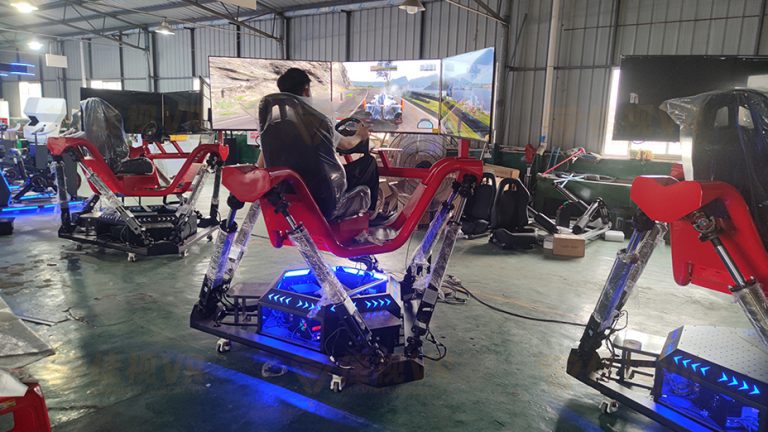
The Advantages of a Six-Axis Motion Car Simulator Platform
Navigating the Virtual Tang Realm: Development Trends of Strange Tales of the Tang Dynasty VR Large-Space Experience
A New Benchmark in Immersive Racing: Versatile Functions and Application Values of Three-Screen Six-Axis Racing Simulator
Experience of Basic Operation Skills of Automobile Driving Simulator
Application and Industrial Value Analysis of VR Full‑Sensation Large‑Space Cinema