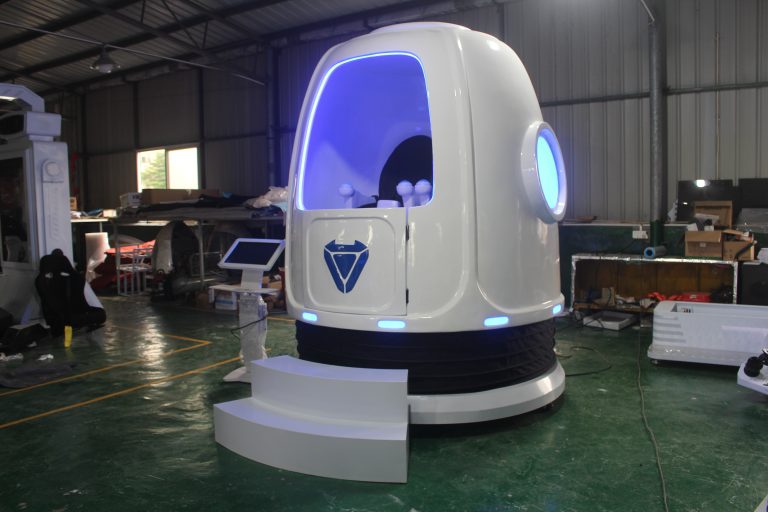
The Future Development Trend of 4-DOF Motion Simulators
Introduction
Multi-degree-of-freedom motion simulators serve as core hardware carriers for virtual reality, simulation training and intelligent testing. According to motion degrees of freedom, they are divided into 3-axis, 4-axis, 6-axis and other product forms. Among them, the 4-DOF motion simulator features four basic motion dimensions: pitch, roll, heave and longitudinal translation. Balancing simulation fidelity, equipment cost, floor space and operation & maintenance difficulty, it boasts a unique product positioning different from high-end 6-DOF simulators and simple 3-DOF equipment, making it the mainstream device with the highest popularity and strongest growth potential in the current mid-range simulation market.
Compared with 6-DOF platforms, the 4-DOF simulator eliminates the independent yaw mechanism, reducing the mechanical structure by over 40%. Its procurement and operation & maintenance costs are only one-third of those of 6-DOF simulators, and no special reinforced foundation is required, suiting scenarios with limited space and moderate budgets such as driving schools, cultural tourism venues, campus science popularization halls and R&D laboratories of small and medium-sized enterprises. When matched against 3-DOF equipment, the 4-DOF simulator adds an independent longitudinal translation axis, which can accurately restore core driving sensations including nosedive during braking, nose-up under acceleration and longitudinal road bumps, lifting simulation fidelity by more than 50%. It perfectly balances cost performance and immersive experience.
At present, the domestic simulation equipment market scale has exceeded 100 billion yuan with a steady annual compound growth rate of over 12%. Relying on its inclusive advantages, 4-DOF motion simulators account for more than 70% of the mid-range motion equipment market share, widely applied in five major sectors: motor vehicle driving training, commercial VR experience, public safety science popularization, simulation testing for small and medium-sized vehicle manufacturers, and special operation training. Driven by rapid iterations of technologies including generative AI, digital twin, domestic servo electronic control, 5G cloud collaboration and unattended self-service operation, as well as multiple demand catalysts such as the digital transformation of driving training policies, the upgrading of immersive cultural tourism consumption, mandatory training for work safety and lightweight testing of intelligent connected vehicles, the decade from 2026 to 2035 will become a golden era featuring technological innovation, market penetration and business model restructuring for the 4-DOF motion simulator industry. This paper systematically analyzes the long-term development trends of 4-DOF motion simulators from seven dimensions: hardware technology iteration, software intelligent upgrading, expansion of segmented markets, innovation of product forms, transformation of business models, construction of industrial standardization and industrial competition pattern, with a full text of approximately 3,000 words.
I. Hardware Technology: In-depth Upgrading of Lightweight Design, High Precision, Full Localization and Multi-modal Interaction
Hardware forms the underlying foundation for the simulation capability of 4-DOF motion simulators. The core logic of hardware upgrading over the next decade is to narrow the sensory gap with 6-DOF simulators, cut the full-life-cycle cost and adapt to flexible deployment across various scenarios, with continuous iterations centered on three modules: motion platform, core components and human-computer interaction.
(1) Extreme Optimization of Motion Platform Performance for Greatly Improved Dynamic Response and Sensory Fidelity
The dynamic response delay of mainstream 4-DOF motion simulators on the market currently ranges from 15 to 20ms, with insufficient synchronization of composite motions. Prolonged use tends to cause motion sickness, while the reproduction of subtle road bumps, emergency braking, side slipping and other working conditions remains rough, which constitutes the core shortcoming restricting the upper limit of user experience. Future hardware R&D will focus on three major breakthroughs:
First, dual optimization of servo drive and motion algorithms. Equipped with domestically manufactured high-precision servo motors and low-backlash planetary reducers, paired with self-developed dual-core control systems based on EtherCAT real-time bus, the dynamic response delay of the complete machine will be compressed to within 5ms, and the synchronization error of four-axis composite motions will be controlled at the 0.2ms level. A new generation of adaptive washout algorithms will be upgraded to dynamically adjust motion amplitude according to human vestibular perception thresholds, significantly alleviating motion sickness caused by mismatched vision and physical sensation and supporting continuous training or commercial experience for more than 2 hours. Motion spectra will be specially optimized for driving scenarios to accurately reproduce refined working conditions including gravel roads, water-slipping sideslip, high-speed crosswind and heavy-duty truck braking nosedive, bringing sensory delicacy infinitely close to entry-level 6-DOF simulators and making up for the core experience shortboard of mid-range simulation equipment.
Second, lightweight modular structural design. High-strength integrated aluminum alloy frames will replace traditional heavy steel structures, cutting the self-weight of the complete machine by 30% and floor space by 25%. A single unit can fit into narrow spaces within 10 square meters. Standardized modular splitting will be implemented, with independent modular assembly for motion platforms, cockpits, electric control cabinets and display systems. A single operator can complete equipment disassembly, transportation and maintenance without large hoisting equipment, adapting to flexible deployment scenarios such as stores, exhibition halls and mobile touring exhibitions. Sealed maintenance-free bearings will be adopted for mechanical joints, slashing annual equipment maintenance working hours by 60% and solving the pain point of cumbersome maintenance for traditional motion equipment.
Third, full configuration of the full-domain haptic feedback system. Breaking away from the limitation of single seat vibration, all models will be equipped with piezoelectric multi-stage vibration cushions, force-feedback steering wheels/clutch and brake pedals, vehicle crosswind vibration modules and safety belt impact feedback. High-end models will expand full-body haptic vests and plantar road vibration modules to realize four-dimensional synchronous immersion integrating vision, audition, motion and haptics, fully restoring multi-level physical perceptions such as collision impact, tire blowout vibration and bumpy undulation to deepen training memory.
(2) Full Localization of Core Components to Eliminate Import Dependence and Sustain Cost Reduction
In the past, core components such as high-precision servo motors, inertial IMU sensors, real-time motion control mainboards and force-feedback actuators relied heavily on overseas brands, pushing up the overall machine cost and after-sales consumable expenses. Driven by the policy of independentization of high-end equipment under Made in China 2025, the domestic industrial chain of servo, industrial control and sensors has matured rapidly. Within the next three years, the self-sufficiency rate of core components for 4-DOF motion simulators will exceed 75%.
Domestic substitution will bring two major industrial transformations: first, the ex-factory price of complete machines will keep declining, with the procurement cost of models with identical configurations reduced by 20%-40%, greatly lowering the procurement threshold for small and medium-sized driving schools, county-level science popularization halls and small and medium-sized experience halls. Second, standardized universal components will enable compatible interchange of motion axes, sensors and electric control mainboards from different manufacturers, broadening the procurement channels for consumables and cutting the price of maintenance accessories by 50%, thus greatly extending the profit cycle of equipment. Meanwhile, local manufacturers can quickly provide customized hardware adjustments to rapidly modify load, stroke and motion angles for segmented scenarios such as heavy trucks, engineering vehicles and earthquake science popularization, halving the delivery cycle compared with models equipped with imported components.
(3) Free Switching of Dual Visual Schemes and Comprehensive Popularization of XR-integrated Visual Systems
Vision serves as the core entry for immersive simulation. Future 4-DOF motion simulators will uniformly adopt a dual visual architecture of “VR head-mounted display + multi-screen surround display” with one-click switching to adapt to different usage scenarios. For unattended commercial experience halls and single-person training scenarios, lightweight short-focus VR devices will be matched, integrated with eye tracking and foveated rendering technologies to dynamically allocate computing power according to human eye focus, reducing hardware computing power demand while ensuring high-definition images and extending the continuous operation duration of equipment. For group teaching in driving schools, centralized safety training for enterprises and group visits in exhibition halls, three-screen or four-screen curved surround displays will be equipped with no threshold for wearing devices, suitable for rapid experience rotation among multiple people. In the medium and long term, XR mixed reality technologies will be gradually introduced to superimpose virtual road conditions onto real cockpit entities, further blurring the boundary between virtuality and reality and improving the transfer effect of driving training practical operations.
II. Software System: Restructuring Core Simulation Capabilities via AI Large Models, Digital Twins and Cloud Platforms
If hardware determines the lower limit of simulation, software algorithms define the upper limit of equipment value. The industrial competition focus of 4-DOF motion simulators will shift from mechanical hardware to software ecosystems in the future. Three technologies including generative AI, digital twin closed-loop virtual-real integration and cloud SaaS management platforms will reshape the software architecture to realize intelligent simulation scenarios, assetized data and remote operation.
(1) AIGC Large Models Empower Simulation Scenarios to Enable Automatic Generation of Unlimited Dynamic Scenarios
Traditional simulator scene libraries rely on manual modeling with limited scene quantity and insufficient coverage of extreme high-risk working conditions, failing to match complex hidden risks on real roads. After integrating large language models and computer vision generative AI, the production mode of simulation content will be completely innovated. Operators only need to input demands in natural language to automatically generate various extreme sudden scenarios including rain, snow and heavy fog, pedestrians crossing highways, tire blowouts of heavy-duty trucks, tunnel fires and mountain landslides, covering long-tail traffic accident working conditions difficult to replicate in daily training.
Meanwhile, reinforcement learning will be introduced to train virtual traffic participants. AI pedestrians and non-motor vehicles will possess anthropomorphic random behavioral logic to simulate real road chaos such as jaywalking pedestrians, electric vehicles randomly changing lanes and novice vehicles occupying lanes at low speed, training drivers to handle irregular sudden risks. For industries including driving training, hazardous material transportation and campus safety, AI can dynamically adjust scenario difficulty according to trainees’ driving proficiency, reducing the frequency of dangerous situations for beginners and superimposing multiple hazardous working conditions for professional drivers to realize an adaptive training system customized for each individual. A supporting AI intelligent assessment system will collect dozens of operational data including accelerator, brake, steering and reaction time throughout the whole process, automatically identify violations such as speeding, emergency braking, lane occupation and fatigue driving, and output standardized archivable training reports to meet compliance requirements of traffic management and enterprise safety assessments.
(2) Digital Twins Build a Virtual-real Closed Loop to Connect Virtual Simulation and Real Vehicle Testing Links
Digital twin technology upgrades 4-DOF motion simulators from a single training and experience tool to an intermediate core carrier connecting real vehicles, cloud traffic big data and vehicle manufacturer R&D platforms, forming a complete closed loop of “real road data – virtual simulation testing – real vehicle calibration and optimization”. For small and medium-sized new energy vehicle manufacturers and chassis component suppliers, 4-DOF motion simulators can undertake entry-level chassis handling, ADAS auxiliary driving and vehicle human-computer interaction simulation testing, replacing high-priced 6-DOF platforms to complete mass verification of basic working conditions, greatly shortening the new vehicle R&D cycle and cutting road test costs. Dynamics, road surface and meteorological data collected from real vehicle road tests will be synchronously transmitted back to the cloud to reversely optimize the vehicle physical model of simulators, enabling virtual simulation to infinitely fit the driving characteristics of real vehicles.
In the field of traffic science popularization, centimeter-level digital twin road models of cities will be constructed relying on LiDAR high-precision map scanning technology to completely reproduce local main roads, school intersections and high-incident accident sections for targeted local traffic safety training, greatly lifting the implementation effect of training.
(3) 5G Cloud-edge Collaboration Makes Unattended Digital Operation an Industrial Standard
Cloud platform SaaS will become an essential support for large-scale deployment of 4-DOF motion simulators in commercial use. A single cloud background will remotely manage dozens of distributed 4-DOF equipment to realize full-process digital management: one-click online update of scene materials, upgrade of dynamics algorithms, remote automatic fault inspection, batch export of trainee training files and statistical analysis of venue operating revenue data. Relying on low-latency 5G transmission, equipment can realize unattended self-service operation. Users scan codes to pay, automatically start experiences and settle fees upon completion without full-time staff on duty, adapting to light-labor scenarios such as mall VR experience halls, unattended campus science popularization exhibition halls and mobile experience sites in scenic spots.
Massive driver operation behaviors and risk disposal data will be encrypted and stored in the cloud to form a traffic safety database that can be reused in compliance, providing data value-added services for traffic management departments, logistics enterprises and scientific research institutions and converting behavioral data generated by equipment into brand-new industrial value, breaking the single hardware profit model.
III. Market Application: In-depth Cultivation of Segmented Tracks, Full Scenario Penetration and Dislocated Complementary Development with 6-DOF Simulators
A clear hierarchical pattern has long taken shape in the industry: 6-DOF simulators monopolize high-precision scenarios including aerospace military industry, high-end vehicle manufacturer autonomous driving calibration and professional racing R&D; 4-DOF simulators firmly occupy the mid-range inclusive market, continuously penetrating sinking markets and horizontally expanding the boundary of segmented industries to form five core growth tracks.
(1) Motor Vehicle Driving Training and Vocational Freight Safety Training (Core Basic Market)
Traffic management departments in multiple regions have issued policies encouraging driving schools to adopt simulation equipment for basic practical teaching, with the proportion of simulated training in driving test class hours raised to around 20%. Traditional driving schools face pain points including high fuel costs, high risks in novice practical training and unavailable training under severe weather, making 4-DOF motion simulators standardized rigid-demand equipment. The market will continue to sink to county-level small and medium-sized driving schools in the future, launching lightweight economical special models covering training of passenger cars, heavy trucks, buses and hazardous material transport vehicles. Mandatory pre-job retraining for logistics, passenger transport and sanitation enterprises has become normalized, with batch procurement of simulators to carry out high-risk scenario training such as fatigue driving, rollover risk avoidance and emergency disposal of dangerous goods, avoiding hidden safety hazards and operation losses in real vehicle training.
(2) Cultural Tourism Commercial Immersive Experience (Fastest-growing Track)
Video game arcades, mall VR experience halls, scenic science popularization halls and urban trendy entertainment spaces will deploy batches of 4-DOF racing, off-road, natural disaster and flight simulation equipment to create lightweight immersive entertainment products for mass consumption. Integrated mobile models will gain rapid popularity, suiting auto shows, technology touring exhibitions and commercial pop-up activities and breaking fixed site restrictions. Three themed models including parent-child science popularization, competitive e-sports and immersive typhoon & earthquake experience will become bestsellers. The equipment placement and revenue sharing model will gain wide popularity in the commercial market, greatly lowering the upfront procurement capital pressure of experience halls.
(3) Campus and Public Emergency Safety Science Popularization (Policy-driven Incremental Market)
Primary and secondary school safety education bases, urban emergency science popularization halls and fire protection publicity centers will fully procure 4-DOF safety simulators covering traffic safety, typhoon & earthquake risk avoidance, fire escape and anti-drug warning education content. Simulators can repeatedly simulate real scenarios such as earthquake shaking and vehicle collisions without limits, solving industry pain points of limited venues, high safety risks and inability to repeated practical drills in offline real-scene exercises. Incorporated into regular safety courses in primary and secondary schools, they will become a stable incremental market with batch procurement funded by government finance.
(4) Lightweight Simulation Testing for Small and Medium-sized Vehicle Manufacturers and Component Enterprises
Leading vehicle manufacturers invest tens of millions in 6-DOF platforms for high-level autonomous driving calibration, while a large number of new energy start-ups, chassis component manufacturers and refitting factories have limited budgets. Relying on high cost performance, 4-DOF motion simulators undertake demand for chassis tuning, vehicle-mounted interaction and pre-testing of basic intelligent driving algorithms, filling the blank of mid-range simulation testing equipment and generating steady new procurement demand every year.
(5) Continuous Expansion of Boundaries for Special Niche Training Scenarios
4-DOF motion simulators will gradually extend to segmented training fields including construction machinery (excavators, muck trucks), inland river ships, UAV plant protection inspection, sightseeing vehicles and mine operation vehicles. Exclusive dynamics models, cockpit control layouts and industrial scene libraries will be customized for different industries to horizontally broaden the industrial application ceiling.
The overall market hierarchical logic is clear: high-end high-spec 4-DOF simulators undertake mid-range R&D and professional training demands transferred down from 6-DOF equipment; standard general models target driving schools and conventional cultural tourism; lightweight low-cost models sink to county towns, communities and small shops to form a full-coverage market layout. It is expected that 4-DOF equipment will account for more than 70% of mid-range motion simulators by 2030.
IV. Product Forms: Three Parallel Lines of Standardized Mass Production, Industrial Customization and Mobile All-in-one Machines
The product system of 4-DOF motion simulators will differentiate into three forms in the future, matching different customer demands respectively to form a complete product matrix:
First, standardized general mass-produced models. Equipped with unified mechanical structures, electric control systems and basic scene libraries, they adopt large-scale mass production to lower unit prices, targeting general scenarios such as driving schools, ordinary VR experience halls and campus science popularization. Featuring fast delivery and universal maintenance accessories, they meet demand for large-batch standardized procurement.
Second, in-depth customized models for vertical industries. For segmented tracks including heavy truck training, earthquake science popularization, racing e-sports and engineering vehicle training, 1:1 real vehicle cockpits will be replaced, motion load and stroke adjusted, exclusive industrial scene packages developed to suit high-precision professional training demands, paired with customized software assessment systems.
Third, integrated mobile 4-DOF motion simulators. Motion platforms, cockpits, displays, electric control and audio systems are integrated into a single transportable cabinet with built-in shock-absorbing bases requiring no fixed foundation. They can be quickly deployed after vehicle transportation for mobile science popularization, enterprise touring safety training and temporary exhibition display at outdoor events, opening up brand-new incremental markets for non-fixed venues.
V. Business Models: Shifting from One-time Hardware Sales to an Ecological Charging Model of “Hardware + Content + Cloud Services”
The traditional industry relies on one-time profit from hardware sales with continuously compressed profit margins. Business models will fully transform to service-oriented operation in the future to build a long-term stable reoccurring revenue system:
Thin profit and high sales volume of hardware: Profit margins of complete machines will keep shrinking, with cost-effective equipment adopted to seize offline sites and market share, and long-term revenue obtained relying on back-end services. The equipment placement and revenue sharing model will gain wide popularity: manufacturers place equipment in experience halls and driving schools free of charge and share revenue according to operating income proportion, lowering customers’ upfront investment threshold and rapidly expanding the scale of offline layout.
Content subscription system: A cloud scene resource library will be built, with annual subscription fees charged for updated driving test regulations, new vehicle models, emergency science popularization and entertainment themed scenes to form stable annual software service income with continuous iteration and updates.
Annual fees for SaaS cloud management platforms: Annual fees will be charged to clients with multi-equipment clusters (chain driving schools, chain experience halls and large logistics groups) for background management, data storage and trainee file systems, with value-added functions including multi-terminal remote management and data export & intelligent assessment provided.
Supporting value-added services: Supporting services including customized curriculum development, door-to-door operation & maintenance, equipment trade-in and R&D of industrial training courseware will be provided to broaden revenue channels.
The industrial value focus will continuously shift to software and services. It is estimated that the revenue proportion of software and service categories in manufacturers’ total revenue will rise to over 32% by 2030, with hardware sales serving only as traffic entry points, completely transforming the industrial profit logic.
VI. Industrial Ecosystem: Improved Standard System, Open Industrial Chain Collaboration and Accelerated Market Concentration to Leading Enterprises
With the large-scale popularization of 4-DOF motion simulators, the industrial standardization process will significantly accelerate, with two core trends gradually emerging:
First, the launch of unified industrial technical and testing standards. Relying on the improvement of national standards including JT/T 378 Automobile Driving Training Simulator, unified specifications for motion precision, delay, safety and assessment data output of 4-DOF motion platforms will be issued to eliminate low-precision small workshop products with independent algorithms. Bidding procurement will prioritize compliant equipment with complete self-developed software and hardware and official testing certification, concentrating market resources on leading enterprises with full-chain R&D capabilities.
Second, the formation of an open and collaborative industrial ecosystem. Leading manufacturers will open API interfaces of simulation engines to allow third-party content developers and training institutions to independently produce industrial scenes and training courses and enrich the supply of software content. Upstream servo and sensor manufacturers will carry out joint R&D with complete machine manufacturers of simulators to optimize hardware adaptability in a targeted manner, while downstream cultural tourism and driving training operators will participate in co-construction of scene demands, forming a complete industrial chain with coordinated development of upstream component suppliers, midstream complete machine equipment manufacturers and downstream content operators.
VII. Existing Industrial Challenges and Long-term Differentiated Development Boundaries
Although 4-DOF motion simulators boast broad development space, their mechanical structure has natural limitations and cannot completely replace 6-DOF equipment. Two core constraints exist in the industry over the long run:
First, inherent shortcomings of motion degrees of freedom. Without an independent yaw motion mechanism, 4-DOF simulators cannot fully restore extreme composite posture simulations such as aviation dive, high-speed vehicle drift and off-road takeoff, having upper limits in high-end autonomous driving calibration, professional pilot and professional racing driver training scenarios. They are long-term positioned for inclusive basic training, lightweight experience and low-cost pre-testing, forming dislocated complementary relations rather than substitution with 6-DOF simulators.
Second, hidden risks of low-price internal competition. A large number of small manufacturers without self-developed algorithms seize sinking markets relying on low-cost inferior hardware, with equipment suffering stuttering motion, high delay and frequent faults, dragging down the overall market perception of 4-DOF motion simulators among end customers. This forces the industry to accelerate standardization and compliance certification and phase out low-quality production capacity.
In the long-term development, software and hardware integrated manufacturers with self-developed motion algorithms, complete cloud platforms and massive segmented scene libraries will build core competitive barriers, while the living space of foundry enterprises merely assembling hardware will continuously shrink, steadily lifting industrial concentration.
Conclusion
In summary, the decade from 2026 to 2035 constitutes a critical transformation cycle for the 4-DOF motion simulator industry. At the hardware level, lightweight design, high precision and full localization will be realized to narrow the sensory gap with high-end 6-DOF equipment. At the software level, intelligent reconstruction will be completed relying on AI generative simulation, digital twin virtual-real closed loops and 5G cloud collaboration. On the market side, full penetration into county towns, communities and sinking business districts will be realized, while brand-new tracks including emergency science popularization, special operation and lightweight testing for small and medium-sized vehicle manufacturers will be horizontally expanded. The business model will completely break away from single hardware sales and shift to an ecological profit model integrating hardware, subscribed content and cloud services.
As the mainstream popular equipment in the mid-range simulation market, 4-DOF motion simulators rely on core advantages of high cost performance, low deployment threshold and full-scene adaptation to deeply empower real economy tracks including digital driving training, immersive cultural tourism consumption, regular public safety training and lightweight testing of intelligent vehicles. Amid the wave of independentization of domestic simulation equipment, they will continuously release market potential worth trillions in the mid-range market, becoming a key carrier connecting virtual simulation technologies with offline real economies and promoting multi-level, balanced and sustainable development of the domestic simulation industry.
RELATED POSTS
Analysis on the Future Development Trends of Six-Person VR Spaceship Simulators
VR Large-Space Full-Sensory Cinema: Breaking the Boundaries of Virtual and Reality, Reshaping a New Ecosystem of Immersive Movie Viewing
Technology Empowers Safe Travel: The Multiple Values of VR Traffic Experience Halls
Experience of Basic Operation Skills of Automobile Driving Simulator
Research on Technical Characteristics and Multi-field Applications of 4-Axis Dynamic Simulators