Analysis on Technical Characteristics and Future Development Prospects of Four-Axis Driving Simulators
Driven by the intelligent transformation of the automotive industry, the rapid iteration of autonomous driving technology and the upgrading of public cultural and entertainment consumption, driving simulation technology has become a core pivotal technology connecting automotive research and development, driver training, intelligent transportation testing and immersive cultural entertainment. Equipped with motion platforms, visual simulation, dynamic algorithms and multi-dimensional sensory feedback technologies, driving simulators replicate the driving states and real-world environments of actual vehicles, effectively eliminating the pain points of physical vehicle testing such as high costs, potential safety risks and limited application scenarios. Featuring controllable costs, simplified structures and balanced simulation performance, four-axis driving simulators fill the market gap between low-cost fixed simulators with insufficient simulation accuracy and high-end six-axis simulators with exorbitant prices. Currently, they have emerged as mainstream devices for R&D of small and medium-sized automobile enterprises, standardized training in driving schools, and commercial cultural and entertainment activities. Based on the latest industry status, this paper comprehensively explores the technical features and application scenarios of four-axis driving simulators, analyzes the driving factors and existing constraints of the industry, and predicts its future development trends, aiming to provide references for relevant industry practitioners.
I. Overview and Development Status of Four-Axis Driving Simulators
1.1 Core Concept and Technical Principles
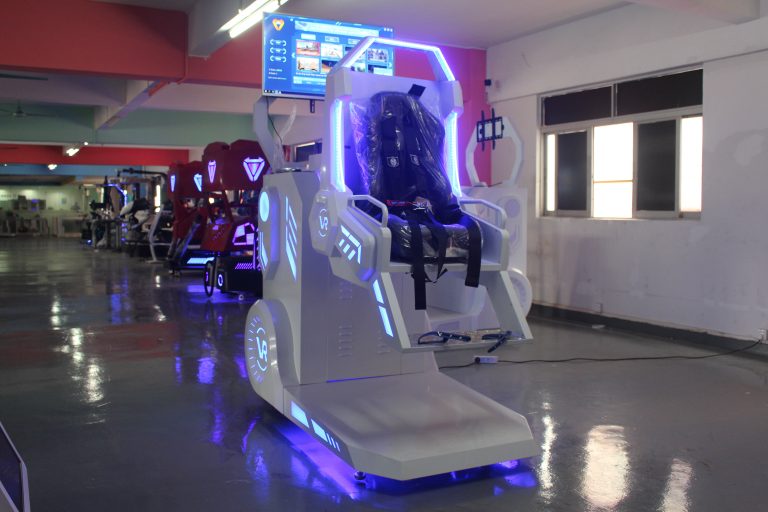
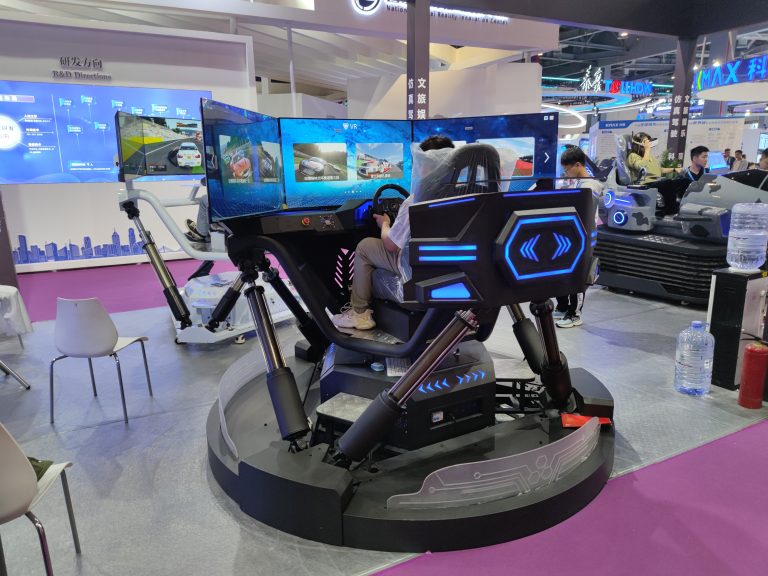
A four-axis driving simulator is a dynamic simulation device centered on a four-degree-of-freedom motion platform. Compared with traditional fixed-base simulators, it realizes four types of dynamic movements including vertical lifting, longitudinal pitching, lateral tilting and horizontal deflection, and accurately reproduces vehicle postures under various working conditions such as acceleration, braking, cornering, driving on bumpy roads and emergency risk avoidance. The complete device consists of five core modules: a four-axis servo motion platform, a high-definition visual simulation system, vehicle dynamic simulation software, force-feedback operating system, and a multi-modal audio sensory system.
Its core working principle is as follows: high-precision inertial measurement units (IMUs) collect real-time data of user operations and platform movements. The built-in real-time operating system (RTOS) and dedicated dynamic algorithms calculate vehicle dynamic parameters based on preset road conditions and vehicle models, so as to drive the four-axis servo mechanism to execute corresponding actions. Meanwhile, the visual, auditory and tactile feedback systems are coordinated to build an all-round immersive driving environment that delivers an authentic driving experience identical to real vehicles. Compared with six-axis simulators, four-axis simulators remove redundant motion dimensions and optimize the internal mechanical structure. This design cuts procurement and operation costs by 40% to 60% while maintaining basic dynamic simulation capabilities, making the devices highly adaptable to the mid-to-low-end market.
1.2 Overall Industry Development Status
The global driving simulator industry is currently in a high-speed growth phase. According to statistics released by Market Research Future, the global market size of driving simulators has exceeded 10 billion US dollars in 2025. The market is expected to maintain a compound annual growth rate of 8.18% from 2025 to 2035, reaching 68.57 billion US dollars by 2035. The growth is mainly fueled by the surging demand for autonomous driving testing and the expanding civilian consumer market. Geographically, the Asia-Pacific region ranks as the fastest-growing market worldwide with a compound annual growth rate of 7.17%. The upgrading of the domestic automotive industry, the construction of intelligent transportation systems and the innovation of the cultural and entertainment sector have created favorable conditions for the development of four-axis driving simulators.
The domestic market presents a bipolar development pattern. The high-end market is dominated by imported six-axis and eight-axis simulators, which are mainly adopted by leading automobile manufacturers and professional research institutes for high-end vehicle R&D and high-level autonomous driving algorithm verification. The mid-to-low-end market is occupied by two-axis, four-axis dynamic simulators and fixed simulators. Four-axis simulators have witnessed a continuous increase in market penetration thanks to their outstanding cost-performance ratio. In terms of localization, domestic manufacturers have made breakthroughs in core technologies in recent years. The localization rate of key components such as high-precision sensors and servo motors has grown steadily, gradually breaking the technological monopoly of overseas enterprises, reducing the mass production cost of four-axis simulators and promoting their popularization in sinking markets. At present, four-axis driving simulators have been widely applied in driver training, preliminary performance testing for small and medium-sized automakers, racing experience halls and immersive entertainment projects in commercial complexes across China.
II. Main Application Fields of Four-Axis Driving Simulators
2.1 Motor Vehicle Driver Training
Driver training is the most fundamental and mature application scenario of four-axis driving simulators. The traditional driver training mode suffers from multiple drawbacks including high fuel consumption, severe vehicle wear, site constraints, high operational risks for novice drivers and suspended training under extreme weather conditions. In addition, China’s driving test standards have been updated in recent years, adding new assessment items covering complex road condition response and driving under special weather, which cannot be fully covered by pure physical vehicle training. Four-axis driving simulators effectively solve the above industry pain points. On the one hand, they can simulate diverse scenarios such as rainy and foggy days, night driving, steep slopes and congested roads to support full-subject training including basic operations, driving under complex conditions and emergency response, thus improving the comprehensiveness of training courses. On the other hand, the simulators can be used for introductory training for new drivers to reduce the time spent on real vehicles, cut down operating costs on fuel, vehicle maintenance and venues, and eliminate safety accidents caused by improper operations of novice drivers.
Furthermore, four-axis simulators support regular retraining and safety assessment for professional drivers engaged in freight and passenger transportation. They can simulate high-risk working scenarios such as fatigue driving, sudden obstacles and crosswind interference to strengthen professional drivers’ emergency response capabilities. Competent traffic authorities in some regions have issued relevant policies to encourage driving schools and transportation enterprises to apply simulation equipment for auxiliary teaching and training, further accelerating the penetration of four-axis simulators in the driver training industry.
2.2 Automotive R&D and Autonomous Driving Testing
The booming development of new energy vehicles and autonomous driving has triggered an exponential increase in automakers’ demand for simulation testing equipment. Relevant data shows that leading Chinese new energy vehicle brands such as NIO and XPENG increased their procurement volume of simulators by 75% in 2023, and simulation testing has become an indispensable link in vehicle development and autonomous driving algorithm iteration. Although high-end six-axis simulators feature higher simulation accuracy, their exorbitant procurement and maintenance costs are unaffordable for most small and medium-sized automakers. In this context, four-axis driving simulators have become the optimal solution for small and medium-sized automobile enterprises and auto parts suppliers.
In terms of complete vehicle R&D, four-axis simulators are applied to basic research projects including chassis tuning, braking system testing, suspension performance adaptation and cockpit human-computer interaction optimization. They can replace real vehicles to complete repetitive and low-risk testing tasks, shorten the R&D cycle of new models and reduce capital investment. In terms of autonomous driving testing, the simulators can be connected to virtual simulation platforms to generate massive extreme traffic scenarios and conduct full-process tests on the perception, decision-making and execution modules of L2-L3 level advanced driver-assistance systems (ADAS), making up for the shortcomings of real-road testing such as insufficient scenario coverage and long testing cycles. Moreover, four-axis simulators are compatible with fuel vehicles, new energy passenger cars, freight vehicles and other vehicle types to meet diversified testing demands of automakers.
2.3 Immersive Cultural Entertainment and Commercial Exhibition
Against the backdrop of consumer upgrading, the immersive experience economy has entered a rapid development stage. Four-axis driving simulators have become popular devices in the commercial entertainment industry due to their highly restored driving experience. Currently, such simulators are widely deployed in commercial complexes, esports venues, racing experience halls, cultural tourism scenic spots and theme parks, providing immersive experience projects such as racing, off-road exploration and long-distance simulated driving targeted at young consumers. Compared with high-end dynamic simulators, four-axis devices occupy less space and require lower maintenance costs, which is more suitable for large-scale deployment in commercial venues.
In addition, auto dealers utilize four-axis simulators for offline marketing activities. By reproducing the driving parameters of specific models, the simulators enable consumers to experience vehicle performance in an immersive manner, boosting brand exposure and transaction rates. For industry exhibitions and auto shows, four-axis driving simulators serve as mainstream display carriers for automakers and parts suppliers to demonstrate technical advantages, realizing dual values of commercial operation and brand promotion.
2.4 Specialized Applications in Specific Industries
Beyond the aforementioned mainstream scenarios, four-axis driving simulators have broad application potential in specialized industries. In the military field, they are used for regular training of drivers of military transport vehicles and special operational vehicles. The simulators can simulate complex wild road conditions and sudden battlefield situations to reduce the wear of military vehicles and enhance soldiers’ driving and combat capabilities. In the field of intelligent transportation research, researchers adopt four-axis simulators to carry out human factor engineering studies, analyzing the impacts of different driving behaviors and road environments on traffic safety, so as to provide data support for the optimization of traffic regulations, the construction of road infrastructure and the formulation of industrial standards for autonomous driving. In rehabilitation medicine, the simulators assist in psychological rehabilitation and physical function recovery training for targeted groups, providing a safe training environment for patients.
III. Driving Factors and Existing Constraints of the Industry
3.1 Core Driving Factors
First, sustained policy dividends. Chinese authorities have attached great importance to the development of the automotive simulation industry and intelligent transportation sector, introducing a series of policies to support the R&D of automotive simulation technologies and promote simulated driving training. Regulatory policies for autonomous driving testing also require automakers to improve virtual simulation testing systems, forcing automakers and training institutions to increase investment in driving simulators. Meanwhile, localization support policies facilitate the localized production of core components, further cutting manufacturing costs and promoting the popularization of four-axis simulators in sinking markets.
Second, the transformation and upgrading of the automotive industry drives market demand. With the rising market penetration rate of new energy vehicles and the upgrading of autonomous driving technology toward L3 and higher levels, the traditional real-vehicle testing mode can no longer meet the demand for massive scenario testing. As core equipment for virtual simulation testing, four-axis driving simulators help automakers reduce costs and improve efficiency when conducting repetitive and high-risk testing tasks, evolving into rigid-demand equipment for the intelligent upgrading of the automotive industry. Additionally, the structural innovation of chassis and power systems of new energy vehicles urges simulator manufacturers to optimize dynamic algorithms, driving the technological upgrading of the entire industry.
Third, diversified expansion of consumer market demand. On the one hand, the driver training industry is transforming from extensive operation to refined and intelligent development, and intelligent simulation devices have become standard equipment for driving school upgrading. On the other hand, the immersive entertainment industry is booming, and consumers’ growing demand for high-quality experiential entertainment has made cost-effective four-axis driving simulators a popular investment choice, unlocking incremental space in the civilian consumer market.
Fourth, the continuous maturity of supporting technologies. The popularization of VR/AR technology, high-precision sensing, servo control, artificial intelligence and big data has laid a solid technical foundation for the upgrading of four-axis driving simulators. Multi-modal perception fusion technology reduces the dynamic response delay of devices to within 10 milliseconds to achieve real-world equivalent driving experience; VR panoramic display technology breaks the limitations of traditional flat screens and improves scenario restoration; AI algorithms can generate diverse extreme road conditions independently, enriching applicable scenarios for testing and training and comprehensively optimizing the overall performance of simulators.
3.2 Existing Industry Constraints
From the technical perspective, restricted by limited motion dimensions compared with six-axis simulators, four-axis products cannot fully restore extreme working conditions such as high-speed drifting, continuous bumpy driving and large-angle sideslip, resulting in a low simulation ceiling that fails to meet the needs of high-end scenarios including high-level autonomous driving R&D and professional racing training. Moreover, most small and medium-sized domestic manufacturers lack independent R&D capabilities for core algorithms and adopt generic dynamic models directly, which cannot adapt to the differentiated driving characteristics of various vehicle models and leads to severe product homogenization. Besides, certain high-precision sensors and high-end servo controllers still rely on imports, and the core technology bottleneck has not been completely broken.
From the market perspective, the industry features low entry barriers, attracting a large number of small and medium-sized manufacturers to crowd into the mid-to-low-end market. Some enterprises cut production costs to lower product prices and seize market share, resulting in the proliferation of low-quality and low-cost products and disrupting the healthy market order. In addition, stakeholders in downstream markets hold biased perceptions of simulators: some driving schools and consumers only recognize the value of simulators in basic operational training while ignoring their advantages in complex scenario and emergency response training, hindering the improvement of market penetration.
From the application perspective, unified industrial standards for product parameters, quality inspection and data interconnection have not been established. Four-axis simulators produced by different manufacturers vary greatly in parameter accuracy, motion performance and simulation algorithms, making cross-brand data sharing impossible. Furthermore, there is no unified credit recognition standard for simulated driving training in the driver training industry. Simulators are only regarded as auxiliary teaching tools in most regions rather than official assessment contents, greatly reducing the willingness of training institutions to purchase relevant equipment.
IV. Future Development Prospects of Four-Axis Driving Simulators
4.1 Technological Development: Intellectualization, High Precision and Lightweight
In the next five years, four-axis driving simulators will focus on making up for simulation defects, optimizing user experience and reducing manufacturing costs. Firstly, integrate artificial intelligence and big data technologies to equip simulators with self-adaptive dynamic simulation algorithms that can adjust parameters according to different vehicle models and road conditions. AI-generated extreme scenarios will cover all application demands for autonomous driving testing and emergency driving training. Secondly, upgrade the multi-modal interaction system by integrating VR panoramic vision, omnidirectional stereo audio, tactile feedback seats and road vibration simulation technologies. The dynamic response delay will be reduced to 5 milliseconds to narrow the experience gap between four-axis simulators and high-end six-axis products. Thirdly, adopt a lightweight and modular design to simplify mechanical structures and reduce floor space. Standardized modular components will lower the costs of production, installation and maintenance. Fourthly, accelerate the full localization of core components, break through technical barriers of high-precision force sensors and dedicated real-time operating systems to eliminate reliance on imported parts and enhance product cost-performance.
4.2 Market Development: Deep Cultivation of Segmented Tracks and Popularization in Sinking Markets
The four-axis driving simulator market will form a three-tier development pattern including high-end supplementary products, mid-end customized products and low-end popular products. The mid-end market will continue to focus on three core tracks: driver training, R&D of small and medium-sized automakers, and commercial immersive entertainment. Manufacturers will launch customized products such as lightweight teaching-oriented simulators for driving schools and high-precision testing-oriented simulators for automakers. The low-end market will expand to county-level driving schools, sinking commercial districts and small and medium-sized cultural tourism scenic spots to tap incremental market resources. In the high-end segment, high-spec four-axis simulators optimized for extreme condition simulation will be developed to undertake partial market demands of six-axis simulators and capture the high-end driver training and mid-tier vehicle R&D market.
In terms of business models, diversified profit modes will emerge gradually. In addition to traditional equipment sales, value-added services including equipment leasing, scenario operation trusteeship, data services and supporting curriculum development will cater to the asset-light operation demands of small and medium-sized clients. Industry forecasts indicate that simulators embedded with AI and VR technologies will account for 70% of the mid-to-low-end dynamic simulator market by 2030, among which four-axis simulators will occupy over 70% of the market share.
4.3 Industrial Development: Standardization Construction and Improved Industrial Collaboration
As the industry matures, competent authorities and industry associations will formulate unified standards covering product manufacturing parameters, quality detection, data interconnection and training credit recognition, so as to standardize market competition, eliminate backward low-quality production capacity and shift industrial competition from price-oriented to technology and quality-oriented. Supported by relevant policies, simulated driving training credits will be incorporated into the national unified driving examination system, turning simulators into rigid-demand equipment for the driver training industry and releasing huge market potential.
The industrial chain will achieve in-depth collaborative development. Upstream component suppliers, midstream simulator manufacturers and downstream application service providers will build an integrated cooperation platform to connect the whole industrial chain including technology R&D, mass production, scenario implementation and data sharing. Leading enterprises will increase R&D investment and integrate industrial resources to form prominent brand effects and raise industrial concentration. Furthermore, four-axis driving simulators will expand to emerging fields such as intelligent transportation, rehabilitation medicine and military training to create new growth drivers and maximize comprehensive industrial value.
V. Conclusion
To sum up, benefiting from the intelligent upgrading of the automotive industry, the popularization of autonomous driving technology, diversified cultural and entertainment consumption and favorable policy support, four-axis driving simulators hold an irreplaceable position in the mid-to-low-end simulation market by virtue of high cost-performance, strong adaptability and low operation and maintenance costs, boasting promising development potential. Although the industry is currently constrained by insufficient simulation performance, serious product homogenization and the absence of unified standards, these drawbacks will be resolved gradually with iterative technological upgrading, improved industrial standards and deeper industrial chain collaboration.
In the future, four-axis driving simulators will evolve from single-functional devices for driver training and vehicle R&D into multi-functional platform simulation equipment covering transportation, automobile, cultural entertainment, medical treatment and military industries. They will become a critical pillar for the high-quality development of China’s automobile industry, the construction of intelligent transportation systems and the upgrading of immersive entertainment industry. Industry participants should seize technological upgrading opportunities, focus on segmented markets and actively adapt to unified industrial standards to gain competitive advantages and share the dividends brought by the booming four-axis driving simulator industry.
RELATED POSTS
Technology Empowerment and Scenario Innovation: An Analysis of the Future Development Trends of Truck Cab Simulators
Application Exploration and Practice of Car Simulators in Experience Halls

Virtuality and Reality Coexisting, Returning to the Prosperous Tang Dynasty: An Analysis of Immersive Narrative of Supernatural Tales of the Tang Dynasty in Large-Space VR
Racing Simulators in Malls: A Case Study Analysis from Traffic-Driving Tool to New Commercial Ecosystem
The Impact of Driving Simulators on Automotive Industry Development