Technology Empowers Water Experiences: The Diverse Values and Application Scenarios of VR Jet Skis
With the rapid iteration of Virtual Reality (VR) technology, its application boundaries have been continuously expanded, extending from entertainment games to education and training, cultural and tourism communication, scientific research and innovation, and many other fields. As a product of the in-depth integration of VR technology and water sports, VR jet skis have broken the time and space constraints, safety barriers, and cost limitations of traditional jet ski experiences. With high-fidelity immersion and flexible application forms, they have demonstrated unique and diverse roles, becoming an important carrier connecting technology with life, and professionalism with the public. They not only provide ordinary people with a safe and convenient water adventure experience but also offer new solutions for training, teaching, and research in professional fields, promoting the digital upgrading of water-related industries.
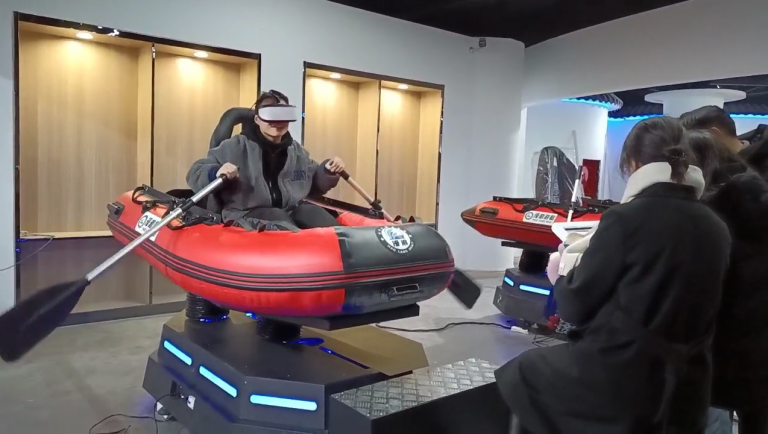
The most intuitive and widespread role of VR jet skis is to restructure the entertainment experience model, making the “speed and passion” of water sports within reach. Traditional jet ski experiences are limited by multiple factors such as venues, weather, and safety, requiring professional waters, equipment, and coaches, and there are certain safety risks, making it difficult for ordinary people to try easily. However, through high-precision 3D modeling, real-time rendering technology, and motion feedback systems, VR jet skis construct highly realistic virtual water scenes, allowing users to feel the thrill of galloping on the water without leaving home. Users only need to wear a VR headset and operate a simulation handle or real-scene console to immerse themselves in virtual scenes such as lakes, oceans, and rivers, experiencing various gameplay such as high-speed cruising, S-shaped slalom, and obstacle crossing. This not only avoids the safety hazards of real waters but also retains the core fun of jet ski driving.
In entertainment scenarios, the interactivity and diversity of VR jet skis further enhance the user experience. The Xiamen Urban Planning Exhibition Hall has developed a VR jet ski experience project with the help of city-level 3D models. Through riding equipment, tourists can shuttle along the coastline of Gulangyu Island in the virtual scene, enjoying the marine scenery while feeling the excitement brought by speed, turning urban landscapes from “viewable” to “experiencable” [2][4]. In addition, VR jet skis support multi-player online battles, team competitions, and other modes. Users can interact with friends in real time, carry out activities such as speed races and cooperative challenges, breaking the limitations of single-player experience and enhancing the fun and sociality of entertainment. At the same time, the equipment can adjust the difficulty according to the user’s operating level. Whether it is a beginner with no foundation or an enthusiast with certain experience, they can find a suitable experience mode, truly realizing the entertainment vision of “enjoyable for all” [6]. This form of entertainment not only enriches people’s leisure life but also provides new drainage highlights for offline entertainment venues, theme parks, science and technology museums, etc., promoting the diversified development of the entertainment industry.
In addition to entertainment value, VR jet skis play an irreplaceable role in professional training, becoming an efficient tool to improve driving skills and ensure operational safety. Traditional jet ski training, whether for civilian yacht driving, maritime law enforcement, maritime rescue, or military special operations, faces problems such as high costs, high risks, and limited scenarios. Real-scene training requires a lot of funds to purchase equipment and rent waters, and is greatly affected by natural conditions such as weather and sea conditions. At the same time, training links such as high-speed driving and emergency response have high safety risks, which are likely to cause equipment damage or casualties [8]. Based on virtual reality technology, VR jet skis have built a full-working-condition and multi-scenario simulation training system, perfectly solving these pain points.
In terms of civilian driving training, VR jet skis can simulate the whole process of operation from start-up to berthing, including basic actions such as engine start-up, throttle adjustment, steering wheel turning, braking and reversing. They can also restore the hydrodynamic characteristics during high-speed driving, allowing students to truly feel the change in hand feel when the hull transitions from a displacement state to a planing state [3]. For professional personnel such as yacht drivers and commercial speedboat captains, the VR system can simulate complex scenarios such as narrow waterway maneuvering, precise dock berthing, and practical operation of international maritime collision avoidance rules, helping students familiarize themselves with operating specifications and improve emergency response capabilities. The Changning District Youth Science and Technology Station has even applied VR technology to youth marine model training. Through VR training equipment, students can carry out speed training without leaving home, which not only solves the problem of venue limitations but also reduces equipment loss in the initial stage of training. At the same time, with the help of the “AI referee” function, international competition rules are integrated into the program, helping students establish a systematic practical foundation [11].
In the field of professional operation training, the value of VR jet skis is more prominent. Departments such as maritime law enforcement, customs anti-smuggling, and coast guard can use the VR system to simulate scenarios such as high-speed pursuit, interception, boarding inspection, and night patrol, training law enforcement personnel’s coordinated combat capabilities and emergency response speed [8]. Maritime rescue departments can simulate sudden dangers such as violent storms, personnel falling into the water, and ship failures through VR jet skis, training rescuers’ search and rescue skills and coordinated cooperation capabilities in complex environments, and improving rescue efficiency and safety [3]. In the military field, VR jet skis can be used for special operation training such as amphibious assaults, special delivery and recovery, and anti-piracy, allowing soldiers to familiarize themselves with operating skills in complex waters in a safe environment and enhance their actual combat capabilities [8]. In addition, the VR training system can collect students’ operation data in real time and generate multi-dimensional evaluation reports, including speed fluctuations, course deviations, and fault handling time, helping instructors accurately grasp students’ training status and conduct targeted guidance, greatly improving training efficiency [3]. Compared with traditional real-scene training, VR jet ski training does not require fuel consumption, does not need to worry about equipment loss, can be trained repeatedly, and is not limited by time and space, which greatly reduces training costs and avoids safety risks during training, achieving the training goal of “zero risk, low cost, and high efficiency” [8].
VR jet skis also show unique advantages in the field of cultural and tourism communication and urban promotion, becoming an important bridge connecting culture, tourism, and technology. Traditional cultural and tourism promotion is mostly presented in the form of pictures, videos, and text, lacking immersive experience, making it difficult for the audience to intuitively feel the regional characteristics and cultural charm. Through real-scene 3D reconstruction technology, VR jet skis restore real natural landscapes and historical features into virtual scenes, allowing users to experience the speed and passion while appreciating the local cultural and natural beauty. The VR jet ski experience project of the Xiamen Urban Planning Exhibition Hall takes the real scenes such as the coastline of Gulangyu Island and the Ring Road as prototypes to build virtual scenes, allowing tourists to feel the coastal style of Xiamen during the experience. This immersive communication method integrating virtual and real turns urban planning from “words on drawings” into “experiencable reality”, effectively improving the city’s popularity and attractiveness [2][9].
In terms of historical and cultural inheritance, VR jet skis can be combined with historical style models to restore historical water scenes and ancient architectural styles, allowing users to feel the thickness of history in virtual driving. For example, for historical style areas such as Gulangyu Island, high-precision real-scene 3D reconstruction technology can be used to restore historical buildings and the original appearance of the coastline into the VR scene. Users driving VR jet skis to shuttle through them can not only experience the fun of water sports but also understand the characteristics and cultural background of historical buildings, realizing the organic combination of entertainment and cultural communication [2]. In addition, VR jet skis can also be used as a characteristic experience project in cultural and tourism scenic spots, enriching the play content of the scenic spots and improving the competitiveness of the scenic spots. In some coastal scenic spots, wetland parks and other places, the introduction of VR jet ski experience equipment can attract more tourists to experience. At the same time, through the customization of virtual scenes, the characteristic landscapes and folk culture of the scenic spots are integrated into them, realizing the digital communication and promotion of cultural and tourism resources [9].
In the field of scientific research and teaching innovation, VR jet skis provide a new virtual simulation platform for the research and teaching of related disciplines, promoting technological innovation and talent training. In the field of ship design and research and development, researchers can use VR jet skis to simulate the operation status of different hull structures and power systems in various water environments, test the maneuverability and stability of the hull, evaluate the application effect of new equipment and technologies, thereby optimizing the design scheme and reducing the research and development cost and cycle [8]. For example, simulating the dynamic characteristics of jet skis under different wave and current conditions through the VR system can help researchers deeply study the impact of hydrodynamics on hull navigation and provide data support for the research and development of new jet skis [1].
In the field of education, VR jet skis can be used as auxiliary teaching tools for related majors such as navigation, aquatic products, and maritime affairs, breaking the time and space limitations of traditional teaching, allowing students to master professional knowledge and skills in an immersive experience. In the past, navigation-related professional teaching was mainly based on theoretical explanation and model demonstration, making it difficult for students to intuitively feel the actual scene of water operation. However, VR jet skis can build realistic teaching scenes, allowing students to simulate operations such as driving and emergency response, combining theoretical knowledge with practical operations to improve teaching effect [7]. At the same time, the VR system can customize different teaching scenes and training modules according to teaching needs, covering basic operations, fault handling, rule learning and other contents, meeting the teaching needs of different majors and different stages [1]. In addition, VR jet skis can also be used for youth popular science education. Through interesting experiences, they can stimulate young people’s interest in navigation technology, water sports, and marine culture, and cultivate reserve talents in related fields [11].
It is worth noting that the development of VR jet skis also faces some challenges, such as core technology bottlenecks, single content ecology, and imperfect industry standards. Some products still have room for improvement in terms of force feedback accuracy and system delay, and the content scenes are relatively single, lacking personalized customization and in-depth social functions [12]. However, with the continuous progress of VR technology, these problems will be gradually solved, the application scenarios of VR jet skis will be further expanded, and their roles will be more diversified. In the future, with the in-depth integration of 5G, AI, big data and other technologies with VR jet skis, their fidelity and interactivity will be further improved. They can not only provide users with a better experience but also play a greater role in intelligent training, smart cultural tourism, precise scientific research and other fields.
In summary, VR jet skis are not simple “virtual entertainment tools”, but diversified technological products integrating entertainment experience, professional training, cultural and tourism communication, and scientific research and teaching. They have broken many limitations of traditional jet ski applications. With the advantages of safety, efficiency, convenience, and immersion, they have brought a new leisure experience to ordinary people, provided efficient solutions for professional fields, and injected new vitality into the fields of cultural tourism and scientific research. With the continuous development of science and technology, VR jet skis will continue to iterate and upgrade, constantly expand the application boundaries, promote the digital transformation of water-related industries, become an important force for technology to empower life and assist industrial development, and let more people feel the unique charm of the integration of technology and water sports.
RELATED POSTS
What Can VR/XR Full‑Sensory Large‑Scale Spaces Achieve?
Diversified Popular Science Applications and Social Value of VR Automobile Collision Simulators
Driving Simulators Unveiled: The Ultimate Co-Pilot for Driver Training
Intelligent Driving Integration, Track Expansion – Analysis of the Future Market Development of Racing Simulators (English Version)
How Visual Immersion Is Achieved in Three-Screen 6-Axis Racing Simulators