VR Large-Scale Equipment: A Spatial Revolution Reconstructing Immersive Experience
As head-mounted VR devices evolve from personal entertainment to scenario-based immersion, VR large-scale equipment is breaking the boundary between virtual and reality with stronger hardware performance, larger spatial capacity, and more realistic multimodal interaction. Far beyond a simple enlargement of single-user headsets, it is an integrated immersive system featuring high-precision positioning, motion simulation, multi-user synchronization, and real-time rendering. Widely applied in cultural tourism, commerce, education, industry, and safety training, it has become the core carrier of immersive experiences in the digital economy era.
I. What Are VR Large-Scale Equipment
VR large-scale equipment refers to professional-grade virtual reality systems designed for multi-user, large-space, high-interaction, and high-immersion scenarios. Distinguished from consumer-grade VR all-in-ones and PC-VR, it typically includes customized hardware, dedicated venues, distributed computing power, and a standardized content ecosystem. Its core features cover: hundred-square-meter free roaming space, real-time multi-user interaction, sub-millimeter motion tracking, motion seat/mechanical platform somatosensory feedback, 4K/8K high-refresh displays, and multi-sensory effects (wind, vibration, temperature, scent). Replacing “head-only experience” with “full-body experience”, it allows users to truly step into the virtual world.
II. Core Technologies: The Cornerstone Supporting Immersion
1. Spatial Positioning and Motion Capture
Centered on laser base stations, UWB (Ultra Wide Band), optical tracking, and SLAM fusion positioning, it achieves sub-centimeter precise tracking. Movements such as squatting, jumping, running, and gesture grabbing are restored 1:1, completely eliminating drift and motion sickness while ensuring interference-free multi-user interaction.
2. Multimodal Somatosensory Feedback
Integrating mechanical simulations like vibration, air injection, leg sweeping, weightlessness, pitching, and rotation, coupled with 3D spatial sound and temperature/scent simulation, it builds full-sensory immersion across vision, hearing, touch, and vestibular sense, endowing virtual scenes with physical realism.
3. Distributed Computing and Cloud Rendering
Adopting an edge computing + local rendering architecture, it supports real-time loading of high-complexity scenes for dozens of simultaneous users. Paired with low-latency wireless transmission via 5G/WiFi 6E, it frees users from cables and enables unrestricted movement in large spaces.
4. Display and Optical Upgrades
High-end devices are equipped with Micro-OLED screens and Pancake folding optics, with single-eye resolution advancing towards 4K and field of view exceeding 140°. This greatly reduces the screen-door effect, significantly enhancing picture clarity and visual comfort.
III. Main Types and Scenarios of VR Large-Scale Equipment
1. Motion Ride VR Equipment
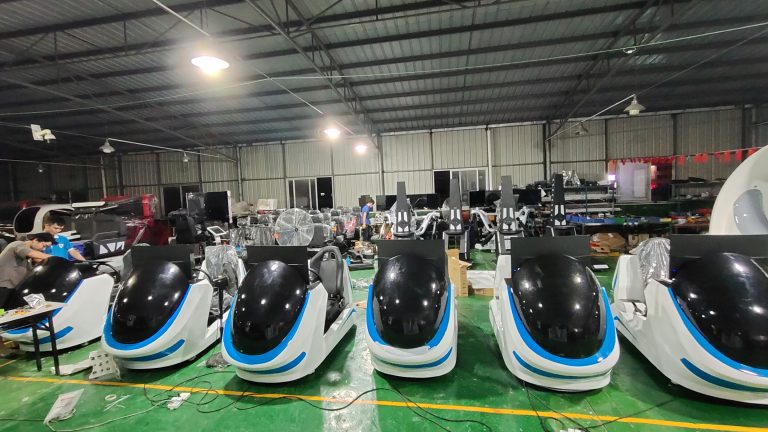
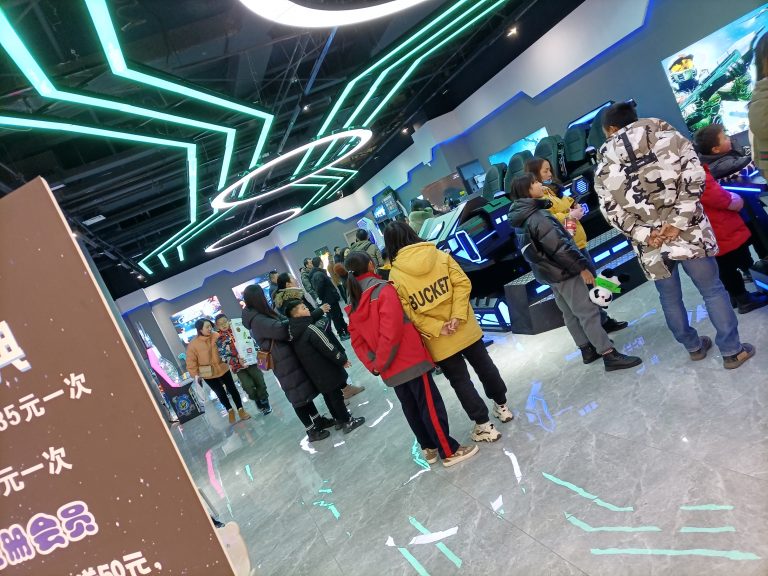
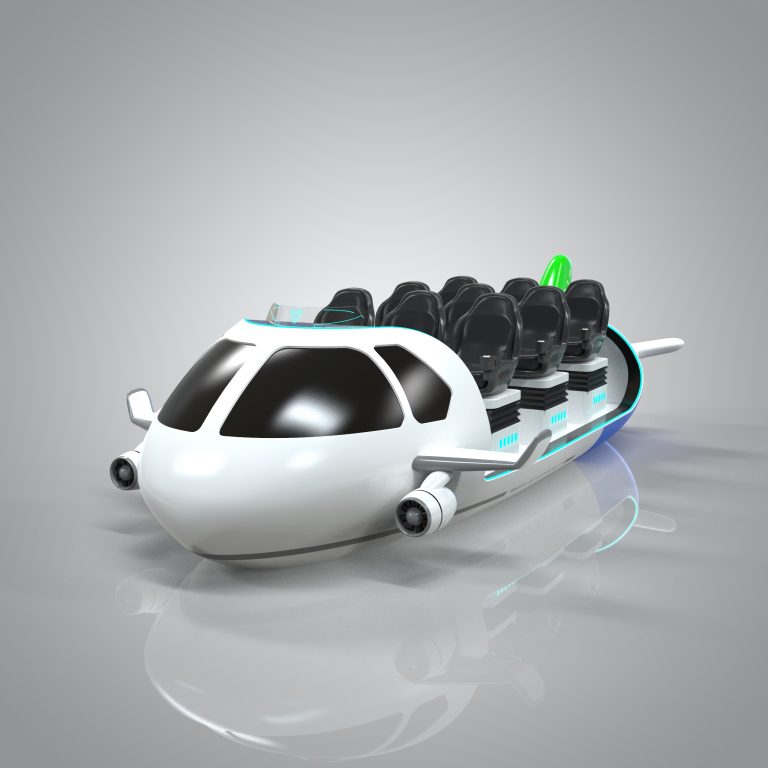
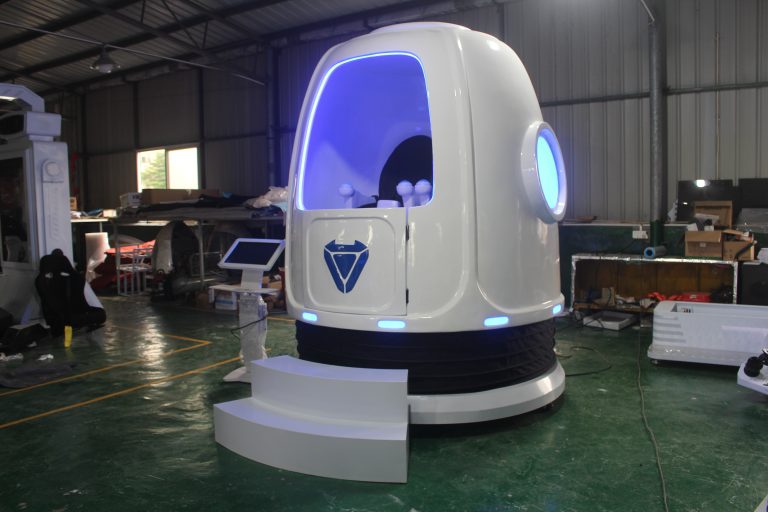
Represented by star warships, VR chariots, and flight cinemas, it carries 6-degree-of-freedom motion platforms and supports 4–12 simultaneous users, suitable for scenic spots, shopping malls, and science museums. Combining diving, acceleration, weightlessness, and special effects with sci-fi, adventure, and popular science content, it boasts high per-hour throughput and excellent per-square-foot efficiency, making it a top commercial traffic driver.
2. Large-Space Free Roaming VR
Customizable venues (ranging from 6m×10m to hundreds of square meters) support 8–20 simultaneous users for competition/collaboration, with content covering anti-terrorism, sci-fi, escape rooms, and team-building scripts. Users roam wirelessly and interact in real-time teams, ideal for VR experience centers, corporate team building, and military training.
3. Dome/Curved Screen VR Cinemas
Integrating giant-screen projection and VR headsets with a 156° ultra-wide angle and suspended seats, it simulates flight, roaming, and traversal experiences. Known as a “Disney alternative”, it targets family and cultural tourism crowds with strong immersion and high repurchase rates.
4. Professional Simulation and Training Equipment
For high-risk industries such as healthcare, aviation, driving, fire fighting, and electric power, it customizes 1:1 virtual consoles and environments, providing zero-cost, high-safety, and repeatable skill training to greatly reduce training costs and risks.
IV. Application Scenarios: All-Dimensional Penetration from Entertainment to Industry
Cultural Tourism and Commerce
Scenic spots, ancient towns, and shopping malls create internet-famous check-in spots with VR flight, traversal, and sci-fi projects to boost passenger flow and revenue; theme parks replace traditional amusement with immersive storylines for rapid content iteration.
Education and Training
History classes “step into” ancient Rome, biology classes conduct virtual specimen dissection, medical schools practice virtual surgery collaboration, and vocational colleges train on equipment disassembly—experiential learning improves efficiency and memory retention.
Industry and Safety
Digital twin factory remote operation and maintenance, high-risk operation simulation, fire/earthquake/traffic emergency drills—trial and error in virtual environments ensures personnel safety and equipment stability.
Entertainment and Social Interaction
Multi-player esports, virtual concerts, immersive script killings, and parent-child interactions shift from single-player entertainment to group socializing, expanding the boundaries of offline experiences.
V. Industry Trends: Lightweight, Intelligent, and Ecological
1. Lighter and Clearer Hardware
Headset weight continues to decrease, with Pancake optics and Micro-OLED becoming mainstream. Wireless and integrated design become standard, dual-improving wearing comfort and visual effects.
2. In-Depth AI Empowerment
AI drives dynamic content generation, intelligent interaction, behavior analysis, and personalized recommendations, reducing content production costs while enhancing experience fluency and realism.
3. Shift from Hardware to “Hardware + Content + Service”
The industry abandons single hardware sales and turns to customized solutions, content library updates, and operation hosting, forming a sustainable ecosystem.
4. Enterprise Sector as Growth Engine
While the consumer market expands steadily, B-end demands in industry, healthcare, education, and training grow rapidly, becoming the core driving force of the VR large-scale equipment market.
VI. Conclusion
VR large-scale equipment has completed the leap from technical concept to commercial implementation, redefining immersive experience with large space, strong immersion, and multi-interaction. As displays, positioning, computing power, and content continue to mature, it will further penetrate life, work, learning, and production, serving as a key interface between the digital and physical worlds. The next immersive experience may no longer be far away, but a virtual new world within reach.
RELATED POSTS
VR Construction Safety Experience Hall
Beyond Popular Science: The Four Core Application Scenarios and Value of VR Fire Experience Halls
Comprehensive Practical Guide to Operating a VR Device Experience Center
The Future Development of Flight Simulators
Analysis on Diversified Applications and Industrial Development Value of VR Aerospace Science and Technology Museum