The Application Market of eVTOL Simulators
Abstract
eVTOL (Electric Vertical Takeoff and Landing) simulators serve as critical infrastructure supporting the commercialization of the low-altitude economy and Urban Air Mobility (UAM). They cover the entire industrial chain, including R&D testing, airworthiness certification, pilot training, operational planning, and public experience. The global eVTOL simulator market is on the verge of explosive growth, shifting from early verification to large-scale commercial use. The global market size is estimated at $4.27 billion in 2025 and is projected to reach $8.12 billion by 2035, with a compound annual growth rate (CAGR) of 6.7%. As a core market for the low-altitude economy, China’s market will reach approximately ¥320 million RMB in 2025, leading global growth. This paper systematically analyzes the application value and commercialization path of eVTOL simulators from five dimensions: market size, core application scenarios, technology drivers, competitive landscape, challenges, and future trends, providing a reference for industrial layout in the low-altitude economy.
1. Market Overview: Scale, Structure and Growth Drivers
1.1 Market Size and Growth Forecast
The eVTOL simulator market is one of the fastest-growing segments in the low-altitude economy industrial chain. According to industry data:
- Global market: Approximately $4.27 billion in 2025, with a CAGR of 6.7% from 2026 to 2035, expected to exceed $8.12 billion by 2035. Commercial applications account for 47.7% (about $2.06 billion), representing the largest sub-market.
- China market: Approximately ¥320 million RMB in 2025, accounting for 25.6% of the global total, with a projected CAGR of over 30% in the next five years. It will enter an exponential growth phase as airworthiness certification accelerates and fleet deliveries scale up.
- Segmentation: By application, they are divided into engineering R&D simulators (35%), training simulators (40%), fully certified FAA/EASA simulators (20%), and public experience simulators (5%). By technology, they include VR/AR immersive simulators, 6-axis/8-axis dynamic simulators, and cloud-based digital twin simulators. High-end full-mission simulators have the highest unit price (¥20–50 million per unit) and form the core market value.
1.2 Core Growth Drivers
- Airworthiness compliance requirementsThe FAA, EASA, and CAAC require thousands of hours of simulation testing before eVTOL certification. Simulator data serves as core evidence for airworthiness reviews, driving mandatory demand for high-end simulators.
- Cost and safety pain pointsActual eVTOL test flights cost over ¥100,000 per hour, and extreme scenarios such as urban canyon turbulence, battery failures, and electromagnetic interference cannot be safely reproduced. Simulators can reduce R&D costs by 30%, cut actual flight training time by 80%, and lower hourly training costs to 5% of real flights, solving industry pain points of high costs and incomplete testing.
- Fleet and talent shortagesThe global eVTOL fleet is expected to exceed 10,000 units by 2030. Based on a 10:1 fleet-to-simulator ratio, more than 1,000 full-mission simulators will be needed. Meanwhile, the talent gap for pilots, maintenance personnel, and air traffic controllers exceeds 100,000, making simulators the only efficient solution for large-scale standardized training.
- Policy dividends for the low-altitude economyChina’s low-altitude economy has become a national strategy. More than 20 cities including Shenzhen, Shanghai, and Guangzhou have issued special plans, accelerating eVTOL commercial pilots and directly boosting demand in R&D, training, and operations.
2. Core Application Scenarios: Value Realization Across the Industrial Chain
eVTOL simulators have expanded beyond single training functions to form a full-scenario ecosystem covering R&D, certification, training, operations, and consumer experience, acting as a “virtual assembly line” and “training ground” for eVTOL commercialization.
2.1 R&D and Testing: Digital Twin Hub for Cost and Efficiency Improvement
This is the earliest and most core application scenario, serving manufacturers and research institutions to verify core technologies:
- Flight control and aerodynamic verification: High-precision flight dynamics models and distributed electric propulsion simulation reproduce vertical takeoff, cruise, and transition dynamics, verifying flight control algorithms, attitude control, and battery management systems (BMS). Hundreds of iterations can be completed without prototype production, shortening R&D cycles by more than 30%.
- Fault and extreme scenario testing: Simulate battery overheating, motor failure, sensor faults, strong crosswinds, urban turbulence, and low-altitude obstacles. More than 100,000 virtual fault injections validate safety redundancy and ensure airworthiness compliance.
- Ergonomics and cabin optimization: Simulate pilot manipulation logic, cockpit layout, and HMI interfaces to evaluate efficiency, fatigue, and passenger motion sickness, improving safety and experience.
- Digital twin collaborative R&D: Integrate urban digital twins, weather simulation, and airspace models to form a virtual-real data closed loop, supporting remote collaborative R&D and reducing cross-regional costs.
2.2 Airworthiness Certification: Accelerating Qualification Approval
Airworthiness certification is the biggest threshold for commercialization. Traditional processes take 5–7 years, and simulators are key to shortening cycles:
- Meet FAA Part 60, EASA CS-25, and CAAC CCAR-29 standards, completing mandatory verification such as MOC8 (handling qualities) and MOC13 (fault simulation). Simulator data directly supports airworthiness reviews, reducing certification to 3–4 years.
- Typical cases: EH216-S, AutoFlight, Volocopter, and other models completed thousands of virtual test hours via simulators, accelerating certification as the world’s first approved eVTOL platforms.
2.3 Pilot Training: Standardized Cradle for Low-Altitude Talent
eVTOL operation logic differs significantly from helicopters and fixed-wing aircraft. Simulators establish a hierarchical training system:
- Leveled training:
- Basic: Desktop/VR simulators for fundamental operation, procedure familiarization, and emergency memory.
- Intermediate: Semi-dynamic simulators for basic flight attitude, route practice, and routine training.
- Advanced: 6-axis/8-axis full-motion Level D simulators with 1:1 cockpit replication, force feedback, and high-fidelity visuals, replacing 80% of real-flight training.
- Core value: Hourly costs are only ¥5,000–10,000 (vs. ¥100,000+ for real flights). They support 24/7 operation and reproduce urban takeoffs, charging station docking, obstacle avoidance, and emergency landings. AI adaptive teaching improves training retention by 33%.
- Market demand: Over 6,000 eVTOL pilots/trainees globally in 2025, growing 72% annually. China plans to train over 5,000 eVTOL pilots by 2030, relying on simulators as core infrastructure.
2.4 Operational Planning: Virtual Sandbox for Urban Air Mobility
For UAM operators, ATC authorities, and urban planners, simulators support commercial operations:
- Route and vertiport planning: Simulate urban airspace, vertiport layout, passenger flow, and charging configuration to optimize site selection, scheduling, and economic models.
- ATC and collaborative drills: Simulate high-density low-altitude flight, multi-vehicle coordination, airspace conflicts, and emergency scheduling to support airspace rule development.
- Emergency and maintenance training: Simulate medical rescue, fire response, and emergency supply delivery to improve crew response capabilities.
2.5 Public Experience: Market Cultivation and Commercial Monetization
For cultural tourism, science museums, and commercial complexes, simulators combine education and profit:
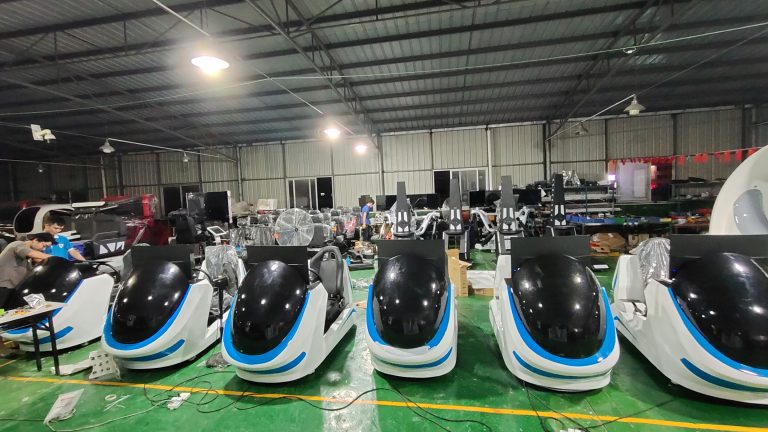
- VR/immersive cabins simulate urban sightseeing and low-altitude flight. Priced at ¥198–398 per session, they attract over 500 visitors daily, popularizing low-altitude mobility while generating direct revenue.
3. Technical Support: Core Capabilities and Iteration Directions
The competitiveness of eVTOL simulators relies on four technological pillars:
- High-precision simulation: Flight dynamics, 4K/8K low-latency digital twins, real-time weather, and 6-axis/8-axis motion platforms with <10ms latency, achieving over 95% operational consistency with real aircraft.
- Intelligent upgrading: AI adaptive training, automatic fault generation, real-time evaluation, and cloud-based digital twins improve efficiency. Cloud deployment accounts for 65% in 2025.
- Technical barriers: Core flight algorithms, airworthiness certification qualifications, and system integration require extensive flight test data and aviation engineering experience.
4. Competitive Landscape: Global and Chinese Players
4.1 Global Leading Enterprises
- Traditional aviation simulation giants: CAE, L3Harris, TRU Simulation dominate high-end certified simulators based on civil aviation expertise.
- eVTOL manufacturers: Volocopter, Joby, EHang develop in-house simulators for R&D and training. VR/XR companies such as Varjo and HTC provide immersive visual systems.
4.2 Chinese Domestic Enterprises
- Haitai Hi-Tech, Lantian Aviation: Develop domestic full-motion eVTOL simulators, supporting EHang, AutoFlight, Xiaopeng Huitong and others.
- Low-altitude tech firms: Focus on mid-to-low-end training and VR experience simulators, gaining share in tourism and popular science markets.
The current pattern is international leaders in high-end certification, domestic players rising in mid-to-low-end training and experience. With improved Chinese airworthiness standards, local firms are expected to break into the high-end market.
5. Market Challenges and Future Trends
5.1 Core Challenges
- Lack of unified standards: No global eVTOL simulator certification standard exists, with differing rules across the FAA, EASA, and CAAC, increasing costs.
- Cost and technical bottlenecks: High-end full-motion simulators cost over ¥20 million. Simulation accuracy for complex urban wind fields and electric propulsion faults needs improvement.
- Talent shortage: A lack of interdisciplinary professionals in aviation simulation, AI, and digital twins restricts development.
5.2 Future Development Trends
- Standardization and domestic substitution: CAAC will issue eVTOL simulator identification standards, promoting domestic equipment into the airworthiness system.
- Lightweight and cloud-based popularization: Desktop/VR lightweight simulators and cloud SaaS models lower entry barriers for small operators.
- Full-scenario ecosystem integration: Simulators connect with digital twin cities, low-altitude ATC, and eVTOL fleets, forming a closed loop of virtual R&D, training, operation, and real-world deployment.
- Consumer market explosion: Experience simulators enter shopping malls and scenic spots, forming a ¥10-billion-level consumer market that nurtures industrial awareness.
Conclusion
eVTOL simulators are not simply “flight game devices” but core infrastructure and value hubs for the low-altitude economy and UAM. They cover R&D, certification, training, operations, and consumption with rigid demand, high growth, and strategic value. As airworthiness accelerates, fleets scale up, and low-altitude policies land, the market will grow exponentially in the next 5–10 years. Supported by policy dividends, a complete industrial chain, and vast market space, China is poised to become a global growth engine for eVTOL simulators. Domestic enterprises should focus on technological breakthroughs, standard development, and scenario implementation to seize strategic advantages in the low-altitude economy.
RELATED POSTS
VR/XR Full-Sense Large-Space Cinema: Customer Acquisition and Profitability Strategy
Integration of Virtual and Real Worlds, Expansion of Low-Altitude Boundaries: Research on the Future Development Trends of VR 360° Aerial Products
Technology Empowers Fire Safety Education: Immersive Protection for Life Safety — Application Practice and Development Prospect of VR Fire Experience Halls
Diverse Applications and Educational Value of VR Campus Safety Experience Halls in Schools
VR Experience Centers: A Comprehensive Overview (Full English Version)