Analysis on the Multi-dimensional Applications and Industrial Value of Six-axis Racing Simulators
Against the tide of intelligent automobile industry, professional motorsports, and immersive entertainment experiences, simulation technology has become the core link connecting the virtual and the real world. As a typical representative of high-end dynamic simulation equipment, the six-axis racing simulator relies on the 6-Degree-of-Freedom (6-DOF) Stewart platform architecture, breaking through the limitations of traditional fixed simulators. It can accurately restore dynamic postures such as vehicle acceleration, braking, cornering, and bumping, replicate the G-force feedback and road feel of real tracks, and achieve an ultimate immersive driving experience. From professional driver training and automotive R&D testing to commercial cultural tourism entertainment and driving science education, the six-axis racing simulator has long transcended the attribute of a single entertainment tool with its core advantages of high simulation, high safety, and high flexibility, becoming a key piece of equipment spanning multiple fields and empowering various industries. This paper comprehensively analyzes the application ecosystem of six-axis racing simulators from the dimensions of technical principles, core application scenarios, industrial value, and future development trends, and explores their unique value in the integration of modern technology and industry.
- The Six-axis Racing Simulator: Technical Core and Core Advantages
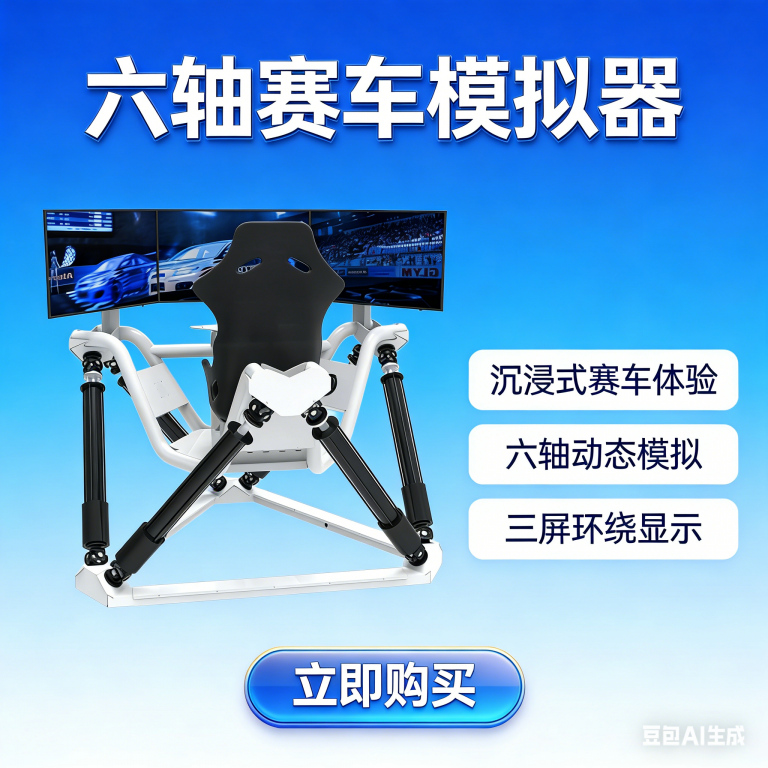
The core of a six-axis racing simulator is the six-degree-of-freedom parallel motion platform, which consists of six groups of electric or hydraulic cylinders, upper and lower platforms, universal hinges, and a control system. Through the coordinated expansion and contraction of the six support legs, it realizes all-round dynamic simulation of three translational degrees of freedom (up-down, front-back, left-right) and three rotational degrees of freedom (pitch, roll, yaw). Compared with the single-dimensional motion of three-axis simulators, the six-axis platform features more delicate dynamic response, more precise posture control, and more realistic force feedback, perfectly restoring subtle sensations such as slight vibrations, drifting, and weightlessness from heavy braking during racing. This is the core technical support that makes it a high-end simulation device.
1.1 Core Technical Composition
A complete six-axis racing simulator system is a product of the integration of mechanical engineering, automatic control, virtual reality, vehicle dynamics and other technologies, mainly composed of four modules:
•
Dynamic Motion Platform: As the core of the equipment, it adopts high-precision servo electric cylinders with advanced inverse kinematics algorithms to achieve millisecond-level response speed, accurately matching vehicle dynamic data and restoring the sensory feedback of real driving. Some high-end models adopt hydraulic drive, which has stronger bearing capacity and more extreme G-force simulation, suitable for professional event training.
•
Driving Interaction Module: It replicates the steering wheel, accelerator, brake, gear shift mechanism, dashboard and other components of real racing cars, equipped with a force feedback system to restore steering wheel damping, brake pedal feel, and gear shift frustration, making the operation feel highly consistent with real vehicles. Some models are equipped with racing seats and five-point seat belts to further enhance immersion.
•
Visual and Sound System: It constructs a panoramic view of more than 220° through three-screen curved displays, 4K projection or VR headsets, rendering virtual scenes such as tracks, vehicles, and environments in real time. Paired with surround sound effects, it reproduces engine roars, tire friction, wind noise and other sounds, achieving dual immersion of vision and hearing.
•
Central Control System: It integrates vehicle dynamics simulation software, motion control algorithms, and data acquisition modules, processing driver operation instructions in real time, calculating vehicle motion postures, and driving the synchronous response of the dynamic platform and visual system. It also supports functions such as data recording, posture calibration, and scene switching to ensure stable system operation.
1.2 Core Application Advantages
Compared with real driving and traditional simulators, the advantages of six-axis racing simulators are subversive, which is also the core premise for their wide application:
•
Ultimate Simulation: It comprehensively restores vehicle dynamics, road feedback, and environmental atmosphere, with minimal sensory difference from real driving, meeting the precision requirements of professional training and R&D testing.
•
Absolute Safety: High-risk scenarios such as extreme driving and emergency operations are carried out in a virtual environment, with no vehicle loss or personnel injury risks, greatly reducing trial and error costs.
•
Scene Flexibility: Parameters such as tracks, weather, road conditions, and vehicle models can be quickly switched to simulate various scenarios such as sunny days, rainy days, snowy days, gravel roads, and track corners, breaking through the limitations of physical venues and environments.
•
Cost Controllability: No need to occupy real tracks, consume fuel, or incur vehicle maintenance costs, making it far more cost-effective than real vehicle training and testing for long-term use.
•
Data Traceability: It records driver operation data, vehicle dynamic data, and posture feedback data throughout the process, facilitating review, analysis, operation optimization, and R&D calibration. - Core Application Scenarios of Six-axis Racing Simulators
Relying on technical and cost advantages, six-axis racing simulators have penetrated into professional motorsports, automotive industry, commercial entertainment, science education, scientific research testing and other fields, forming a diversified application ecosystem where each scenario plays an irreplaceable role.
2.1 Professional Motorsports Field: A Core Tool for Driver Training and Event Preparation
Motorsports is a highly competitive sport that demands extremely high driver reaction speed, handling skills, track memory, and mental resilience. However, real vehicle training is limited by venues, weather, costs, safety and other factors, making it difficult to meet the needs of high-frequency and refined training. Six-axis racing simulators have become standard training equipment for professional event teams such as F1, WTCC, and GT, serving as a key tool for drivers to improve their competitive level.
In driver training, six-axis simulators realize three core values: first, refined track polishing, allowing drivers to repeatedly practice the driving line and braking points of single corners and continuous curves, strengthening muscle memory and track memory to overcome driving weaknesses; second, extreme scenario training, simulating high-risk scenarios such as vehicle out-of-control, tire blowouts, and skidding in rainy days to improve drivers’ emergency handling ability and mental stability; third,event preparation simulation, replicating every detail of the official event track, combined with parameters such as weather, tire wear, and fuel consumption, allowing drivers to adapt to the event environment in advance and formulate the optimal race strategy. At the same time, coaches can monitor drivers’ operations in real time through system data and provide targeted guidance and optimization, greatly improving training efficiency. For young drivers, six-axis simulators are also an important way to get started at low cost and lay a solid driving foundation, helping the construction of racing talent echelons.
2.2 Automotive Industry Field: A Virtual Platform for R&D Testing and Performance Calibration
Modern automotive R&D has entered a collaborative stage of “virtual simulation + real vehicle testing”. As a Driver-in-the-Loop (DiL) testing platform, the six-axis racing simulator runs through the entire process of automotive R&D, calibration, and verification, greatly shortening the R&D cycle and reducing testing costs.
In the vehicle R&D link, engineers can build virtual vehicle models through simulators to conduct preliminary verification of vehicle dynamic performance, chassis calibration, steering system, and brake system, quickly screening the optimal design scheme; in the testing of ADAS (Advanced Driver Assistance System) and autonomous driving functions, simulators can simulate massive complex road conditions and extreme scenarios to verify the reliability and safety of the system, making up for the insufficient coverage of real vehicle testing scenarios; in the calibration of performance cars and sports cars, relying on the precise sensory feedback of the six-axis platform, engineers can intuitively perceive the optimization effect of vehicle handling and comfort, and complete the refined calibration of chassis stiffness, suspension damping, and steering wheel feel. In addition, simulators can also be used for automotive component performance testing and ergonomic verification, making the R&D process more efficient and accurate. Compared with traditional real vehicle testing, six-axis simulators can reduce early testing costs by more than 60% and shorten the R&D cycle by 3-5 months, becoming a core equipment for intelligent R&D in the automotive industry.
2.3 Commercial Cultural Tourism Field: A Popular Hit for Immersive Entertainment
With the upgrading of immersive entertainment consumption, traditional amusement projects can no longer meet consumer demand. With its ultimate dynamic experience, the six-axis racing simulator has become a popular internet-famous project in shopping malls, e-sports halls, VR experience halls, theme parks, and cultural tourism scenic spots, combining entertainment, competitiveness, and viewing.
In commercial scenarios, six-axis racing simulators mainly operate in three modes: first, single-player experience mode, where consumers can experience extreme drifting, track racing and other projects to feel the excitement of racing driving; second, multi-player competitive mode, supporting online battles between multiple devices to create offline racing events and enhance interactivity and social attributes; third, theme customization mode, customizing scenes and appearances in combination with cultural tourism IP and event IP to improve project recognition. Compared with traditional video game equipment, six-axis simulators have higher unit prices and stronger user stickiness, quickly attracting young consumer groups and creating a highlight of venue traffic. At the same time, the equipment covers a small area and is simple to operate and maintain, adapting to various commercial spaces and becoming a high-quality choice for the upgrading of the cultural tourism and entertainment industry.
2.4 Science Education Field: A Training Base for Driving Training and Safety Education
In driving teaching and traffic safety science popularization, six-axis racing simulators break through the limitations of traditional “theory + real vehicle” teaching, creating a safe, efficient and intuitive training scenario, especially suitable for novice driving training, adolescent traffic safety education, and special vehicle driving teaching.
In driving school training, simulators can be used as pre-class preheating equipment to help trainees familiarize themselves with the operation logic of the steering wheel, accelerator, and brake, master basic actions such as starting, turning, and reversing, relieve tension in real vehicle training, and reduce the teaching pressure of coaches; in traffic safety science popularization, simulating dangerous scenarios such as drunk driving, speeding, running red lights, and driving in severe weather allows experiencers to intuitively feel the hazards of illegal driving and establish a safe driving awareness. This “immersive experiential” education effect is far better than traditional display boards and video teaching; in special vehicle driving training, simulating exclusive driving scenarios for special models such as racing cars, engineering vehicles, and police vehicles to improve drivers’ professional handling ability. In addition, simulators can also be used in campus science popularization and public welfare education activities to popularize automobile culture and traffic safety knowledge, combining educational significance and fun.
2.5 Scientific Research and Testing Field: A Research Carrier for Ergonomics and Vehicle Technology
With high-precision data collection and controllable experimental environments, six-axis racing simulators have become an important platform for universities and research institutions to conduct research on vehicle engineering, ergonomics, and driver behavior. Researchers can control experimental variables through simulators to carry out research on driver reaction speed, operation habits, and physiological state under different road conditions and vehicle parameters, analyzing the interaction between humans, vehicles, and the environment; for intelligent driving and Internet of Vehicles technologies, conduct Hardware-in-the-Loop (HiL) testing to verify the feasibility and stability of algorithms; at the same time, it can also be used for traffic accident reconstruction, restoring the vehicle dynamics and driver operations at the time of the accident, providing a scientific basis for accident cause analysis. This risk-free, repeatable and quantifiable scientific research model provides strong support for vehicle technology innovation and traffic research. - Industrial Value and Practical Significance of Six-axis Racing Simulator Applications
The wide application of six-axis racing simulators not only brings efficiency improvement and cost optimization to various fields, but also promotes the in-depth integration of simulation technology, automobile industry, and entertainment culture tourism, generating significant economic and social values.
3.1 Economic Value: Reducing Costs, Improving Efficiency and Cultivating New Business Forms
For the professional motorsports field, simulators reduce team training costs, improve drivers’ competitive level, and promote the commercial development of events; for the automotive industry, they accelerate the R&D process, promote automotive technology innovation, and enhance the market competitiveness of enterprises; for commercial cultural tourism, they create new consumption hotspots, drive offline passenger flow, and foster new business forms such as simulation entertainment and offline e-sports; for the equipment manufacturing industry, they drive the development of upstream and downstream industries such as servo motors, sensors, and control algorithms, forming a complete industrial chain and creating considerable economic benefits.
3.2 Social Value: Empowering Science Popularization and Prioritizing Safety
Six-axis simulators break the niche barrier of motorsports, allowing the general public to experience the fun of racing and popularize automobile culture and racing knowledge; in traffic safety education, immersive experiences strengthen public safety awareness, reduce illegal driving behaviors, and help build traffic safety; in driving training, they improve teaching efficiency and trainees’ skill levels, easing the teaching pressure of driving schools; at the same time, the risk-free training mode of simulators also reduces potential safety hazards in motorsports and driving teaching, highlighting the social significance of technology empowering safety.
3.3 Technical Value: Promoting the Iterative Upgrade of Simulation Technology
The application demands in various fields have reversely promoted the continuous optimization of six-axis simulator technology, achieving leapfrog improvements in motion platform accuracy, control algorithm response speed, visual and sound rendering, and data collection and analysis capabilities. At the same time, the integration of simulators with VR/AR, artificial intelligence, 5G and other technologies has further expanded the application boundaries of simulation technology, providing technical reference for other simulation fields such as aerospace, marine navigation, and engineering machinery, and promoting the development of the entire dynamic simulation industry. - Pain Points and Future Development Trends of Six-axis Racing Simulator Applications
4.1 Current Application Pain Points
Despite the broad application prospects of six-axis racing simulators, there are still some problems restricting their development at this stage: first, high cost threshold, the high cost of high-end professional models limits the popularization in small and medium-sized driving schools and small commercial venues; second, insufficient scene adaptability, the dynamic simulation accuracy of some low-end simulators is limited, making it difficult to completely replace the real vehicle experience; third, shortage of professional talents, lack of professionals for simulator operation and maintenance, scene customization, and data analysis; fourth, imperfect industry standards, lack of unified standards for equipment quality, simulation accuracy, and safety specifications, resulting in uneven market products.
4.2 Future Development Trends
With technological progress and upgrading market demand, six-axis racing simulators will develop towards intelligence, lightweight, inclusiveness and diversification, and application scenarios will be further expanded:
•
Technological Intelligence: Integrate artificial intelligence algorithms to realize intelligent correction of driving actions and personalized training plan customization; combine with VR/AR and meta-universe technology to create a more realistic virtual driving space and realize cross-regional online competitions.
•
Cost Inclusiveness: With the localization of core components and technological maturity, equipment costs will gradually decrease, and lightweight, cost-effective models will be launched to accelerate the popularization of the sinking market.
•
Application Diversification: Expand to new scenarios such as e-sports competitions, auto exhibitions, corporate team building, and film and television shooting; in the field of intelligent driving, become a core virtual platform for autonomous driving algorithm training and testing.
•
Industrial Standardization: Establish unified industry technical standards, safety specifications and quality certification systems to regulate market order and improve the overall quality of equipment. - Conclusion
The six-axis racing simulator is a typical achievement of technology empowering industry. With its ultimate simulation technology, it breaks the barrier between virtual and reality, showing strong application potential and diverse value from professional arenas to commercial venues, and from automotive R&D to science classrooms. It is not only a dynamic entertainment device, but also a tool for professional training, a platform for industrial R&D, a carrier of science education, and a window for technological innovation. With the continuous iteration of technology and the continuous expansion of application scenarios, six-axis racing simulators will further release industrial vitality, promote the in-depth transformation of motorsports, automotive industry, cultural tourism education and other fields, and become an important pillar of the future simulation technology field. Under the trend of intelligent and immersive consumption, the application path of six-axis racing simulators will surely become wider and wider, bringing people a more realistic, safer and richer driving experience and industrial value.
RELATED POSTS
The Applications of Racing Simulators: A Comprehensive Analysis
The Future is Here: A Deep Dive into the Flying Theater Market and Forecasting Industry Transformation at the Technological Singularity
Analysis on the Future Development Trends of Environment Simulation Multifunctional Desks
Overview and Feature Analysis of Mainstream Truck Simulator Applications
Driving Simulators Unveiled: The Ultimate Co-Pilot for Driver Training